Is the NVIDIA AI Strategy building a $1 trillion data-center empire or setting investors up for the next big disappointment?

How central is NVIDIA to Wall Street’s AI trade?
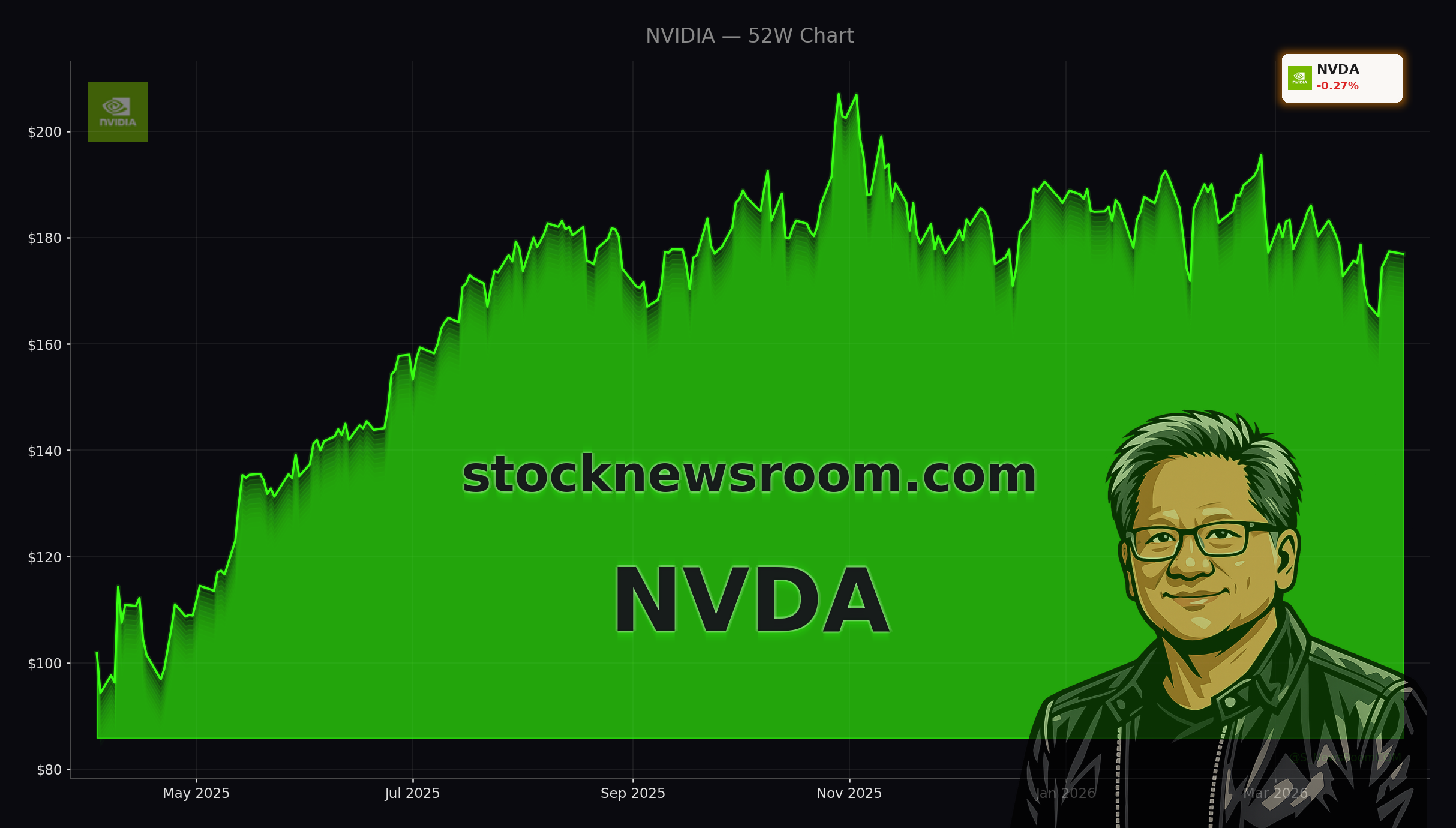
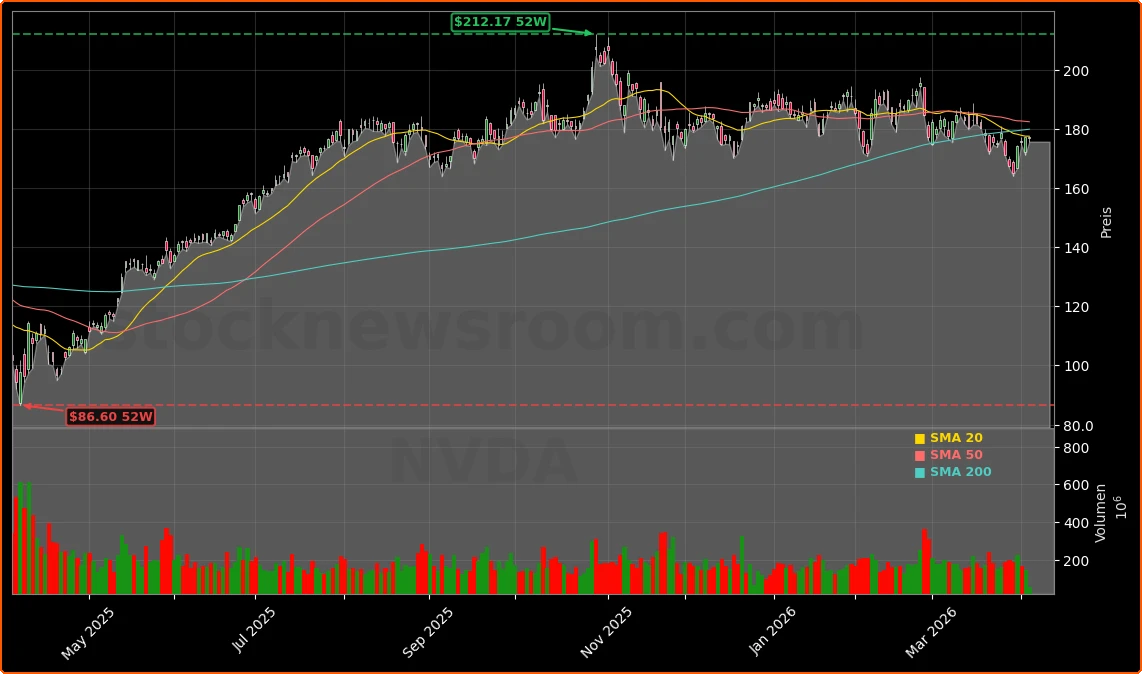
Despite the modest 0.3% intraday move, NVIDIA remains one of the most important swing factors for the S&P 500 and Nasdaq‑100. Its GPUs are the de facto standard for training and running large language models, making the stock a core holding in growth ETFs such as Vanguard’s S&P 500 Growth and Mega‑Cap Growth funds, where it sits alongside mega‑caps like Apple and Microsoft. After a historic run since late 2022, NVDA is still one of the cheaper “Magnificent Seven” names on a forward earnings basis, trading near 21x the coming year’s profit estimates while delivering revenue growth that far outpaces its peers.
Recent quarters underscore why the NVIDIA AI Strategy matters for benchmarks as well as single‑stock investors. The company posted roughly $68 billion in revenue in its latest reported quarter, up about 73% year over year, with full‑year sales around $216 billion, up 66%. Data‑center revenue — driven by AI GPUs and networking — now accounts for the bulk of the business, and guidance points to about $78 billion in the next quarter even after excluding China data‑center compute under new U.S. export rules.
What defines the current NVIDIA AI Strategy?
At its core, the NVIDIA AI Strategy is to sell not just chips but complete AI factories: GPUs, networking, storage, software and services in tightly integrated systems. Management is refreshing its flagship architectures annually — from Hopper to Blackwell and soon to “Rubin” and the “Vera Rubin” update — in a deliberate attempt to stay at least one full generation ahead of rivals in performance per watt and cost of inference. The Rubin platform is expected to cut inference costs by up to 10x versus Blackwell, which already enjoys robust demand among hyperscalers.
To keep these systems fed with data, NVIDIA recently committed $4 billion split between optical specialists Lumentum and Coherent, securing next‑generation 1.6‑terabit interconnects that are becoming critical as copper wiring hits physical limits inside AI data centers. This spending reinforces the idea that the NVIDIA AI Strategy now treats high‑speed optics as essential infrastructure, on par with GPUs, to support ever‑larger clusters and “agentic AI” workloads that CEO Jensen Huang says mark a new inflection point in computing demand.
Are memory and supply risks starting to bite NVIDIA?
The bull case assumes AI capex has years to run, but investors are increasingly focused on constraints that could slow NVIDIA’s trajectory. Analysts at Investor’s Business Daily highlight concerns that a shortage of advanced memory — specifically high‑bandwidth memory (HBM) — could crimp near‑term production of Rubin‑based systems, limiting shipment volumes even as demand stays strong. Any prolonged HBM tightness would threaten NVIDIA’s ability to fully monetize its annual upgrade cadence.
Geopolitics is another overhang for the NVIDIA AI Strategy. As Benzinga points out, most of the world’s cutting‑edge GPU manufacturing runs through Taiwan, leaving the entire AI hardware stack exposed to regional tensions. While NVIDIA has demonstrated resilience through recent conflicts and export restrictions — including plans to restart shipments of H200 GPUs into China under compliant configurations — the concentration of supply at a single geography remains a structural risk that even the strongest balance sheet cannot completely hedge.
How are analysts valuing NVIDIA in 2026?
Sell‑side sentiment remains broadly positive. Zacks Investment Research reports that NVIDIA is one of the most‑searched names on its platform, with analyst models still reflecting multi‑year double‑digit growth as AI spending expands from hyperscalers into enterprises and verticals like automotive, healthcare and robotics. Wedbush tech analyst Dan Ives recently labeled NVIDIA a “table‑pounder” at current levels, calling for 30%–40% upside from roughly $177 and arguing that investors are focusing too much on macro noise and not enough on what he sees as a path toward $1 trillion in annual revenue by 2027.
Other research houses echo the view that the latest drawdown is more about sentiment than fundamentals. Seeking Alpha contributors note that NVDA’s forward P/E multiple is below its own three‑year average when adjusted for growth, with a PEG ratio under 1 implying that earnings expansion more than compensates for the headline valuation. Still, skeptics warn that current 50%‑plus net margins are unlikely to be permanent as deep‑pocketed chipmakers ramp their own accelerators and cloud providers such as Tesla’s Dojo efforts and in‑house silicon at hyperscalers try to claw back some of the AI economics.
What does this mean for diversified investors?
For U.S. investors holding broad market ETFs, the NVIDIA AI Strategy is effectively embedded in index exposure. S&P 500 and Nasdaq‑100 products allocate heavily to mega‑cap tech, and new filings from BlackRock for a Nasdaq‑100 ETF will add yet another wrapper around a concentrated group of AI beneficiaries, including NVIDIA and Apple. That concentration cuts both ways: it has supercharged returns during the AI boom but also amplifies volatility if sentiment turns or if a supply shock hits the GPU ecosystem.
Fund managers tracking growth benchmarks have little choice but to own the name, which keeps liquidity high and makes NVDA one of Wall Street’s favorite trading vehicles. Day traders are drawn to its massive average daily volume and options activity, while long‑term investors focus on whether today’s AI build‑out will eventually translate into durable software and services revenue, not just hardware cycles. The answer to that question will determine whether NVIDIA can maintain its premium multiples once AI capex normalizes.
Related Coverage
Investors looking for a deeper dive into NVIDIA’s long‑term potential can read the analysis in NVIDIA AI Outlook Boom: $1 Trillion Supercycle Warning, which explores whether the company’s trillion‑dollar ambition signals a durable supercycle or the risk of a “peak AI” narrative. For context on how AI enthusiasm and bubble fears are playing out in adjacent names, the piece Palantir Defense AI Boom: Pentagon Demand Meets Bubble Warnings examines how defense‑focused software group Palantir is navigating surging Pentagon demand amid rising bubble talk across the broader AI complex.
Computing demand is growing exponentially — the agentic AI inflection point has arrived.— Jensen Huang, CEO of NVIDIA Corporation
In the end, the NVIDIA AI Strategy keeps the company at the center of the global AI build‑out, pairing annual chip refreshes with bold bets on optics, storage and software to extend its lead. For U.S. investors, that means NVDA will likely remain a cornerstone of both growth portfolios and major indices, with upside tied to how quickly AI adoption catches up to capex. The next few quarters of execution on Rubin, supply diversification and China‑compliant products will show whether this strategy can sustain another leg higher in the stock’s remarkable run.