Can the NVIDIA AI Strategy unveiled around GTC 2026 keep powering record growth even as Wall Street starts to question the trade?
How central is NVIDIA to the AI trade right now?
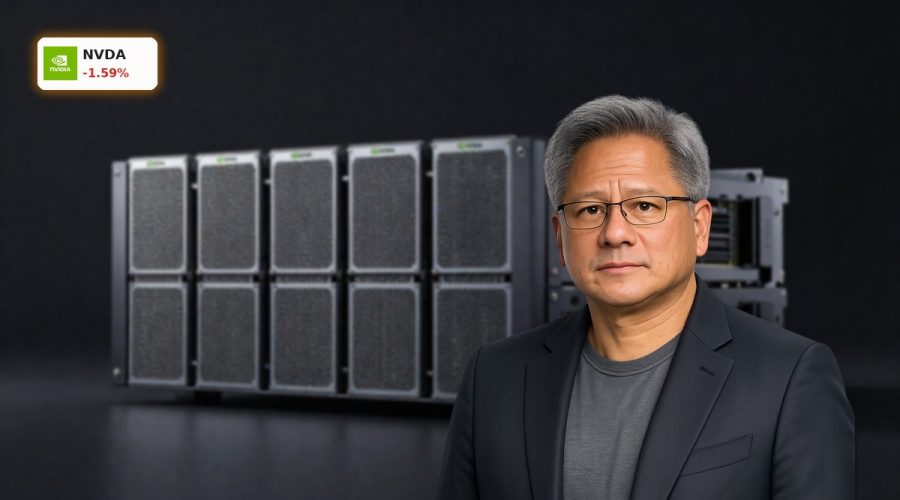
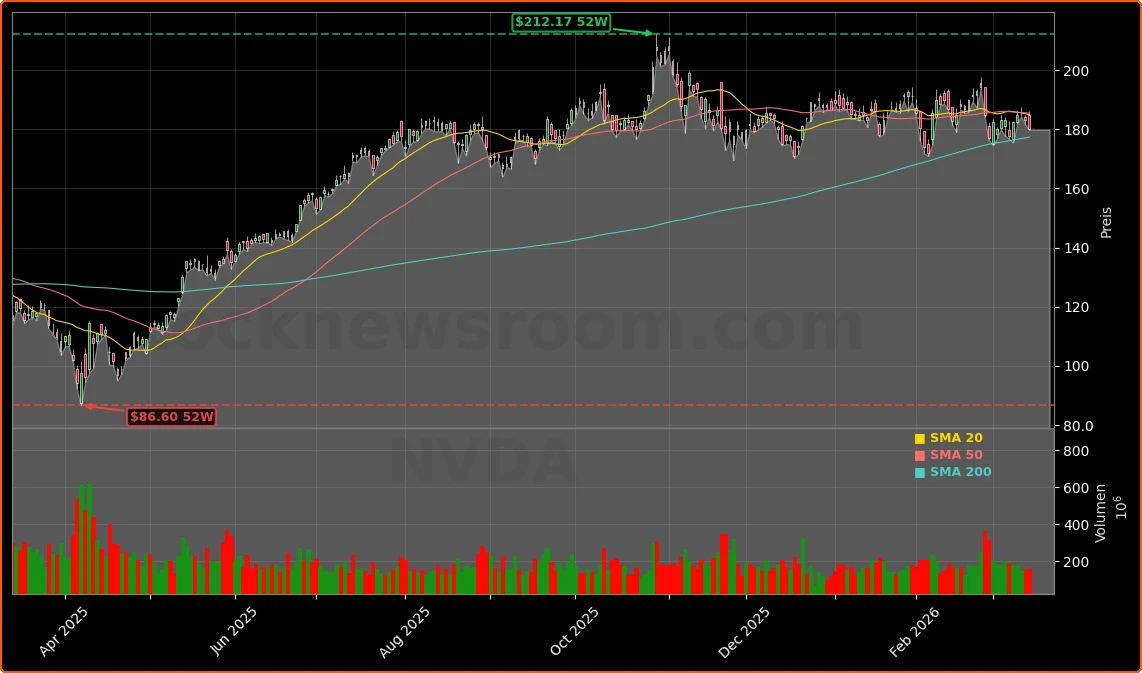
NVIDIA Corporation remains the defining bellwether for the AI trade on Wall Street. Its GPUs power training and inference for large language models and other high-intensity workloads, making the company a core holding in many tech-heavy portfolios. NVDA closed Friday at $180.25, down 1.59% on the day and essentially flat in recent months as investors reassess AI valuations and macro risk, including war in Iran and slower global growth. Yet the stock is still up dramatically over the past few years, and analysts broadly see more upside as data center AI spending accelerates.
Recent financials have reinforced that view. NVIDIA reported roughly $68 billion in revenue last year, up about 73%, with non-GAAP earnings per share rising more than 80%. Wall Street consensus now projects earnings to grow around 38% annually over the next three years, while the forward P/E near the mid-30s to high-30s leaves room for multiple expansion if AI demand continues to surprise to the upside. Morgan Stanley’s semiconductor analyst Joseph Moore has called NVIDIA a top sector pick, citing multi-year AI capex commitments from hyperscalers and prepayments to component suppliers as evidence that this cycle is still in its early innings.
What defines the NVIDIA AI Strategy at GTC 2026?
GTC 2026, running March 16–19 in San Jose, is designed to showcase the next chapter of the NVIDIA AI Strategy. Jensen Huang’s two-hour keynote on March 16 at 2 p.m. ET will cover the “full AI stack” – chips, networking, software, models, and real-world applications. The company is emphasizing that it is no longer just a GPU vendor, but an AI infrastructure platform that integrates GPUs, CPUs, high-speed interconnects, and a deep software ecosystem from CUDA to enterprise AI tools.
The conference will host about 39,000 attendees from 190 countries, over 700 workshops, and nearly 400 exhibitors. Sessions span physical AI, such as robotics and autonomous vehicles, AI factories for hyperscale data centers, and agentic AI that can act autonomously on complex tasks. This breadth is core to the NVIDIA AI Strategy: lock developers and enterprises into its ecosystem by making it the default environment for building and deploying advanced AI workloads.
Huang will also moderate a panel on open-source versus closed-source AI models, sharing the stage with leaders from Cursor and Thinking Machines Lab – both private AI companies in which NVIDIA has invested. That dual exposure to proprietary and open ecosystems is another strategic pillar, ensuring NVIDIA hardware and software remain central regardless of which model framework wins out.
How is NVIDIA reinforcing its AI moat through investments?
Beyond product launches, direct capital deployment is becoming a key lever of the NVIDIA AI Strategy. The company recently committed a $2 billion warrant investment into Nebius, the cloud and AI infrastructure business spun out of Yandex. That stake could reach roughly 7.7% on a fully diluted basis and would help secure long-term demand for NVIDIA-powered AI capacity as Nebius ramps data center spending through 2030.
NVIDIA has also taken a significant position in optical specialist Lumentum, a move that several Wall Street firms, including Barclays, Rosenblatt, and Morgan Stanley, have highlighted as strategically important. By prepaying and locking in future optical product capacity, NVIDIA is effectively de-risking one of the tightest parts of the AI supply chain – high-speed optical links that connect GPU clusters inside AI data centers.
These moves sit alongside smaller but symbolically important bets in AI software startups such as Cursor and Thinking Machines Lab. The goal is to ensure that the entire AI pipeline, from data center hardware to developer tools, is optimized around NVIDIA’s platforms, making it harder for rivals in GPUs or custom accelerators to dislodge its lead.
What does all this mean for Wall Street and competition?
Institutional positioning shows that large investors remain committed to NVDA, even as they rebalance risk. Texas Capital Bancshares recently cut its NVDA stake by more than 40%, yet the stock still represents about a fifth of its portfolio and remains its second-largest holding, underscoring how central the name is for many funds. At the same time, other institutions like Chesapeake Capital Corp IL are initiating or increasing positions, with Chesapeake’s latest purchase making NVDA its 18th largest holding.
On valuation and growth, NVIDIA continues to outpace mega-cap peers such as Apple, Microsoft, Alphabet, and Tesla. While Amazon and Alphabet trade at forward earnings multiples in the low 20s, NVIDIA and Microsoft command higher premiums, reflecting faster expected growth in AI and cloud. Analysts covering NVDA maintain a broad “Buy” consensus, with one recent average price target around $270–$275, implying substantial upside from current levels if the NVIDIA AI Strategy delivers as planned. Some AI-driven forecasting models now project the stock could reclaim and surpass the $200 mark by the end of Q2 2026.
Volatility remains high – NVDA is a favorite among day traders thanks to massive liquidity and options activity – but that same liquidity also makes the stock a core vehicle for expressing views on the entire AI complex, from data centers to autonomous vehicles.
Compute demand is growing exponentially — the agentic AI inflection point has arrived.
— Jensen Huang, CEO of NVIDIA
Conclusion
In conclusion, the NVIDIA AI Strategy heading into GTC 2026 centers on deepening its full-stack AI platform, securing key supply-chain and cloud partners, and embedding its technology across both closed and open AI ecosystems. For U.S. investors, NVDA remains a high-beta gateway into the broader AI build-out, with strong institutional backing and bullish analyst targets. The next catalysts will come quickly, as GTC announcements, hyperscaler capex updates, and further strategic investments reveal whether NVIDIA can extend its AI dominance into the next phase of the cycle.
Further Reading
- NVIDIA Corporation (NVDA) Stock Price & Data (Yahoo Finance)
- Nebius: Why Nvidia’s $2 Billion Move Matters More Than AI Bubble Fears (Seeking Alpha)
- Nvidia’s Top AI Event Is Here: Will Nvidia Stock Rise During the Week of March 16? (The Motley Fool)
- AI sets Nvidia stock price for Q2 2026 (Finbold)