Is the latest pullback in NVIDIA’s AI empire a warning sign or the perfect entry into its next infrastructure super‑cycle?

Is Wall Street mispricing NVIDIA after the pullback?
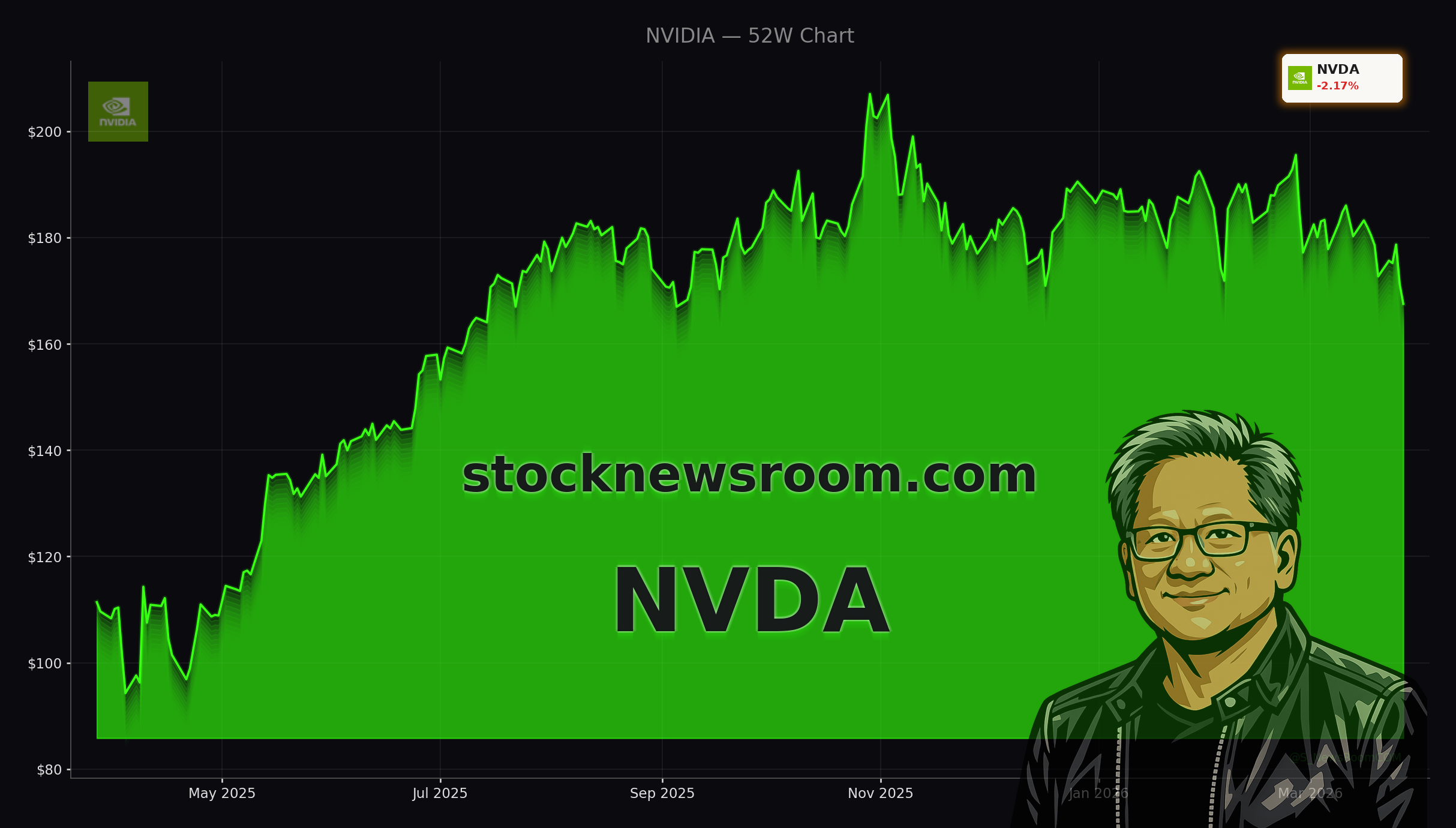
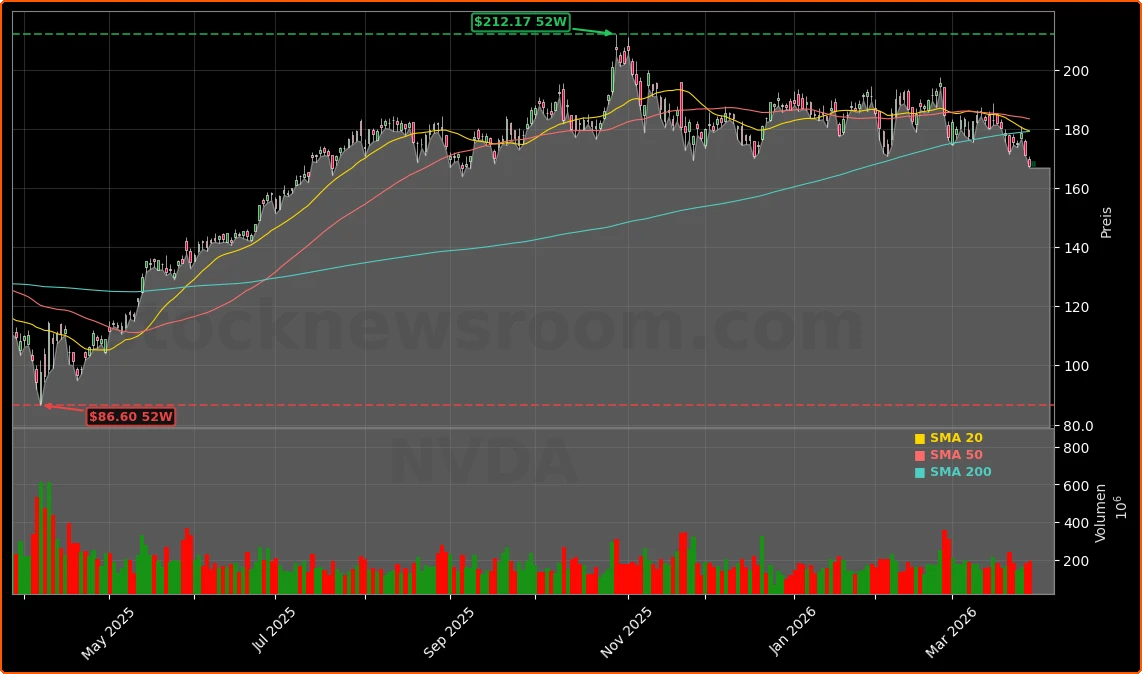
At Friday’s close, NVIDIA Corporation (KI-Infrastruktur, Vera Rubin & OpenClaw) ended at $166.59 and is changing hands near $167.52 in Monday trading, with pre‑market indications around $169.15. That leaves the shares roughly 20% below their record high and has dragged the forward P/E down to about 19–21 times the next 12 months’ earnings, cheaper than the S&P 500’s multiple despite far higher expected growth. Analysts project average earnings expansion above 70% in the current fiscal year, versus roughly 19% for the index.
The correction is not NVIDIA‑specific. The Nasdaq has fallen more than 11% from its high, officially entering correction territory as war‑related energy fears and rate worries pressure high‑multiple technology names. AI leaders, including Apple and Tesla, have seen valuations questioned, with some strategists arguing that price‑to‑earnings and price‑to‑sales ratios across the AI complex remain stretched even after the sell‑off.
Yet fundamental momentum remains strong. NVIDIA’s data center segment – now the core earnings engine – recently grew about 75% year over year, with sequential revenue up more than 20%, sustaining the thesis that the company is the backbone of global AI infrastructure. Gross margins near 75% and trailing 12‑month net income of roughly $120 billion underpin the $4 trillion market capitalization. In this context, the NVIDIA AI Strategy unveiled at GTC 2026 is less about starting a new story and more about proving this earnings base is only the beginning.
How is NVIDIA redefining AI infrastructure?
At its latest GTC conference, CEO Jensen Huang repositioned NVIDIA as a full‑stack infrastructure provider centered on three pillars: the long‑standing CUDA and CUDAX software ecosystem, advanced systems platforms like Grace‑Blackwell and Vera Rubin, and a new concept he calls “AI factories” – vertically integrated data centers optimized to manufacture tokens, the output units of generative and agentic AI.
CUDA, now running on hundreds of millions of GPUs across every major cloud and most PC OEMs, anchors more than 1,000 domain‑specific CUDAX libraries. These span financial services, healthcare, robotics, telecom and industrial workloads, from cuDNN for deep neural networks to cuOpt for logistics and cuLitho for chip manufacturing. This software base, combined with a deeply entrenched developer community, remains one of NVIDIA’s most durable competitive moats and is central to the NVIDIA AI Strategy.
On top of that, Huang introduced two key data libraries: QDF for structured data frames and QVS for vector database workloads, aimed at accelerating both traditional analytics and retrieval‑augmented generation. Partnerships with IBM (for Watsonx.data), Dell (AI data platforms) and Google Cloud (BigQuery and Vertex AI acceleration) underscore how NVIDIA is embedding itself into the modern data stack rather than just selling chips.
Importantly, the roadmap is backed by staggering demand visibility. NVIDIA now expects cumulative purchase commitments for its current Blackwell GPUs and upcoming Rubin family to exceed at least $1 trillion through 2027, up from a prior $500 billion outlook through 2026. That forecast assumes a continued explosion in compute needs as generative AI, reasoning models and autonomous agents move from experimentation into production.
What does Vera Rubin change for AI factories?
The centerpiece of GTC 2026 was the Vera Rubin platform, presented as the next generation of AI supercomputer architecture purpose‑built for agentic AI and low‑latency inference. A full Vera Rubin system combines seven chips across five rack‑scale computers, delivering roughly 3.6 exaflops of AI compute and 260 terabytes per second of all‑to‑all NVLink bandwidth.
Crucially for hyperscalers and enterprise buyers, Vera Rubin is 100% liquid‑cooled, cutting installation times from two days to about two hours while significantly improving energy efficiency and rack density. Huang emphasized that for a gigawatt‑scale data center costing around $40 billion to deploy, architecture‑level efficiency is the decisive factor in maximizing token output per dollar – the economic core of the AI factory model.
NVIDIA claims a 35x gain in performance per watt from Hopper to Grace‑Blackwell, with some third‑party analysts estimating up to 50x. That directly translates into what Huang describes as the lowest token cost in the world. In a macro environment where surging energy prices and grid constraints threaten to slow AI data center build‑outs, this efficiency message is central to the NVIDIA AI Strategy and may prove as strategically important as raw performance.
Vera Rubin also integrates licensed LPU (Language Processing Unit) technology from Groq, fabricated by Samsung. The first Grok LP30 chips are in volume production and slated to ship in Q3, with NVIDIA’s Dynamo software orchestrating inference pipelines so Rubin handles prefill and attention while Grok accelerates token decoding for latency‑sensitive work like coding and engineering. Microsoft Azure has already installed the first Vera Rubin rack, an early signal that top‑tier cloud providers are committing to the new stack.
How does OpenClaw fit into the NVIDIA AI Strategy?
Hardware alone is no longer enough to differentiate in AI. Huang introduced OpenClaw as an open‑source operating system for agentic computing, drawing an analogy to Windows for the PC era and Linux or HTML for the internet era. OpenClaw coordinates large language models, tools, resources and scheduling to create autonomous agents capable of executing complex workflows across enterprise systems.
NVIDIA is positioning OpenClaw as a strategic necessity for every company aiming to become “agentic” – where internal and customer‑facing processes are executed by fleets of AI agents rather than static software. To make this deployable in corporate environments, NVIDIA is offering OpenClaw Enterprise Secure and Enterprise Private Capable, along with OpenShell for hardened security and Nemoclaw as a reference design.
The company also announced the NVIDIA OpenClaw Reference, a toolkit that connects agentic AI frameworks to SaaS policy engines for governed execution. In practice, this means enterprises can define granular rules and compliance policies for what agents can access and do, while still leveraging powerful frontier models. For investors, OpenClaw extends the NVIDIA AI Strategy beyond chips and clusters into the orchestration layer that could become embedded in every AI‑enabled workflow – a potential recurring software and services revenue stream.
What role do open models and robotics play?
NVIDIA’s OpenModel initiative now encompasses nearly 3 million models across language, vision, biology, physics and autonomous systems. The company is building and releasing six families of open frontier models: NemoTron for language, Cosmos for physical AI and world models, Alpamyo for autonomous driving, Groot for robotics, BioNemo for biology, and Earth‑2 for high‑resolution weather and climate simulation.
NemoTron 3 Ultra was presented as NVIDIA’s best current base LLM, and the company launched a NemoTron coalition with partners including Mistral, LangChain, Cursor, Perplexity and others to co‑develop NemoTron 4. This open, partner‑driven approach aims to ensure NVIDIA’s hardware remains the default target for training and inference runs, while customers retain flexibility in model choice.
Robotics and physical AI are another pillar. NVIDIA is working with major industrial and automotive players on robo‑taxi‑ready platforms, claiming partners collectively produce 18 million vehicles per year. A large partnership with Uber is designed to bring autonomous capabilities to multiple cities. On the industrial side, NVIDIA’s Isaac Lab, Newton physics simulator and Cosmos world models are being adopted by robotics leaders like ABB, Universal Robots and KUKA. Disney Research, for instance, is using Camino Physics in Newton and Isaac Lab to train character robots such as Olaf, powered at the edge by NVIDIA Jetson. As humanoid and mobile robots proliferate, NVIDIA increasingly becomes the “brain” provider – a long‑duration growth vector beyond data centers.
How are investors and competitors reacting?
Institutional positioning around NVIDIA remains active. MarketBeat data shows some investors, such as Founders Grove Wealth Partners, increased their NVDA holdings in Q4, while others, like Avanza Fonder AB, trimmed positions amid the volatility. Despite profit‑taking and insider selling, the analyst community stays broadly constructive. Consensus ratings remain firmly in “Buy” territory, with average price targets near $275, implying substantial upside from current levels.
External demand signals support that optimism. French AI startup Mistral is raising about $830 million in debt financing to build a Paris data center running roughly 13,800 NVIDIA GB300 chips, signaling that smaller but ambitious AI players – not just the mega‑cap hyperscalers – are locking in large multi‑year GPU commitments. Barron’s and The Wall Street Journal both highlighted how this single customer’s spending plan could meaningfully contribute to NVIDIA’s already massive data center backlog.
At the same time, NVIDIA faces a more complex macro and competitive landscape. Broadcom is carving out a niche with application‑specific accelerators that avoid direct head‑to‑head battles with NVIDIA’s general‑purpose GPUs. Energy price spikes and geopolitical risk threaten to slow data center construction. And on the demand side, moves like OpenAI’s decision to halt work on the compute‑hungry Sora video generator illustrate that not every blue‑sky AI workload will scale as first imagined, potentially moderating near‑term GPU demand growth and pricing power.
Still, with the stock trading at a forward price‑to‑cash‑flow ratio near 16 – cheaper than Apple and far below Tesla – and with NVIDIA returning roughly $97 billion to shareholders via dividends and buybacks over the past five years, many on Wall Street see the current reset as a chance to add to positions rather than exit the AI leader.
Related Coverage
For a deeper dive into how NVIDIA’s capital returns and massive order book intersect, readers can explore NVIDIA AI Infrastructure -2.2%: Record Demand And Buyback Boom, which analyzes whether the company’s trillion‑dollar AI infrastructure vision and aggressive repurchases can still justify the stock after its latest pullback. For a broader sector view on hyperscaler spending, Amazon AI Strategy -4%: $200B Capex Shock For AWS examines whether Amazon’s enormous AI capex wave can convert into durable cash‑flow growth before investors lose patience – a key question for major NVIDIA customers and the sustainability of the current AI cycle.
The NVIDIA AI Strategy is now explicitly about owning the full stack of AI factories, from energy‑efficient systems like Vera Rubin to orchestration layers like OpenClaw and expansive open‑model ecosystems. For investors, that means the story is no longer just about selling more GPUs, but about embedding NVIDIA deeper into every stage of AI deployment across cloud, enterprise and robotics. The next few quarters of capex decisions from hyperscalers and emerging AI players will show whether this strategy keeps translating into trillion‑dollar order books and robust earnings growth, but for now NVIDIA remains at the center of the global AI build‑out.