Is the NVIDIA AI Strategy still an unbeatable growth engine, or are Broadcom, China risks and new rivals closing in?
NVIDIA AI Strategy: Still the Core Engine of the AI Trade?
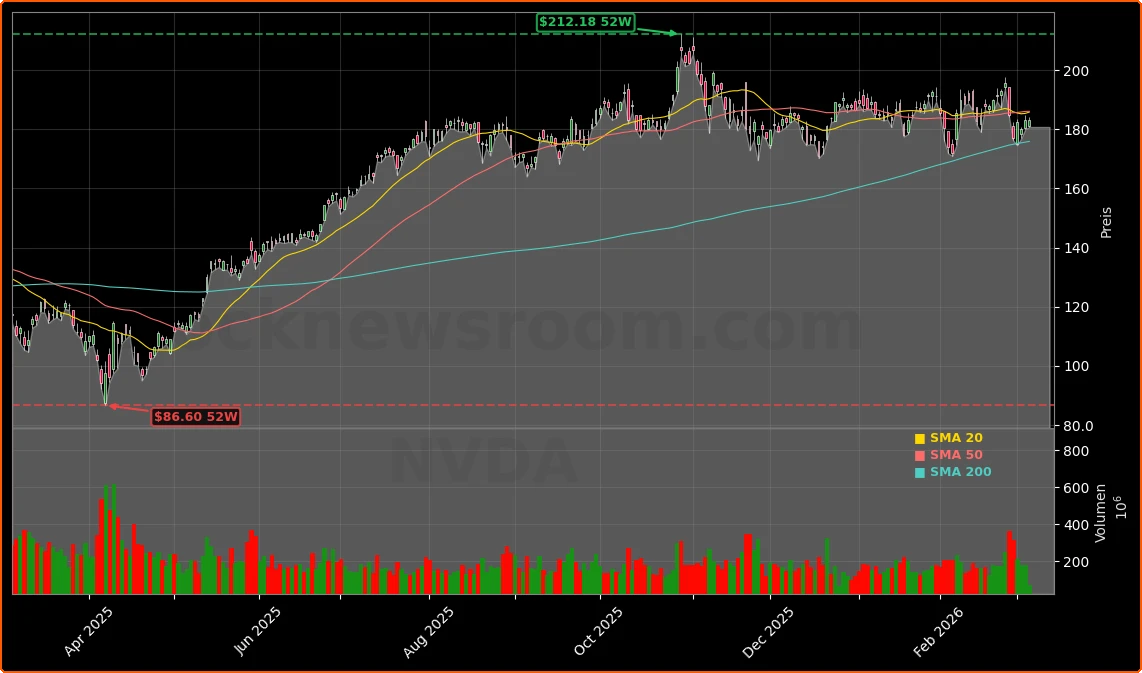
At roughly $183.18 (up about 0.1% on the day), NVIDIA remains one of the central pillars of the global AI build‑out. Over the past three years, the stock has climbed more than 1,100%, turbo‑charging the S&P 500 and NASDAQ 100. That move has been backed by fundamentals: revenue in the most recent fiscal year jumped about 73% year over year to roughly $68 billion, driven overwhelmingly by data center AI GPUs and networking. The AI data center segment alone generated around $62–63 billion, now the vast majority of sales.
The NVIDIA AI Strategy is built around three pillars: (1) leadership in data center GPUs and networking, (2) a full‑stack software and systems ecosystem that locks in developers, and (3) extending that technology into new domains like scientific computing, robotics, autonomous driving and edge AI. This strategy has created a powerful moat, but it also raised expectations so high that even blowout quarters can trigger post‑earnings sell‑offs. NVIDIA trades at roughly 37–38 times trailing earnings yet just around the low‑20s on forward earnings, as Wall Street bakes in 50%+ annual EPS growth through at least fiscal 2028.
For now, hyperscale cloud players and major AI customers are in the middle of what many analysts call the biggest capex cycle in tech history. Estimates suggest more than $700 billion of combined AI and data center capex from a handful of U.S. giants this year alone, feeding directly into GPU and networking demand. Some long‑term projections even envision AI infrastructure spending reaching $3–4 trillion annually by 2030, implying that NVIDIA’s addressable market may still be in early innings if that scenario materializes.
NVIDIA Corporation vs. Broadcom: Who Owns the Next Leg of AI Hardware?
For U.S. investors, the most immediate strategic risk to the NVIDIA AI Strategy is no longer just AMD or custom ASICs from hyperscalers. Broadcom has emerged as a serious challenger across networking, custom accelerators and AI‑optimized Ethernet fabrics. Broadcom’s CEO now projects AI chip revenue above $100 billion by 2027, a figure that directly encroaches on territory widely viewed as NVIDIA’s core domain. Several Wall Street houses, including Seeking Alpha‑tracked analysts, have upgraded Broadcom to “Buy” on the back of this AI outlook.
On current estimates, NVIDIA is still far ahead in raw compute: consensus points to roughly $290 billion of AI compute revenue in its fiscal 2027. But Broadcom’s positioning as the backbone for Ethernet‑based AI clusters and custom silicon for hyperscalers is clearly gaining momentum. Recent commentary described Broadcom as the “poor man’s NVIDIA,” highlighting that while it may not control the GPU standard, it is deeply embedded wherever hyperscalers want alternatives to full NVIDIA stacks.
Valuation complicates the picture. Recent assessments put NVIDIA at around 22x forward earnings versus roughly the mid‑30s for Broadcom. That means the market is not only assigning NVIDIA a leadership premium in AI compute but also acknowledging that Broadcom’s surge comes with higher multiple risk. Some portfolio managers now explicitly frame the pair as a spread trade: long NVIDIA as the system‑level AI leader, paired with selective exposure to Broadcom as a high‑margin follower in networking and custom chips.
Day by day, the relative performance between these two names has become an important sentiment gauge for the entire AI hardware complex. When Broadcom rallies on AI guidance and NVIDIA lags or trades lower despite strong numbers, it signals that investors are starting to price in a more competitive landscape, even if NVIDIA’s position remains dominant in absolute terms.
China, Vera Rubin and the Geopolitical Test of NVIDIA AI Strategy
The most striking near‑term move has been NVIDIA’s decision to halt production of its H200 AI chips for China and reassign TSMC capacity to the next‑generation Vera Rubin platform. Despite having recently received U.S. licenses to ship small quantities of H200s to China, no meaningful volumes ever reached Chinese customers. Export controls, embedded licensing checks and a generally unpredictable regulatory regime effectively froze demand.
Rather than wait for clarity, management is using this moment to accelerate the NVIDIA AI Strategy toward Vera Rubin and other leading‑edge platforms destined for markets with more stable regulatory frameworks. Multiple commentators have framed this as “NVIDIA gives up on China” for this particular chip generation. It widens the tech gap between Western AI ecosystems and China, but it also means NVIDIA is implicitly accepting that, at least for now, China will not be a key growth driver for its highest‑end AI GPUs.
From a Wall Street perspective, this is a double‑edged sword. On the one hand, reallocating scarce TSMC wafer capacity from low‑visibility China shipments to high‑volume Western demand is rational capital allocation and should support revenue and margin quality. On the other hand, it underscores how exposed NVIDIA’s long‑term growth is to U.S. export policy and Taiwan‑centric manufacturing. A tech industry association that includes NVIDIA, Google and Anthropic has already raised concerns in Washington about being labeled supply‑chain risks, underscoring political fragility.
Investors have to ask whether the NVIDIA AI Strategy is resilient enough to deliver 20–30% annual growth even if China contributes little to high‑end GPU sales. So far, the answer looks like yes: demand in the U.S., Europe and other allied markets is far from saturated. But China was historically a meaningful gaming and data center customer, and any durable exclusion will likely be felt when the current capex super‑cycle slows.
Full‑Stack Compute: Why NVIDIA’s AI Moat Still Looks Deep
Much of the bullish thesis rests on more than just hardware. The NVIDIA AI Strategy is to be the full‑stack AI computing platform — from chips to systems to software. The company designs rack‑scale architectures that integrate CPUs, GPUs and high‑speed networking into cohesive systems. By optimizing performance and power efficiency at the system level rather than the chip level, NVIDIA often delivers lower total cost of ownership despite premium upfront pricing.
Two elements particularly reinforce the moat. First, NVIDIA’s networking solutions — including InfiniBand and NVLink — effectively let thousands of GPUs operate as a single massive supercomputer. Networking has become the company’s fastest‑growing line, with quarterly revenue more than tripling to around $11 billion recently. Second, the CUDA software platform has been built over roughly two decades, accumulating hundreds of libraries, frameworks and pretrained models. Most foundational AI work originally targeted CUDA first, and that early lead has translated into a lock‑in effect that rivals struggle to overcome.
The ecosystem spans far beyond cloud training. Projects like Earth‑2 aim to create high‑fidelity digital twins of the planet for advanced weather and climate modeling. In genomics, generative AI models trained on DNA sequences are enabling more personalized medicine. Autonomous driving platforms used by nearly every major OEM, robotics stacks for industrial automation, and generative AI tools for media and gaming all rely on NVIDIA’s combination of GPUs and software. This breadth is why many analysts argue that even if data center GPU growth normalizes, ancillary AI verticals can carry the next leg of expansion.
Recent moves highlight how NVIDIA is extending this stack. It invested another $2 billion in CoreWeave, an exclusive GPU cloud partner that operates data centers optimized for large‑scale NVIDIA clusters. At the same time, NVIDIA has been selective in its strategic equity exposure, signaling it will not deploy the full $100 billion once discussed for OpenAI as that company heads toward an IPO. Investments in startups through programs like NVIDIA Inception, including AI‑driven investor relations platforms, help ensure that new AI applications and infrastructure players grow up around the NVIDIA ecosystem rather than outside of it.
Robotics, Edge AI and the Battle with Qualcomm, Tesla and Apple
While data center compute remains the core profit engine, the NVIDIA AI Strategy also targets what it calls “physical AI” — intelligent machines, robots and autonomous vehicles operating in the real world. A new partnership with Texas Instruments brings together TI’s motor control, mmWave radar and power technologies with NVIDIA’s Jetson Thor and Holoscan platforms to improve 3D perception and safety in humanoid robots. Demonstrations at the upcoming GTC conference in March will show how robots can move from simulation to real‑world deployment using this combined stack.
This area puts NVIDIA in more direct competition with names like Qualcomm and even Tesla. Qualcomm’s management argues it has a structural lead at the battery‑powered edge, where ultra‑low power consumption is critical, and sees itself as the clear market leader in smartphones and other mobile edge devices. In their view, NVIDIA’s strengths in massive data center clusters do not automatically translate into battery‑constrained devices. At the same time, Tesla is designing in‑house AI supercomputers (Dojo) and car‑grade chips, while Apple continues to integrate AI accelerators into its A‑ and M‑series processors to run on‑device models.
NVIDIA’s counter is, again, the full‑stack nature of its offering. Jetson‑class modules and software kits aim to make it as easy to deploy AI inference on robots and industrial devices as it is in the cloud. In automotive, nearly every major OEM and mobility platform uses NVIDIA for autonomous driving compute, with management guiding that required compute per vehicle will increase by orders of magnitude. If this plays out, edge AI could become a meaningful revenue pillar later this decade, even if Qualcomm and others hold share in smartphones and lightweight devices.
Valuation, Cyclicality and What Happens If the Bubble Pops?
Even bullish analysts readily admit that NVIDIA’s greatest risk is not a single competitor but the cyclical nature of semiconductors and the possibility that today’s AI boom morphs into a bubble. Some research highlights that chip stocks are often cheapest on a P/E basis at the peak of the cycle, just before earnings roll over. One recent analysis specifically flagged NVIDIA as a name that could struggle in the event of an AI‑driven market correction in 2026, simply because it has become the “stock market’s biggest company” and primary source of index concentration risk.
On the flip side, many Wall Street firms still see upside from here. Among roughly 69 analysts following the stock, the median price target sits around $265, implying about 45–50% upside from the current $180 area. More aggressive models suggest a path to $285 or even $300 per share by late 2026 if NVIDIA can sustain 25%+ revenue growth and 50%+ EPS growth while maintaining a high‑30s earnings multiple. Some long‑duration forecasts go further, projecting that if revenue compounds near 27–28% annually into the early 2030s and margins hold near 70–72%, the stock could be worth $500–650 by 2030 on a 20–25x forward P/E.
Institutional strategists increasingly describe the AI hardware space as the epicenter of a massive wealth transfer, with hyperscalers like Microsoft, Alphabet and Meta redirecting virtually all free cash flow into GPU clusters and networking. As long as this capex cycle persists, NVIDIA’s fundamentals are likely to remain robust, even if the stock experiences 20–30% corrections along the way. Some investors explicitly plan to buy those dips as “one last hurrah” in semis before the cycle inevitably normalizes.
Importantly, analyst ratings from major banks continue to skew positive. Large firms like Goldman Sachs, Morgan Stanley and Bank of America maintain Buy or Overweight stances with elevated price targets, while a few more cautious houses, such as UBS and Barclays, stress test scenarios where AI infrastructure spending moderates sharply after 2027. These risk cases rarely project a collapse in NVIDIA’s business, but they do envision multiple compression toward the low‑20s if growth slows into the teens.
For now, the market is giving the NVIDIA AI Strategy the benefit of the doubt. The company trades at a premium but not an extreme one for a business growing earnings at >50% annually with dominant share in a structurally expanding market. The bigger issue is that as AI becomes a larger slice of the S&P 500’s overall profits, any disappointment at NVIDIA would propagate quickly across indices, ETFs and AI‑heavy portfolios.
NVIDIA’s true competitive advantage comes from combining world‑class AI hardware with a deeply entrenched software ecosystem that lowers total cost of ownership for customers.
— Jensen Huang, CEO of NVIDIA (paraphrased from recent investor commentary)
Conclusion
In the end, the investment case comes down to conviction in the durability of AI infrastructure demand and confidence that NVIDIA’s full‑stack strategy can stay ahead of Broadcom’s custom silicon, AMD’s accelerators and in‑house chips from hyperscalers. The latest pivot away from China H200s toward Vera Rubin and cutting‑edge Western deployments suggests management is willing to make hard, geopolitically driven calls to protect that lead. For investors weighing risk and reward, this evolving NVIDIA AI Strategy remains both the biggest opportunity and the biggest single point of failure in the AI hardware trade.
Further Reading
- NVIDIA Corporation (NVDA) Quote and Profile (Yahoo Finance)
- Nvidia pulls the plug on China H200 production as Vera Rubin takes priority (Yahoo Finance)
- Broadcom Takes Aim At NVIDIA, $100 Billion AI Sales Forecast (Seeking Alpha)
- New TI–NVIDIA project aims to make humanoid robots safer in crowds (Stock Titan)
- Akamai to run huge NVIDIA AI cluster for major US tech client in $200M deal (Stock Titan)