
Is the NVIDIA AI Valuation still justified as growth roars ahead while Huawei and other rivals quietly chip away at its dominance?

Is NVIDIA AI Valuation really expensive here?
On traditional metrics, the NVIDIA AI Valuation looks rich but not extreme for a hyper‑growth name. Shares trade around 34.9x trailing earnings and 19.4x sales, near the lowest multiples seen since the early phase of the AI boom, even as revenue has exploded more than 60% year over year. Return on equity above 31% and EBITDA above $50 billion dwarf most semiconductor peers, while the price‑to‑earnings multiple actually sits slightly below the broader chip industry average.
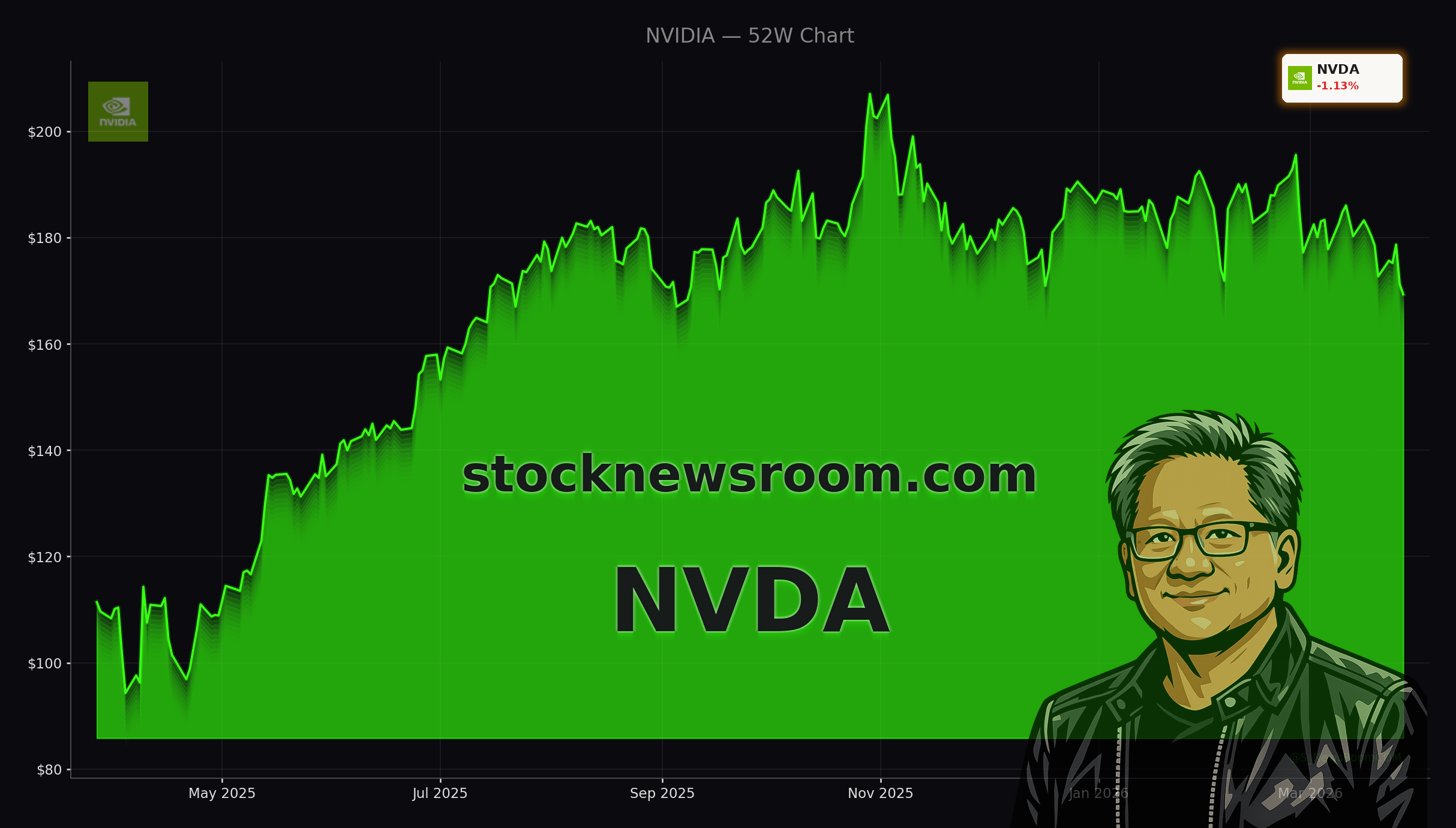
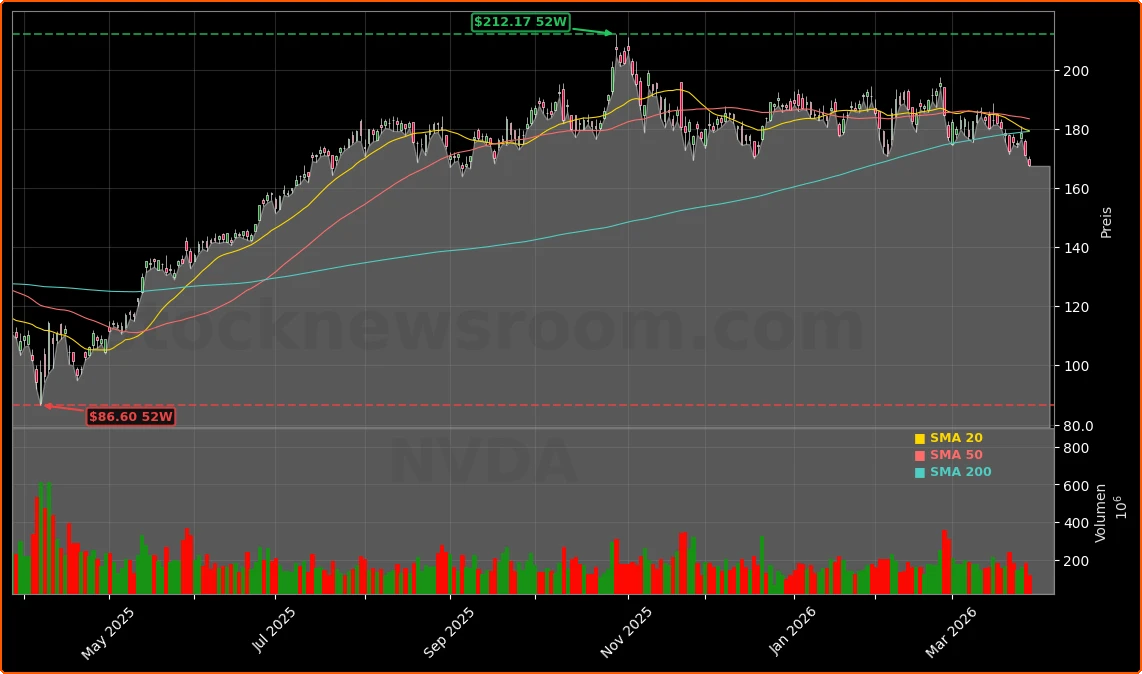
Technically, the picture is softer. The stock is roughly 4% below its 20‑day moving average and almost 7% under its 100‑day, with an RSI near 39 and a bearish MACD, signaling ongoing downside pressure. Still, Wall Street largely sees the recent drop as a valuation reset rather than the end of the AI cycle, with the next earnings release expected on May 27 and consensus calling for EPS of $1.74 on nearly $79 billion in annual revenue.
How serious is Huawei’s challenge to NVIDIA?
The most acute competitive threat comes from China, where Huawei’s new Ascend‑based 950PR accelerators are gaining traction with giants like Alibaba and ByteDance. U.S. export restrictions on advanced NVIDIA data‑center GPUs have forced Chinese hyperscalers to shift budgets toward domestic chips that increasingly claim CUDA‑like compatibility. Huawei is targeting mass production of roughly 750,000 units in 2026, a scale that could structurally reduce NVIDIA’s addressable market in China if U.S. approvals stay tight.
At the same time, rivals including Intel and Advanced Micro Devices are pushing cheaper workstation and server accelerators, sometimes marketing better “tokens per dollar” on specific AI workloads. Yet NVIDIA’s deeply entrenched CUDA software ecosystem and networking stack still create high switching costs, keeping it the default choice for most large language model training in the U.S. and Europe.
What are analysts saying about NVIDIA AI Valuation now?
Despite the pullback, the analyst community remains firmly in the bull camp on the NVIDIA AI Valuation. Rosenblatt maintains a Buy rating with a $325 target, Cantor Fitzgerald stays Overweight at $300, and Raymond James recently lifted its target to $323 with a Strong Buy. Strategists highlight that investors are paying a mid‑30s P/E for a company growing faster than almost any member of the S&P 500, and some see the risk/reward skewed favorably if China export approvals allow even partial resumption of high‑end GPU shipments.
The stock is also heavily embedded in major ETFs and index products, magnifying flows. In several growth and AI‑themed funds, NVIDIA holds double‑digit weightings, meaning any renewed AI optimism could mechanically drive fresh buying. That concentration cuts both ways, but it reinforces the company’s status as a defining KI‑Schluesselplayer for U.S. portfolios.
Related Coverage
For a deeper dive into how data‑center demand, ecosystem bets and full‑stack software are shaping NVIDIA’s next leg of growth, readers can explore NVIDIA AI Strategy +2.5%: Can the Data Center Surge Last?. Investors interested in broader AI sector risk can also review how sentiment shocks spill over to cyber stocks in CrowdStrike AI Risk: -5.6% Plunge on Anthropic Shock and Growth Jitters, which highlights how quickly Wall Street can rotate across AI winners and losers.
In sum, the current NVIDIA AI Valuation reflects both a rare $5 trillion franchise and fresh concerns about competition, export limits and technical momentum. For long‑term investors, the mix of premium but easing multiples, dominant AI infrastructure positioning and still‑supportive analyst targets suggests NVIDIA remains a central, if volatile, building block of any AI‑heavy portfolio. The next earnings report and any shift in U.S.‑China chip policy will likely determine whether today’s prices mark a lasting top or another consolidation before the next leg higher.