Is NVIDIA’s GTC strategy laying the groundwork for a $1 trillion AI boom or setting up investors for a harsh reality check?

How is NVIDIA’s AI roadmap shifting after GTC?
The core of the NVIDIA GTC Strategy is a pivot from an AI market dominated by training workloads to one increasingly defined by inference – running models in real time for billions of users. NVIDIA already commands an estimated mid‑ to high‑90s share of data center AI accelerators, and its CUDA software ecosystem has become the default environment for AI researchers and hyperscalers. At GTC 2026, Huang projected more than $1 trillion in cumulative revenue from Blackwell and next‑generation Vera Rubin chips between 2025 and 2027, and later indicated that figure is a floor that excludes CPUs, storage, networking and newer rack‑scale offerings.
The Vera Rubin platform, due to ship in commercial quantities in the second half of this year, is positioned as NVIDIA’s answer to the cost pressure emerging in inference. Rubin combines a new GPU, a Vera CPU, NVLink 6 switches and updated networking hardware. NVIDIA claims customers will be able to run identical AI training workloads with up to 75% fewer GPUs versus Blackwell, while slashing inference token costs by as much as 90%. That cost advantage is central to the NVIDIA GTC Strategy: cheaper tokens should both accelerate AI adoption and free up customer budgets for even more infrastructure spending.
What does this mean for data center growth at NVIDIA?
AI infrastructure remains the main engine of growth. In its last fiscal year, NVIDIA Corporation generated $215.9 billion in total revenue, up 65% year over year, with the data center segment contributing $193.7 billion and growing 68%. Wall Street now expects roughly $367.7 billion in revenue for fiscal 2027, implying an even faster 70% growth rate as Blackwell and Vera Rubin shipments ramp. Consensus earnings estimates call for $8.25 per share in fiscal 2027, up 73% from the prior year, and $10.80 per share in fiscal 2028.
Bank of America Securities analyst Vivek Arya reaffirmed a Buy rating after GTC, with a $300 price target, arguing that the $1 trillion data center revenue projection covers only GPUs and that adding CPUs, storage and new rack designs could expand the opportunity by roughly 50%. Truist Securities, Rosenblatt and Needham also reiterated Buy ratings this week, with targets of $287, $325 and $240 respectively, while Raymond James lifted its target to $323 and kept a Strong Buy stance after incorporating Huang’s updated outlook.
From a valuation perspective, NVIDIA trades around 36–37 times trailing earnings, a discount to its 10‑year average multiple north of 60. On a forward basis, the stock changes hands at roughly 22 times expected fiscal 2027 earnings, a level many growth investors view as undemanding if the NVIDIA GTC Strategy delivers on its growth and margin ambitions.
How are markets and competitors reacting?
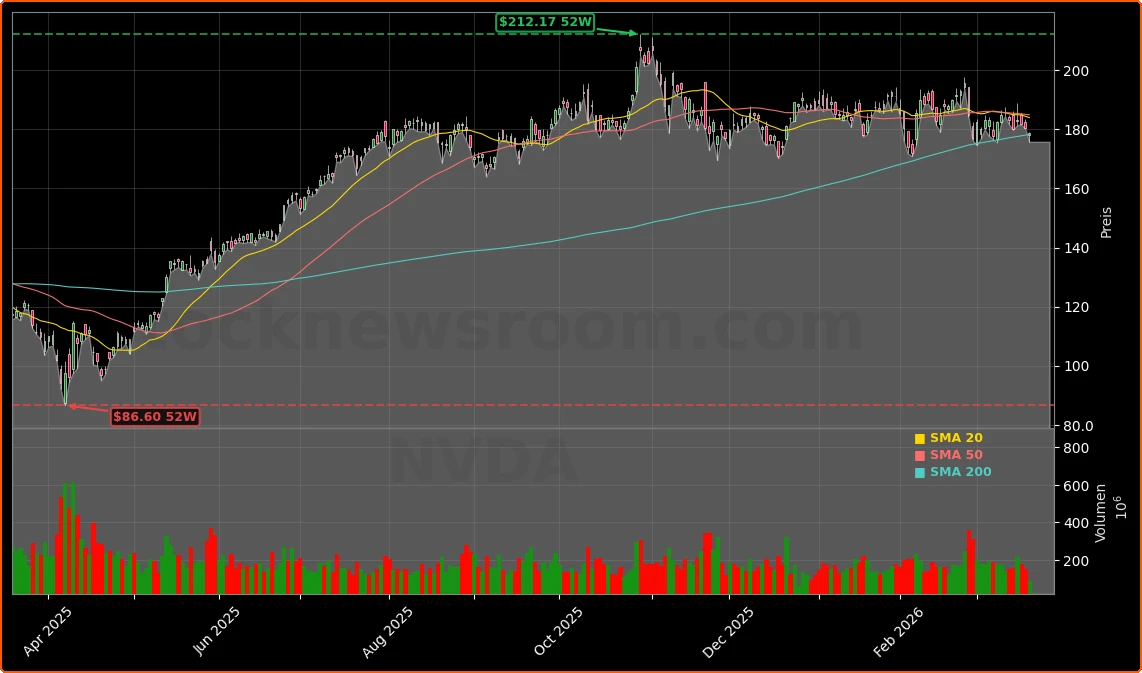
Despite the upbeat narrative, NVDA shares have been consolidating. The stock sits about 2–3% below its 20‑day and 100‑day simple moving averages and is closer to its 52‑week high than its low, but momentum indicators like MACD remain mildly bearish. A broader pullback in semiconductor names tied to geopolitical tensions and helium supply concerns has also weighed on sentiment across the sector in recent sessions.
For U.S. investors comparing megacap AI plays, NVIDIA remains the clear infrastructure leader, in contrast to platform peers such as Apple and Microsoft, whose AI exposure is more software and services driven. Fellow chipmakers Advanced Micro Devices, Intel, Broadcom and Taiwan Semiconductor are all vying for slices of the AI capex boom, particularly in inference and custom accelerators. Yet NVIDIA’s tight integration of GPUs, CPUs, networking and CUDA software – a full‑stack approach often likened to Apple’s “walled garden” – makes displacement difficult. Even major customers building in‑house silicon, including cloud hyperscalers and AI start‑ups, continue to rely heavily on NVIDIA hardware for their largest clusters.
The ecosystem effect extends to partners such as Super Micro Computer, which has seen strong demand for its AI servers built around NVIDIA’s latest Blackwell GPUs, and to enterprise vendors like NetApp, which recently launched an AI Data Engine co‑engineered with NVIDIA. New collaborations, like Qnity Electronics using NVIDIA’s open technologies for advanced materials research, underscore how deeply embedded the platform has become across the broader technology stack.
What are the long‑term levers in the NVIDIA GTC Strategy?
Beyond hyperscale data centers, the NVIDIA GTC Strategy highlights new verticals that could drive the next decade of growth. NVIDIA is pushing AI down into autonomous vehicles, humanoid robots, industrial automation and edge devices. Its automotive and robotics platforms, including DRIVE and Isaac, are designed to extend the company’s inference capabilities beyond the cloud. Partnerships with companies in mobility and logistics, including ride‑sharing and EV manufacturers, illustrate how embedded NVIDIA wants to be in the future of transportation.
Huang has suggested global AI infrastructure spending could reach $3 trillion to $4 trillion annually by 2030, outpacing even aggressive Wall Street forecasts. If that scenario plays out, and if NVIDIA maintains a leadership position across GPUs, networking and software, some analysts believe NVDA’s market capitalization could potentially double or more by 2027. For now, the next clear catalyst is the company’s late‑May earnings report, where investors will look for confirmation that early Blackwell orders and the upcoming Vera Rubin ramp are tracking to plan.
Related coverage: For a deeper dive into how NVIDIA’s data center dominance evolved and why a trillion‑dollar demand wave is central to its outlook, readers can revisit our earlier analysis, “NVIDIA AI Strategy Record: $1 Trillion Data Center Boom”, which examines the company’s prior guidance and market positioning ahead of GTC 2026.
You’re free to leave the garden through a well-hidden gate, but the flowers are nice and the sun is shining, so why would you?— Adam Levine, Barron’s columnist, on NVIDIA’s Apple-like AI ecosystem
In sum, the NVIDIA GTC Strategy lays out a clear attempt to turn today’s AI training boom into a durable, full‑stack platform business anchored in inference, networking and software. For U.S. investors, the stock now represents a rare combination of megacap scale, visible growth and still‑moderate forward multiples relative to its history. The coming Vera Rubin launch and the next earnings report will show whether NVIDIA can translate its ambitious roadmap into sustained upside – and keep its central place in AI‑heavy portfolios on Wall Street.