
Are NVIDIA’s latest mega deals with OpenAI and Marvell just another AI headline, or a real inflection point for the stock?

How do the NVIDIA Mega Deals move the stock today?
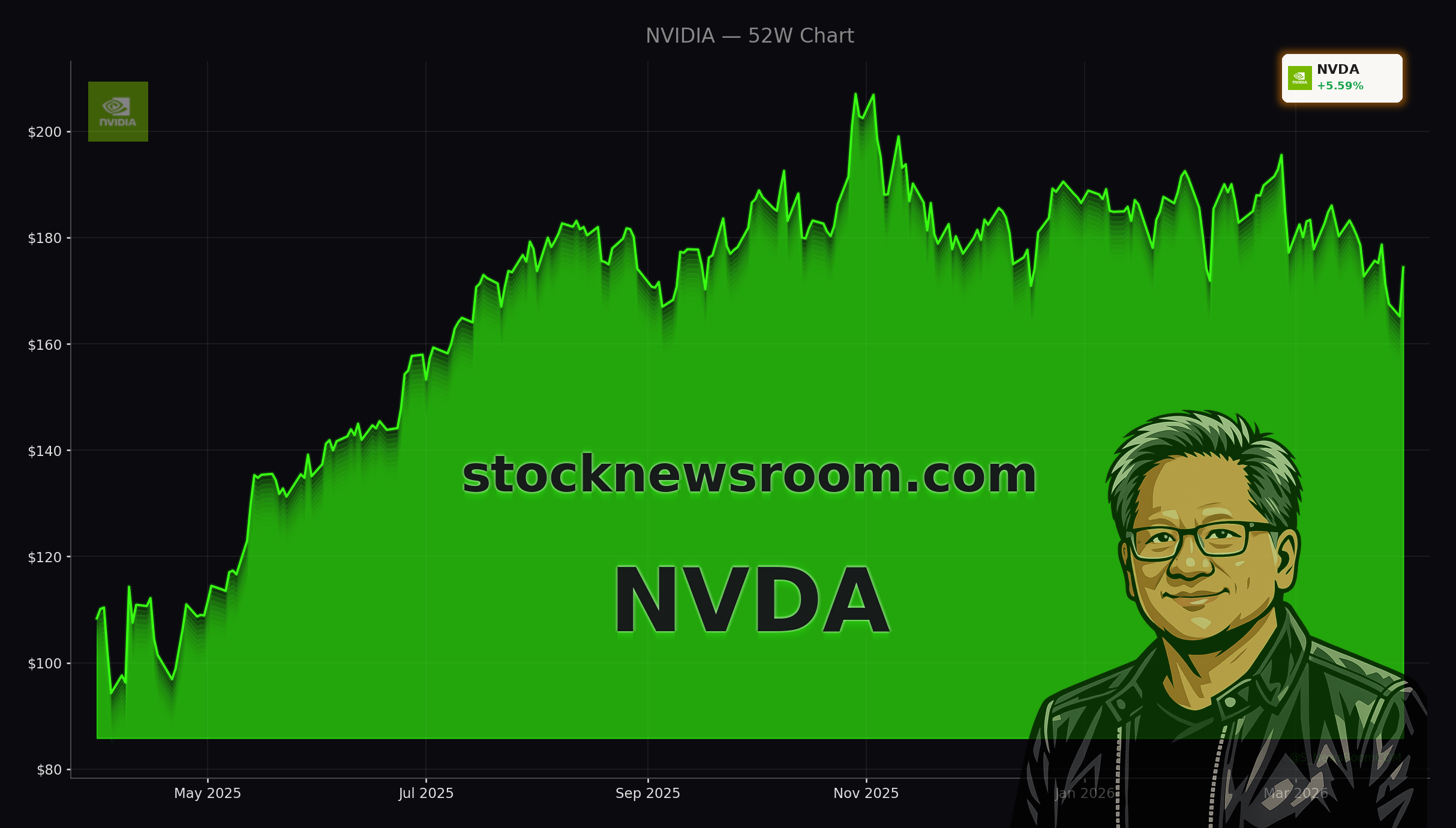
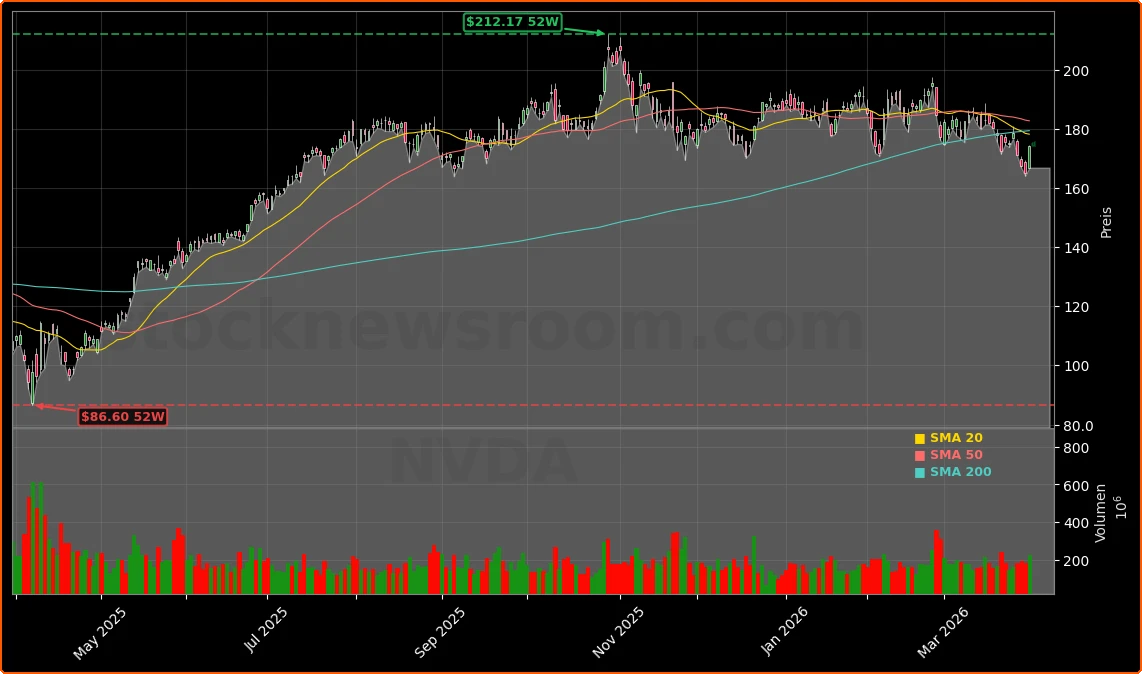
NVIDIA (NVDA) is trading around $174.40, up about 5.6% from the prior close, with pre‑market quotes near $175.59 as of early Wednesday in New York. That rally comes despite the stock sitting below its 52‑week high of $212.19, highlighting how sensitive the market remains to any fresh AI catalysts. The announcement of the NVIDIA Mega Deals with OpenAI and Marvell has reignited risk appetite in high‑beta chip names right as some investors had started to question the durability of the AI trade.
Analyst commentary remains broadly bullish. The average Wall Street target near $275 implies substantial upside from current levels, with firms like Citigroup, Goldman Sachs, and RBC Capital Markets maintaining Buy or Outperform stances on the AI leader. At the index level, NVIDIA is the largest weight in the Nasdaq‑100 via QQQ, ahead of Apple and other megacaps, meaning any sustained move driven by these transactions can ripple across passive portfolios and AI‑heavy ETFs.
What does the OpenAI investment really buy NVIDIA?
OpenAI has just closed the largest funding round in its history, raising about $122 billion at a valuation close to $852 billion. Roughly $30 billion of that comes from NVIDIA, with Amazon and SoftBank also anchoring the round. For NVIDIA, this is not a classic venture bet – it is an aggressive way to lock in future demand for its GPU‑driven AI “factories” and to anchor itself deeper inside the world’s most visible AI model provider.
OpenAI reports around $2 billion in monthly revenue and is racing to scale compute, data centers, and talent. Every additional model, agent platform, or humanoid robotics project it pursues will require massive GPU capacity for both training and inference. NVIDIA already dominates this stack with its Blackwell and upcoming Vera Rubin architectures, as well as its CUDA software ecosystem that underpins most foundational AI code. By tying its capital directly to OpenAI’s expansion, NVIDIA turns the startup’s fundraising into indirect visibility on multi‑year hardware demand.
There is also a strategic layer: as debates grow around global AI proliferation and potential restrictions on high‑end GPUs, OpenAI’s access to NVIDIA hardware becomes a geopolitical asset. With NVIDIA still the only large‑scale supplier of cutting‑edge AI GPUs, and most of its chips fabricated via TSMC in Taiwan, the partnership reinforces U.S. leadership in frontier models while keeping critical infrastructure inside a relatively tight circle of American and allied tech giants.
Why is Marvell central to the NVIDIA Mega Deals story?
Alongside OpenAI, NVIDIA has committed about $2 billion to a strategic stake in Marvell Technology. The market reaction has been emphatic: Marvell shares jumped more than 12%, while NVIDIA itself climbed over 5% as investors digested the AI infrastructure implications. Unlike a simple financial holding, the two companies are joining forces around silicon photonics and high‑bandwidth connectivity, the technologies that move data between chips at scale with much lower energy consumption.
NVIDIA’s core competence is in GPUs, networking fabrics like InfiniBand and Spectrum‑X, and full AI data center platforms. Marvell brings deep strength in optical components, DSPs, and custom ASICs that hyperscalers such as Amazon use for AI workloads. By investing directly into Marvell, NVIDIA strengthens a key supplier in optics and interconnects while also creating a friendlier home for custom chips that might otherwise evolve into direct GPU competitors via players like Broadcom.
From an ecosystem perspective, the partnership aims to make it easier for cloud providers to mix Marvell custom silicon with NVIDIA GPUs inside next‑generation “AI factories.” This includes tighter integration of Amazon‑style ASICs with NVIDIA hardware, higher‑speed photonic links between racks, and a more resilient supply chain that can scale with exploding data center capex. Jensen Huang has framed this as an expansion of the pie, not a zero‑sum race – a way to prevent bottlenecks in optics and networking from capping GPU demand.
How do these moves stack up against Broadcom and other rivals?
For U.S. investors deciding between NVIDIA and rivals like Broadcom, AMD, and custom‑chip specialists, the NVIDIA Mega Deals clarify the company’s roadmap. Broadcom has become a powerhouse in AI accelerators through custom ASICs for the hyperscalers, while AMD is pushing aggressively into GPU compute. Yet NVIDIA continues to pair world‑class hardware with tightly integrated software and now, with OpenAI and Marvell, with critical stakes in both the model layer and the plumbing layer.
Recent analysis comparing NVIDIA and Broadcom for April highlighted two advantages for NVIDIA: faster top‑line growth and a lower forward P/E multiple, even after its massive run. NVIDIA’s guidance that lifetime sales for its Blackwell and Rubin architectures could reach $1 trillion by 2027 underscores the scale it is targeting. At the same time, the company is evolving beyond GPUs into CPUs, inference‑optimized accelerators (via Groq technology), and full server racks for compute, inference, storage, and agentic AI. These mega transactions reinforce that forward‑looking strategy rather than representing a late‑cycle gamble.
Investors should also note the macro context. The AI market is estimated to have doubled from around $200 billion last year to roughly $400 billion this year, with data center silicon alone adding about $200 billion in annual spend. NVIDIA’s order book for Blackwell and Rubin has reportedly swelled toward $1 trillion in commitments through 2027. If even a conservative fraction of that materializes, the current share price near $175 could prove undemanding relative to potential earnings power in the $20–$25 EPS range over the next couple of years.
Related Coverage
For a deeper dive into how NVIDIA’s architecture roadmap fits into the broader AI super‑cycle, including its Vera Rubin chips and NemoClaw agentic AI platform, see this analysis of NVIDIA’s AI strategy and $4 trillion valuation reset. It explores whether the latest pullback is a warning sign or a fresh entry point.
Investors interested in the wider AI hardware complex beyond GPUs should also read our coverage of SanDisk’s earnings surge and its Nanya partnership. That piece examines how memory and storage players are responding to the same AI demand wave that is driving these NVIDIA Mega Deals.
The NVIDIA Mega Deals with OpenAI and Marvell underline how rapidly the AI infrastructure map is consolidating around a handful of U.S. champions, with NVIDIA at the center of both model training and data center plumbing. For investors, the transactions sharpen the company’s growth visibility across GPUs, networking, and ecosystem partnerships, even as the stock remains volatile after two softer quarters. With AI data center capex poised to expand for years, these bold capital allocations keep NVIDIA firmly on offense and make the next few earnings reports critical for anyone positioning around the AI build‑out.