Are the latest Okta Earnings the start of a profitable AI identity boom or just a pause in a much rougher reset for the stock?
Okta Earnings: How Did the Market React?
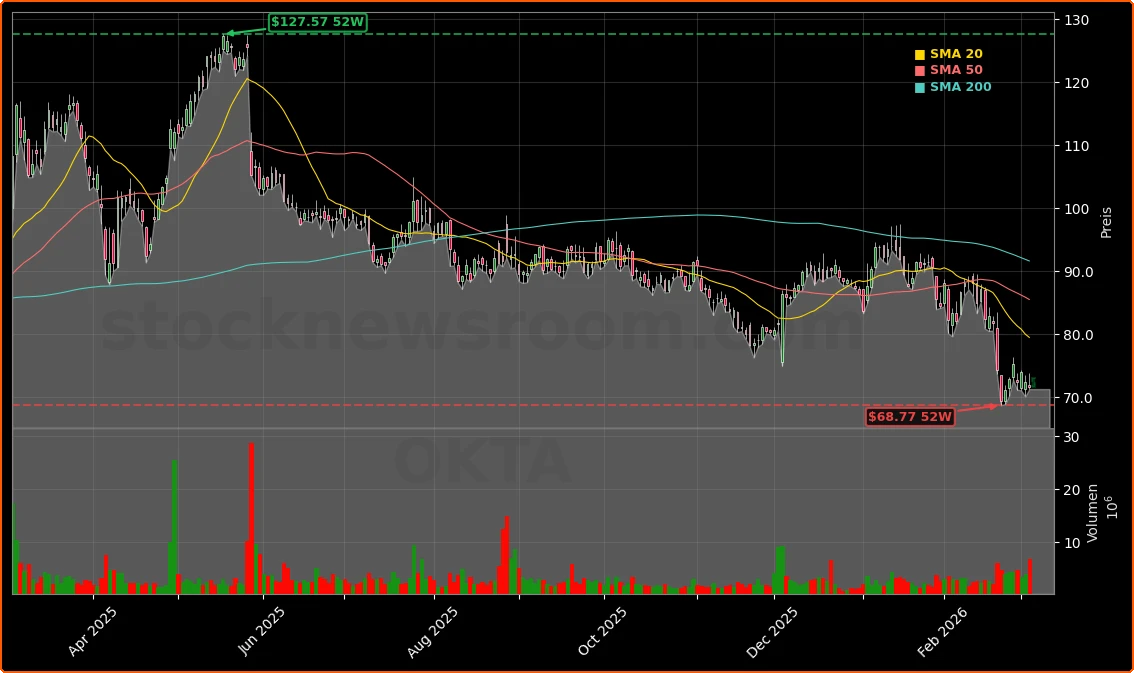
Heading into the latest Okta Earnings release after Wednesday’s close, sentiment around cybersecurity and identity stocks was fragile. New AI‑driven security tools and fears of disruption had triggered sharp sell‑offs across the sector in recent weeks, and Okta’s own share price had already lost roughly a third of its value year to date. Against that backdrop, the company’s fourth‑quarter beat initially looked like the kind of catalyst that could stabilize the stock.
Okta reported adjusted earnings per share (EPS) of $0.90, ahead of Wall Street expectations of $0.85, and revenue of $761 million, beating consensus estimates of around $749–$750 million. That translates into roughly 11–12% year‑over‑year growth, a modest but respectable rate in today’s slower enterprise IT spending environment. Net income jumped to $63 million, or $0.35 per share on a GAAP basis, up from $23 million, or $0.13, a year ago, highlighting the operating leverage now coming through the P&L.
Yet despite these better‑than‑expected Okta Earnings, the stock’s after‑hours move was only mildly positive, with trading oscillating between small gains and minor losses. Part of that reflects an already bruised share price and a market that is laser‑focused on forward guidance rather than backward‑looking beats. It also reflects a broader rotation within NASDAQ growth names, where investors are demanding cleaner visibility into durable double‑digit growth and AI monetization before rewarding stocks with higher multiples.
For U.S. investors comparing Okta with high‑growth mega‑caps like NVIDIA or identity‑adjacent platforms such as Apple and cloud security vendors, the latest Okta Earnings suggest a transition phase: the company is moving from a high‑growth, cash‑burning story toward a profitable, more measured growth profile—while trying to attach itself to the most powerful secular driver in tech today: AI.
Okta: What Do the Headline Numbers Really Tell Us?
Beneath the headline Okta Earnings beat, the mix of growth, profitability and backlog metrics offers a more nuanced view of the business. Revenue at $761 million grew about 11% year over year, and management emphasized that subscription revenue continues to grow faster than total revenue as lower‑margin professional services shrink from roughly 2% to about 1% of the total. That shift is strategically important because it enhances gross margins and underscores Okta’s push to let partners and global system integrators handle more implementation work.
Profitability is clearly improving. The quarter reflected strong non‑GAAP operating margins in the mid‑20s, and free cash flow margins in the 30%+ range, with management signaling that these strong margin levels should persist in the new fiscal year. The company exited the quarter with more than $2.5 billion in cash, cash equivalents and short‑term investments, and has started to return capital to shareholders via a $1 billion share repurchase program. In January alone, Okta repurchased and retired more than 875,000 shares for $79 million, and it signaled continued disciplined capital allocation, including an intent to settle the remainder of its 2026 notes in cash.
Another positive signal in the Okta Earnings was remaining performance obligations (RPO), a key metric for subscription software businesses. Okta’s RPO rose 15% year over year to $4.83 billion, beating sell‑side expectations and indicating that contract backlog remains healthy, even as reported revenue growth slows. The company also surpassed $3 billion in annual contract value (ACV) and closed a record $1.3 billion in total contract value during the quarter, with channel partners involved in 18 of the top 20 deals.
The mix of bookings is shifting in Okta’s favor as well. Approximately 30% of bookings in the quarter came from newer products like Okta Identity Governance, Okta Privileged Access and other advanced identity security offerings. When these newer modules are included, average contract value increases roughly 40% over the life of the deal. That suggests Okta still has substantial upsell potential with its existing enterprise customer base, which is critical as net new logo growth slows in a more cautious macro environment.
Okta: How Cautious Is the New Guidance?
The key reason the latest Okta Earnings did not trigger a stronger rally is the company’s forward guidance. For the first quarter of the new fiscal year, Okta expects revenue between $749 million and $753 million, implying roughly 9% year‑over‑year growth and missing analyst estimates of about $755 million at the midpoint. Adjusted EPS is guided to $0.84–$0.86, slightly below the $0.87 consensus. Management described this as a “prudent” outlook given macro uncertainty and its own strategic decisions.
For the full fiscal year (often referred to as fiscal 2027 in Okta’s reporting), the company guided to revenue between $3.17 billion and $3.19 billion, essentially in line with the $3.17 billion market expectation. More importantly, Okta is signaling about 9% top‑line growth for the year, the slowest since its 2017 IPO. Non‑GAAP operating margin is expected in the 25%–26% range, and free cash flow margin at 27%–28%, reflecting continued discipline but also some incremental headwinds.
There are a few specific drags embedded in this guidance. First, Okta is shifting more professional services work to global system integrators, which reduces recognized revenue by roughly one percentage point but is intended to strengthen partner relationships and ultimately expand the reach of Okta’s platform. Second, free cash flow margin will take about a one‑point hit from lower interest income, as Okta deploys cash into share repurchases and prepares to settle its 2026 notes in cash. Third, the company updated its non‑GAAP tax rate assumption to 21% from 26% to reflect recent federal tax law changes, which slightly boosts EPS for a given level of operating income but does not change underlying cash generation.
For growth‑oriented investors accustomed to double‑digit expansion, the single‑digit revenue outlook will feel underwhelming. That said, the combination of mid‑20s operating margins, high‑20s free cash flow margins and a large, underpenetrated identity and AI‑security market still offers an appealing risk/reward setup—if Okta proves that growth can reaccelerate once enterprise IT budgets normalize. In the meantime, these Okta Earnings reinforce the view of the company as a profitable, cash‑rich mid‑cap software platform, rather than a hyper‑growth story.
Okta: Is AI Identity a Real Growth Engine or Just Hype?
One of the most closely watched aspects of the latest Okta Earnings is the company’s AI narrative. Management has been increasingly vocal about the “agentic AI” opportunity: as enterprises deploy AI agents to automate tasks, each agent effectively becomes a new digital identity that must be secured, authenticated and authorized. Some industry analysts estimate that companies could eventually run 10 to 100 AI agents per human employee, implying a massive expansion in the total number of identities that need protection.
Okta is positioning itself at the center of this shift with offerings such as Okta for AI Agents and Auth0 for AI Agents. Okta for AI Agents entered early access in January, and Auth0 for AI Agents is now generally available. The company reported “huge interest” and highlighted several early wins, though the revenue contribution remains small at this stage. Pricing models for AI agents are flexible: some customers pay via a multiplier on person‑based licenses, while others pay based on the number of agent connections to back‑end systems.
These developments give substance to the AI story embedded in Okta Earnings, separating it from generic AI marketing. Newer products across the portfolio—Identity Governance, Privileged Access, Identity Security Posture Management, Identity Threat Protection, Okta Device Access and Fine‑Grained Authorization—are performing well, and Okta Identity Governance already counts more than 2,000 customers after a little more than three years on the market. Together, these modules form a unified identity security fabric that can extend to both human users and machine‑driven AI agents.
Still, investors should recognize that AI‑driven identity is a medium‑term growth lever, not an immediate fix for slowing macro‑driven demand. Management itself has indicated that suite‑based pricing and AI‑agent offerings are still early in their adoption curve and not yet a meaningful contributor to run‑rate growth. The real test will be whether Okta can translate early AI identity traction into sustained double‑digit subscription growth over the next several years, as enterprises standardize on a smaller set of trusted identity providers.
Okta: How Does It Stack Up Against Security and Cloud Peers?
From a Wall Street perspective, Okta now sits in an interesting middle ground between high‑growth security names and mature, cash‑generating software platforms. While direct business model comparisons to companies like Tesla or NVIDIA are imperfect, U.S. investors often think in terms of portfolio buckets: where does Okta fit relative to cloud‑platform giants and pure‑play cybersecurity vendors?
Okta focuses squarely on identity and access management (IAM), a category that has become a core layer of modern security architecture. Competitors include both large platform vendors and specialized players. Cloud hyperscalers such as Apple (through its device ecosystem and authentication systems) and other tech giants bundle identity capabilities into broader offerings, while cybersecurity firms and legacy IAM providers also compete for large enterprise contracts. In this environment, Okta’s pitch is that being an independent, cloud‑native identity partner allows it to integrate broadly across ecosystems, rather than tying customers to a single stack.
The latest Okta Earnings suggest that this independent‑platform strategy continues to resonate with large enterprises. Channel partners participated in 18 of the top 20 deals in the quarter, and contract value sourced through the AWS Marketplace grew more than 45% for the year to roughly $750 million. Management also highlighted strong performance in the large‑enterprise segment and stable gross retention, with net retention driven more by upsell activity than by churn.
On valuation, Okta does not command the kind of premium multiples seen in mega‑cap AI leaders like NVIDIA, but its transition to high‑20s free cash flow margins and active share repurchases provides a support layer for long‑term holders. The company’s guidance for adjusted EPS of $3.74–$3.82 for the new fiscal year, above consensus around $3.66, underscores its ability to grow earnings faster than revenue through margin expansion. For investors in the NASDAQ and S&P 500 ecosystems looking for profitable mid‑cap software names with a credible AI adjacency, the current setup after these Okta Earnings may look attractive—provided they are comfortable with macro‑driven volatility and execution risk.
Sell‑side opinion remains mixed but generally constructive. Analyst commentary from firms such as Evercore ISI has described market fears of AI‑driven disruption of Okta’s business model as overblown, arguing that identity providers will significantly benefit from the proliferation of AI agents rather than be displaced by them. At the same time, other analysts have flagged the deceleration to single‑digit revenue growth as a key reason to remain selective, with some price targets trimmed to reflect lower top‑line expectations even as rating stances like “Outperform” or “Sector Perform” are maintained by houses such as RBC Capital Markets and similar institutions focused on security software coverage.
For portfolio construction, the takeaway from the latest Okta Earnings is that the stock now leans more toward a quality, cash‑generating compounder than a momentum growth name. Investors who want pure AI torque may prefer GPU or model providers, while those looking for durable, subscription‑driven cash flows with AI‑linked optionality may find Okta’s current risk/reward compelling, especially after the year‑to‑date drawdown.
Identity is fast becoming the most important aspect of security, with AI acting as a catalyst.
— Todd McKinnon, CEO of Okta
Conclusion
In sum, the newest Okta Earnings underscore a company at an inflection point: revenue growth is slowing, but operating discipline is strong, the balance sheet is robust, and the AI identity opportunity is real, even if early. For long‑term investors willing to ride out near‑term macro headwinds, Okta looks positioned as a central piece of the identity layer in a world where both people and AI agents increasingly need secure, trusted digital identities.
Further Reading
- Okta, Inc. (OKTA) on Yahoo Finance (Yahoo Finance)
- Okta beats fourth-quarter estimates, but issues weak guidance (CNBC)
- Okta forecasts slowest revenue growth since IPO amid economic uncertainty (Reuters)
- Okta (OKTA) Q4 Earnings and Revenues Top Estimates (Zacks Investment Research)
- Okta Announces Fourth Quarter and Fiscal Year 2026 Financial Results (Business Wire)