
Can Oracle’s massive AI infrastructure and $523 billion cloud backlog really justify its debt-fueled data-center spending spree?
Can Oracle’s AI gamble move the stock today?
Wall Street will focus squarely on how aggressively Oracle Corporation is funding Oracle AI Infrastructure when it reports fiscal Q3 results after the close on Tuesday at 4:00 p.m. ET. Consensus estimates call for roughly $1.70–$1.71 in earnings per share on about $17 billion in revenue, with cloud growth expected around 40%. Options pricing implies a potential 10% move in either direction, reflecting how polarized sentiment has become.
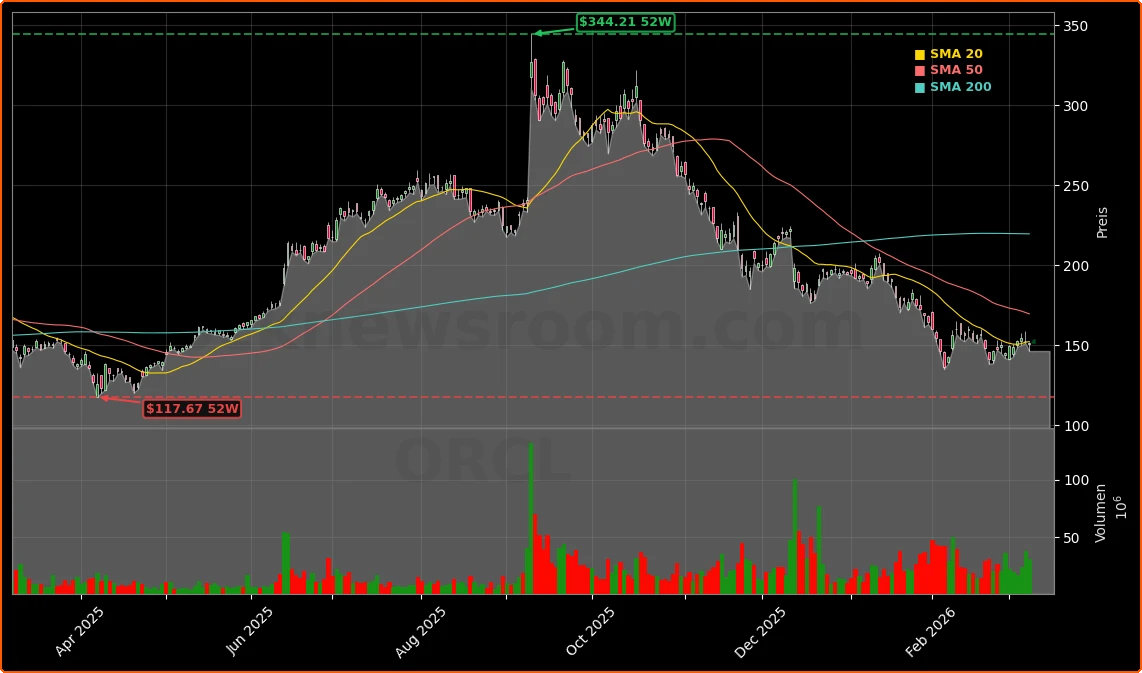
Shares slipped 0.9% on Monday to $151.56 but are indicated modestly higher in pre‑market trading near $153.21. That leaves the stock down roughly 22% in 2026 and more than 50% below last September’s peak, making it one of the most bruised names in the AI trade on the NYSE despite its inclusion in many S&P 500 and large‑cap tech portfolios.
CNBC notes that Oracle recently lined up a $50 billion financing package to accelerate its data‑center expansion, underscoring just how central Oracle AI Infrastructure has become to the company’s strategy. The question for investors is whether that acceleration is happening at a sustainable cost.
How strong is Oracle’s cloud and AI pipeline?
On the operational side, Oracle has posted eye‑catching growth metrics. Remaining Performance Obligations (RPO) surged 438% year‑over‑year to $523 billion in Q2 FY2026, signaling years of contracted cloud and infrastructure work. Management also highlighted that its multicloud database business grew 817% in the same period, as Oracle builds 72 multicloud data centers embedded within the clouds of Amazon, Microsoft and Google and operates or plans more than 211 regions worldwide.
Commentators like Jim Cramer have gone so far as to call Oracle the “king of the data center” and the fastest‑growing player in the space, arguing that its chip‑neutral, multicloud approach differentiates it from hyperscalers. For investors comparing Oracle to names like NVIDIA or Apple in AI‑heavy portfolios, the appeal is clear: exposure to infrastructure demand regardless of which AI model or chip wins.
However, the market has become more skeptical about how durable that $523 billion backlog really is. Analysts expect tonight’s call to provide more granular detail on contract duration, cancellation clauses and utilization ramp‑up, especially for large AI training deals.
Is Oracle AI Infrastructure overbuilding into a fast chip cycle?
A growing worry is that Oracle’s massive Oracle AI Infrastructure bet may be colliding with the rapid pace of GPU innovation. Recent commentary highlighted that OpenAI pulled back from a planned expansion of a flagship data center project in Abilene, Texas, amid power‑infrastructure delays. By the time full power arrives, NVIDIA’s current Blackwell chips could already be eclipsed by next‑generation Vera Rubin hardware, raising questions about whether facilities designed for one chip generation will be economically optimal when they finally go live.
For Oracle, that dynamic creates a classic capex‑to‑revenue timing risk. The company has disclosed supply commitments of about $95.2 billion for chips and infrastructure, alongside capital expenditures that reached $8.5 billion in Q1 FY2026 alone and $20.54 billion across the first half—more than consuming operating cash flow and pushing free cash flow negative. Unlike Microsoft or other megacaps with far larger revenue bases, Oracle has less room to absorb delays or renegotiations from a handful of anchor AI customers.
Investors will scrutinize updated capex guidance tonight, with some forecasts pointing to as much as $60 billion of spending next year if Oracle pushes ahead with its current build‑out schedule. Any hint of moderation or phasing could be read positively for free‑cash‑flow visibility, even if it tempers infrastructure growth headlines.
Debt, layoffs and lawsuits: How fragile is the balance sheet?
On top of the capex surge, Oracle’s balance sheet is carrying more than $100 billion of debt, and credit default swap spreads have been widening as markets reprice risk. Commentators have warned that with Oracle reportedly preparing tens of thousands of job cuts to free up cash for data‑center investments, the company is effectively betting its traditional software franchise on Oracle AI Infrastructure.
Legal pressure is also rising. Separate shareholder class actions filed by firms such as The Gross Law Firm and Bernstein Liebhard LLP allege securities fraud tied to previous disclosures, adding to the wall of worry even if such suits are common for large‑cap tech names.
Still, not all on Wall Street is bearish. RBC Capital Markets and Scotiabank have kept bullish ratings on the stock, pointing to significant upside versus current levels based on their price targets, while broader analyst consensus compiled by major data providers still sits north of $250 per share with a majority of Buy recommendations.
Oracle’s AI infrastructure bet is either building a once‑in‑a‑generation moat or front‑loading a decade of risk into the next few quarters; tonight’s numbers will tell us which story is winning.
— Senior Wall Street technology strategist
Conclusion
Against this backdrop, tonight’s earnings call could reset the narrative. If Oracle can show that Oracle AI Infrastructure is beginning to translate into accelerating OCI revenue growth—investors are looking for 80% or more in the flagship infrastructure segment—and robust RPO additions above roughly $18 billion, some confidence may return. Disappointment on those metrics, combined with another jump in capex or debt, would reinforce fears that the AI build‑out is running ahead of sustainable demand.
Further Reading
- Oracle Corporation (ORCL) on Yahoo Finance (Yahoo Finance)
- Oracle’s Biggest Earnings Challenge Is a Market Fixated on Risk (Bloomberg)
- Oracle earnings will show whether its expensive AI bet is starting to pay off (CNBC)
- Jim Cramer: Oracle Is the King of Data Centers and Fastest Growing (24/7 Wall Street)