
Can Oracle AI Infrastructure turn massive cloud commitments into lasting profits before its soaring debt load spooks investors for good?
Is Oracle AI Infrastructure justifying the AI hype?
Oracle Corporation stunned investors last year with guidance that its cloud infrastructure revenue could surge 77% in fiscal 2026 to roughly $18 billion and potentially climb toward $140 billion-plus by 2030. The core growth engine is Oracle AI Infrastructure, a global network of data centers renting GPU capacity to AI developers in a model similar to Microsoft Azure and Amazon Web Services. In the latest fiscal third quarter, total revenue rose 22% year over year to $17.2 billion, with cloud revenue jumping 44% and now accounting for more than half of group sales.
A critical metric for AI hyperscalers is remaining performance obligations (RPO) — contracted revenue not yet recognized. Oracle ended the quarter with an eye-catching $553 billion in RPO, up sharply and ahead of many Wall Street expectations. A sizable portion is tied to a handful of AI clients such as OpenAI, underscoring both the opportunity and concentration risk behind Oracle AI Infrastructure.
How dependent is Oracle on OpenAI?
Earlier in the cycle, investors grew nervous when it emerged that roughly $300 billion of Oracle’s RPO came from OpenAI, which has committed to long-term AI capacity deals across providers. With OpenAI’s annual recurring revenue estimated around $20 billion, the gap between current cash generation and $1.4 trillion in total data center commitments industry-wide raised questions about counterparty risk and the durability of Oracle’s backlog.
Those concerns eased after OpenAI secured a $110 billion private financing round led by heavyweight partners including Amazon, Nvidia and SoftBank, implying a pre-money valuation near $730 billion. OpenAI is also preparing to roll out advertising on ChatGPT, with some Wall Street research suggesting ad revenue alone could eventually reach tens of billions of dollars annually. Internal projections reported in financial media point to a long-term revenue goal in the hundreds of billions, which, if even partially realized, would significantly de-risk OpenAI’s ability to honor contracts embedded in Oracle AI Infrastructure.
Can Oracle manage its AI capex and balance sheet?
The flip side of Oracle’s AI ambition is a rapidly expanding capital spending program. In its fiscal 2026 second quarter, management lifted full-year capex guidance from $35 billion to $50 billion to accelerate AI data center build-out, leading to negative free cash flow and intensifying scrutiny of the balance sheet. The company has raised roughly $30 billion through a mix of investment-grade bonds and mandatory convertible preferred stock, and still plans to utilize an additional $20 billion through an at-the-market equity program.
Long-term debt has swelled to about $125 billion, up more than 40% year over year, making leverage the key bear argument on Oracle AI Infrastructure. While the AI capacity delivered in the latest quarter generated healthy 32% gross margins, above the 30% target, much of the early cash flow is likely to be absorbed by interest expense and continued investment, delaying a clean inflection to strong free cash flow.
How does Oracle stack up against other AI leaders?
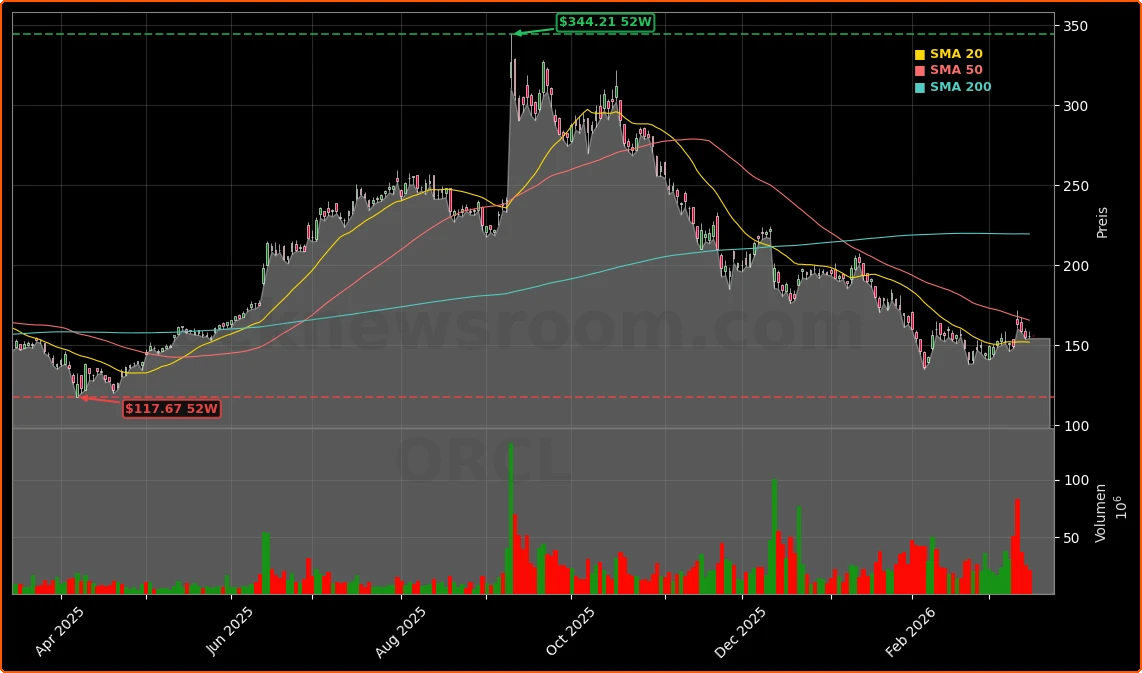
For U.S. investors comparing options across the AI stack, Oracle’s valuation has become more compelling. After a sharp sell-off from its September peak, the stock trades around a 29x trailing P/E and roughly 22x forward earnings, close to the S&P 500 despite far faster expected growth. That places Oracle alongside other AI beneficiaries like Nvidia and Meta Platforms, whose forward multiples have also compressed toward index levels even as their AI-driven outlooks remain robust.
On the Street, opinion is split but generally constructive. Guggenheim recently reiterated a Buy rating on Oracle Corporation with a bullish $400 price target and added the name to its “Best Ideas” list for 2026, arguing that AI data center investments will ultimately strengthen both growth and the balance sheet. Stifel, while trimming its target from $275 to $220, kept a Buy rating and highlighted infrastructure-as-a-service and software-as-a-service momentum as drivers of earnings growth into 2027. Against that backdrop, some ETF managers expect funds heavily exposed to hyperscalers like Microsoft and Oracle to continue outperforming the S&P 500 as AI demand exceeds available infrastructure.
Oracle has effectively transformed itself from a traditional software vendor into a key infrastructure provider for the AI era, but the speed of that transition is testing the limits of its balance sheet.
— Independent Wall Street technology analyst
Conclusion
For investors, the thesis around Oracle AI Infrastructure boils down to whether its enormous backlog, deep relationships with AI leaders like OpenAI, and improving cloud margins can outrun the risks of high leverage and aggressive capex. If management can convert its contracted revenue into cash while gradually normalizing spending, Oracle could evolve from a discounted value play into one of Wall Street’s core AI infrastructure champions.
Further Reading
- Oracle Q3 Fiscal 2026 Earnings Release (Oracle Investor Relations)
- Guggenheim Research on Oracle Corporation (Guggenheim)
- Stifel Equity Research on Oracle (Stifel)
- Oracle Corporation bei Yahoo Finance (Yahoo Finance)