
Are Oracle AI Investments building a future profit engine or loading the balance sheet with unsustainable debt risk?
Is Oracle’s AI bet breaking the stock?
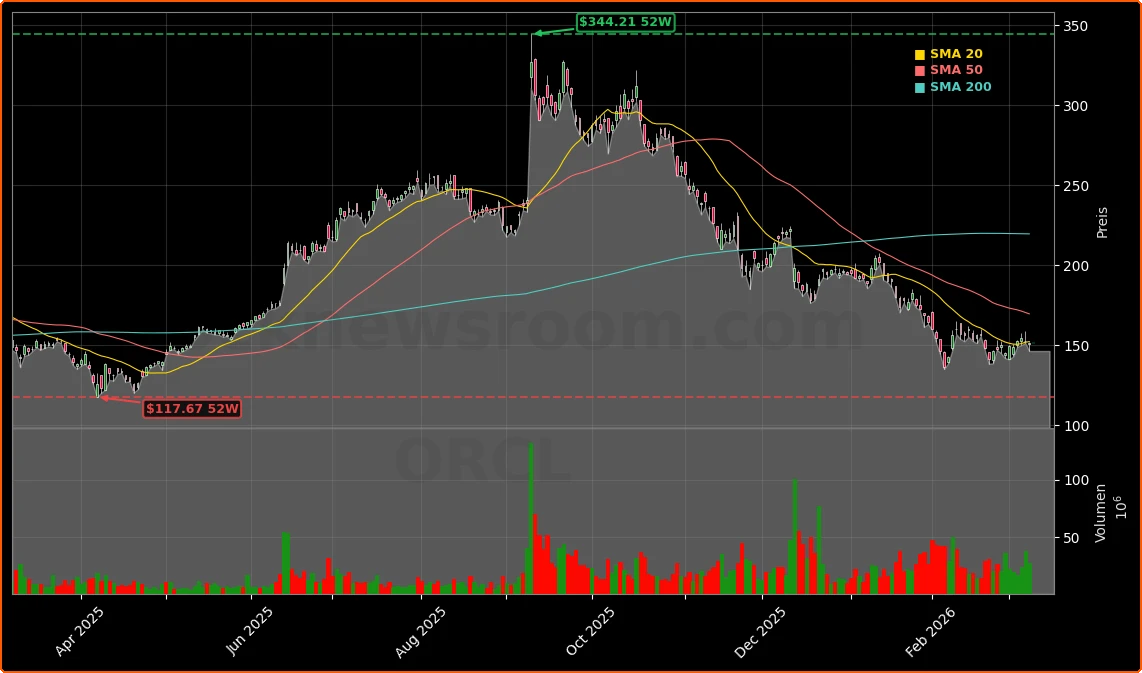
At Monday’s close, Oracle Corporation traded at $151.56, down 0.92% on the day, with a slight after‑hours uptick to $151.66. That leaves the stock well below its 52‑week high and far from the euphoric spike when management first highlighted its ambition to become a core AI infrastructure provider. Since then, the narrative around Oracle AI Investments has flipped from excitement to concern.
Equity investors have watched the shares fall more than 20% year‑to‑date and over 50% from peaks reached around the height of AI enthusiasm. A major overhang is the sheer scale of capital deployed: through the first six months of fiscal 2026, Oracle reported capex of about $16.4 billion versus $6.6 billion a year earlier, and it has signaled plans to raise roughly $50 billion this year to finance AI‑ready data‑center expansion. That ramp is being funded primarily with debt, leaving Oracle carrying more than $100 billion in obligations while free cash flow has turned negative.
This stands in sharp contrast to AI leaders like NVIDIA and hyperscale cloud peers, which have largely funded expansion from robust operating cash flow and equity strength. The result: investors are questioning whether Oracle is building the right kind of data centers, at the right time, and on the right balance sheet.
What will earnings reveal about Oracle AI Investments?
Tuesday’s fiscal Q3 report after the Wall Street close has become a referendum on Oracle AI Investments. Analysts expect around $17 billion in revenue and roughly $1.70 in earnings per share, implying a forward P/E of about 20 if that run rate holds. For a company positioning itself as a key AI infrastructure player, that multiple is not demanding, but only if growth and profitability hold up.
Two metrics dominate the bull‑bear debate. First, Oracle Cloud Infrastructure (OCI) growth: OCI has delivered accelerating year‑over‑year revenue increases of 49%, 52%, 55% and 68% in the last four reported quarters. To rebuild confidence, many on Wall Street argue OCI needs to show 80% or better growth, signaling that AI‑driven demand is fully absorbing the new capacity. Second, Remaining Performance Obligations (RPO): a figure north of $18 billion would suggest that long‑term cloud and AI contracts are still ramping, undercutting fears that demand has stalled.
Any miss on those numbers could reignite concerns that Oracle has overbuilt AI capacity or misread customer timelines. Conversely, a strong OCI beat and robust RPO could shift attention back to earnings power once the current capex spike normalizes.
How are analysts and the bond market reacting to Oracle?
Analysts have been trimming expectations ahead of the print. Barclays, for example, recently cut its price target on Oracle to $230, warning that margins are likely to stay under pressure as front‑loaded AI infrastructure costs weigh on profitability. Deutsche Bank, which still rates the stock a buy, has lowered its target from $375 to $300, acknowledging that the market is not yet convinced by the AI build‑out while the stock trades around $150.
The bond market is sending a similarly cautious message. Credit default swap spreads on Oracle’s debt have jumped from about 40–50 basis points to roughly 125–145 basis points, reflecting higher perceived default risk as leverage climbs and cash burn accelerates. That raises Oracle’s cost of funding precisely as it seeks tens of billions of fresh capital for AI data centers.
These dynamics put Oracle in a different bucket from cash‑rich megacaps like Apple or AI chip winner NVIDIA, whose balance sheets act as strategic assets. For Oracle, the upcoming numbers need to demonstrate that today’s leverage is a bridge to significantly higher AI‑driven earnings rather than a structural drag.
What does the OpenAI shift mean for Oracle?
Another cloud over Oracle AI Investments is the evolving relationship with OpenAI. Plans to significantly expand the flagship “Stargate” data center in Texas have been scaled back, as OpenAI has signaled a preference for next‑generation GPUs at new sites rather than deepening its commitment to Oracle’s existing facilities. Commentary out of CNBC highlighted the risk that Oracle is “building yesterday’s data centers with tomorrow’s debt,” if AI workloads increasingly favor more advanced, flexible architectures.
That shift matters beyond one project. Oracle has pitched its AI data‑center build‑out as tightly linked to marquee customers like OpenAI and major media deals in Hollywood, where studios are exploring how to leverage AI for content and distribution. If cornerstone clients slow or redirect their commitments, Oracle faces both utilization risk and heightened concentration risk—exactly what cautious investors fear.
At the same time, class‑action lawsuits filed by several law firms allege that Oracle misled investors about aspects of its AI strategy and financial outlook between June 2025 and December 2025. While such cases are common in high‑volatility tech stories and may take years to resolve, they add to the perception that management must deliver a clear, credible roadmap for monetizing AI spend.
For US investors managing diversified portfolios across the S&P 500 and Nasdaq, Oracle now serves as a key test case for second‑tier AI beneficiaries. If Oracle can turn massive Oracle AI Investments into durable, high‑margin cloud revenue, it could validate the broader thesis that incumbents beyond the usual mega‑cap names can win. If not, capital may continue to migrate toward perceived safer AI winners like NVIDIA and even higher‑beta plays such as Tesla.
Only one number really matters this quarter: whether Oracle’s AI and cloud engines are growing fast enough to justify one of the most aggressive data‑center build‑outs on Wall Street.
— stocknewsroom.com analysis
Conclusion
Ultimately, the upcoming earnings call needs to show more than headline beats; it must convince both equity and credit markets that Oracle AI Investments are strategically sound, financially sustainable and aligned with where AI infrastructure demand is really going.
Further Reading
- Oracle Corporation (ORCL) Stock Price & Data (Yahoo Finance)
- Oracle faces a high bar for earnings as investors look for an AI payoff (MarketWatch)
- Oracle is building yesterday’s data centers with tomorrow’s debt (CNBC)
- Oracle Stock Dips As Firms Slash Price Targets (Benzinga)