Can the Oracle AI Strategy and its massive data center bet really turn this legacy giant into a top‑tier AI infrastructure winner?

How is Oracle AI Strategy reshaping the stock story?
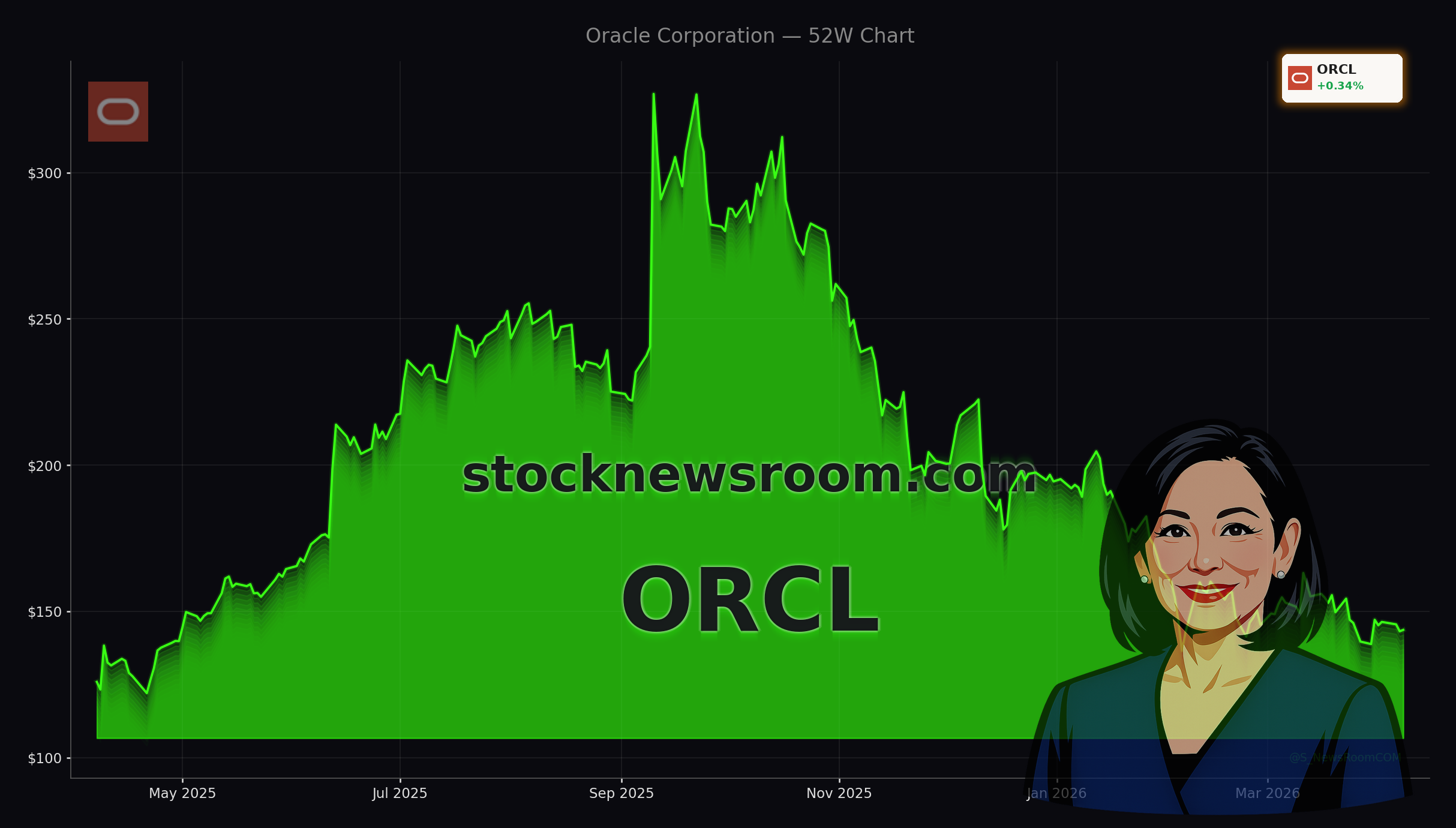
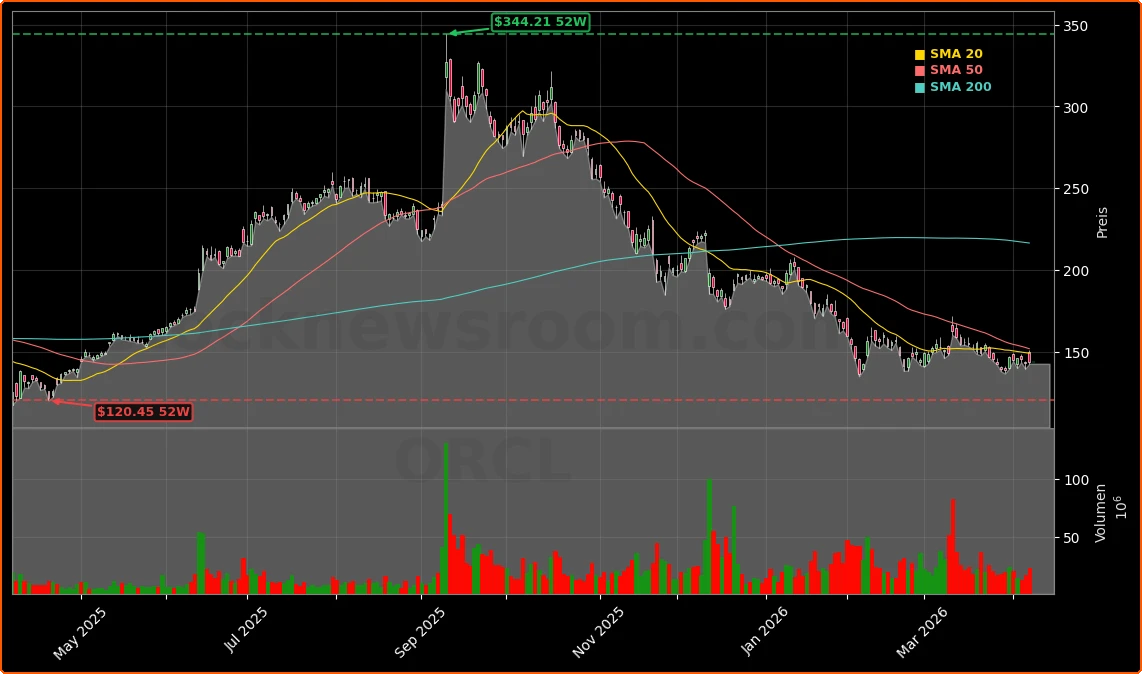
Oracle Corporation (ORCL) is trading modestly higher at around $143.66, edging above Wednesday’s close of $143.93 after a volatile week for Big Tech on Wall Street. The stock remains well below its 52‑week highs, but enthusiasm around generative AI and new cloud contracts has turned ORCL into a high‑beta AI infrastructure play alongside hyperscalers like Microsoft, Alphabet and Amazon. Every incremental dollar these players spend on AI infrastructure requires a proportional increase in memory bandwidth, GPUs and data center capacity, and Oracle wants a larger slice of that spend.
The Oracle AI Strategy centers on three pillars investors are watching closely: an expanding portfolio of AI agent–driven applications, mega cloud deals that could lock in years of compute demand from OpenAI and potentially Meta Platforms, and a capital-intensive build‑out of AI data centers financed with a mix of debt and partner equity. At the same time, rising leverage and sweeping layoffs mean the stock now carries a higher risk‑reward profile than legacy database peers and even some cloud rivals like Apple or NVIDIA in diversified portfolios.
What do Oracle’s new agentic apps deliver?
At its AI World Tour in New York, Oracle unveiled Fusion Agentic Applications for customer experience, finance and supply chain, and HR. These are outcome‑driven, reasoning‑based AI agents embedded directly into Oracle Fusion Cloud Applications, designed to move beyond simple copilots and actually execute workflows.
In customer experience (CX), the new Contract Compliance Workspace, Cross‑Sell Program Workspace, Marketing Command Center, Sales Command Center and Service Manager Workspace run on Oracle Cloud Infrastructure and large language models to analyze contracts, monitor pipeline risk and continuously execute next‑best actions in sales and service. For finance and supply chain, twelve additional workspaces and command centers – including Claims Settlement, Collectors, Cost Accounting Close, Logistics Execution and Warehouse Operations – aim to accelerate closes, improve working capital and reduce disruption across ERP and SCM processes.
For HR, eight agentic apps such as Career Advancement Command Center, Manager Concierge and Workforce Operations Command Center target labor‑intensive tasks like scheduling, talent reviews and employee support. All of these offerings are orchestrated through Oracle AI Agent Studio, which lets enterprises assemble and monitor AI agents with built‑in observability, ROI tracking and safety controls. This deep application integration is a core differentiator of the Oracle AI Strategy versus more tool‑centric approaches from competitors.
How do cloud mega deals and Michigan fit in?
Oracle’s infrastructure ambitions are just as aggressive as its application roadmap. The company is reported to have signed one of the largest cloud contracts ever with OpenAI, under which the ChatGPT maker could purchase roughly $300 billion of compute capacity over about five years. Oracle is also in talks with Meta Platforms for a multi‑year cloud deal estimated around $20 billion, underscoring social media’s scramble for additional AI compute beyond the capacity of in‑house data centers and existing deals with providers like NVIDIA‑heavy clouds run by Microsoft and Amazon.
To support these workloads, Oracle is planning a massive new data center campus in Michigan backed by about $16.3 billion in financing. Roughly 15% will come as equity – including around $2 billion from Blackstone – while Pacific Investment Management Co. (PIMCO) anchors approximately $14 billion in debt that will be issued via a special‑purpose vehicle. PIMCO is already exploring secondary sales of slices of that debt, reflecting strong institutional hunger for AI infrastructure exposure but also highlighting the sheer scale of leverage required to fund the Oracle AI Strategy.
Investors have rewarded these moves with periodic rallies, but some commentators continue to flag Oracle’s rising debt load as a structural risk, particularly if OpenAI or Meta were to change course or redirect spend to other providers.
Is Oracle’s database and compliance push enough?
On the core technology side, Oracle also introduced major enhancements to Oracle AI Database 26ai on Exadata, raising the bar on availability and security for mission‑critical and AI workloads. New Platinum‑tier availability promises disaster failover typically under 30 seconds for high‑throughput clusters without application changes, while Diamond‑tier architectures using Oracle GoldenGate and Globally Distributed AI Database target sub‑three‑second failover with zero data loss for ultra‑critical applications such as real‑time payments.
Security features including Deep Data Security, post‑quantum cryptography and Database Security Central are designed to safeguard agentic AI and retrieval‑augmented generation workflows across multicloud and on‑premises estates. At the same event, Oracle extended its Financial Crime and Compliance Management (FCCM) portfolio by embedding AI agent–driven investigation technology from Lucinity into its Oracle AI Investigator platform, aiming to boost productivity for banks combating money laundering and fraud.
These moves are meant to reinforce Oracle’s reputation as a mission‑critical data platform just as enterprises push more sensitive AI workloads into production. Recognition as a Leader in two 2026 Gartner Magic Quadrant reports for supply chain planning further supports the narrative that Oracle’s AI‑infused Fusion Cloud SCM can compete with specialized SaaS rivals for complex manufacturing and logistics customers.
How do layoffs and governance color the outlook?
Behind the growth story, Oracle is undergoing a painful restructuring. Over 700 workers in California – including more than 500 in Silicon Valley – are being laid off, with estimates that global cuts could eventually reach tens of thousands. At the same time, Oracle hired a new CFO, Hilary Maxson, on a $950,000 base salary plus a potential $2.5 million bonus, as the company prepares for what management has flagged as roughly $50 billion of AI data center capex this fiscal year alone.
This combination of heavy investment, workforce reduction and leadership change has divided Wall Street. Some analysts see outsized upside if Oracle becomes a top‑tier AI infrastructure and applications provider alongside Microsoft and Tesla‑scale innovators in other industries, while others warn that free cash flow could turn negative for years if the Oracle AI Strategy fails to convert contracted compute into durable, high‑margin revenue.
Related Coverage
For a deeper dive into how leadership and capital allocation intersect with this build‑out, “Oracle CFO Change Warning as $50B AI Capex Bet Builds” examines whether Oracle’s new finance chief can manage the risks of such an aggressive spending plan. Investors comparing Oracle’s trajectory with other AI bellwethers can also look at “Microsoft Forecast Boom: Are 2030 AI Price Targets Realistic?”, which discusses how long‑term AI growth assumptions are being embedded into mega‑cap tech valuations across the S&P 500 and NASDAQ.
In sum, the Oracle AI Strategy now spans agentic apps, hyperscale cloud contracts and multibillion‑dollar data centers, creating both unprecedented opportunity and execution risk for shareholders. For U.S. investors building AI‑heavy portfolios, Oracle offers leveraged exposure to enterprise AI adoption but demands close monitoring of debt, free cash flow and customer concentration. The next few quarters – especially updates on the Michigan campus, OpenAI and Meta workloads, and Fusion Cloud AI adoption – will be critical in determining whether Oracle’s bold AI offensive ultimately rewards patient, long‑term investors.