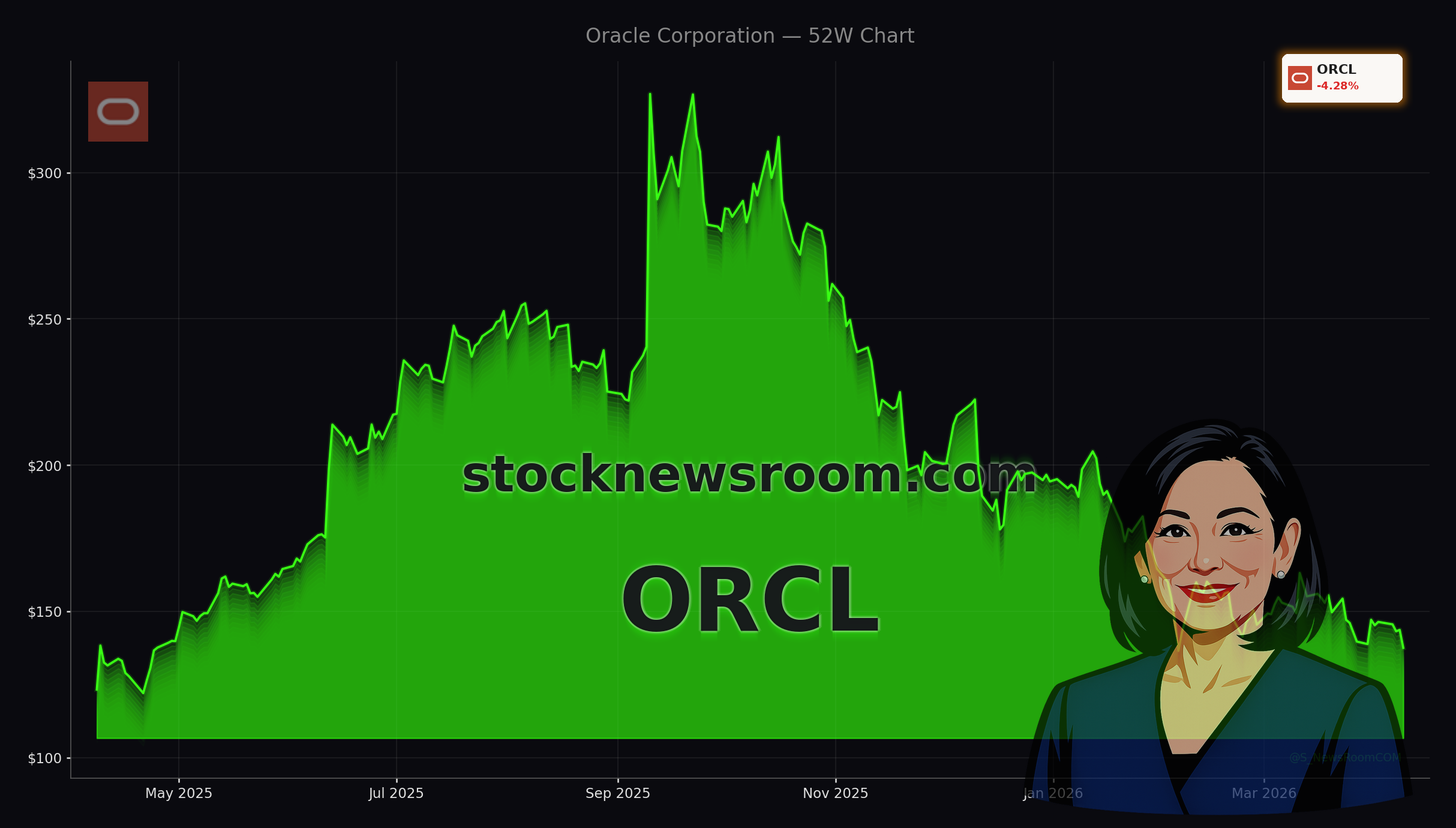

Is Oracle’s aggressive AI strategy a springboard for long-term growth or a risky bet now hitting the stock price?

How is Oracle AI Strategy reshaping growth?
The core of the Oracle AI Strategy is to monetize both sides of the AI boom: infrastructure and applications. On the infrastructure front, Oracle is reported to have struck one of the largest cloud deals ever with OpenAI, under which the ChatGPT maker is expected to buy roughly $300 billion of computing power over about five years. Oracle is also in talks with Meta Platforms about a separate multiyear cloud computing deal that could be worth around $20 billion, underscoring how hyperscalers are scrambling to secure GPU‑rich capacity alongside players like NVIDIA and Apple.
Every incremental dollar of AI infrastructure spending by Microsoft, Alphabet, Amazon, Meta and Oracle requires a proportional increase in memory bandwidth and data center power, creating a long runway for capital deployment. For Oracle, that means building out Oracle Cloud Infrastructure (OCI) as an AI‑optimized platform where large language models, retrieval‑augmented generation and AI agents can run at scale. That capital intensity amplifies both upside and balance‑sheet risk.
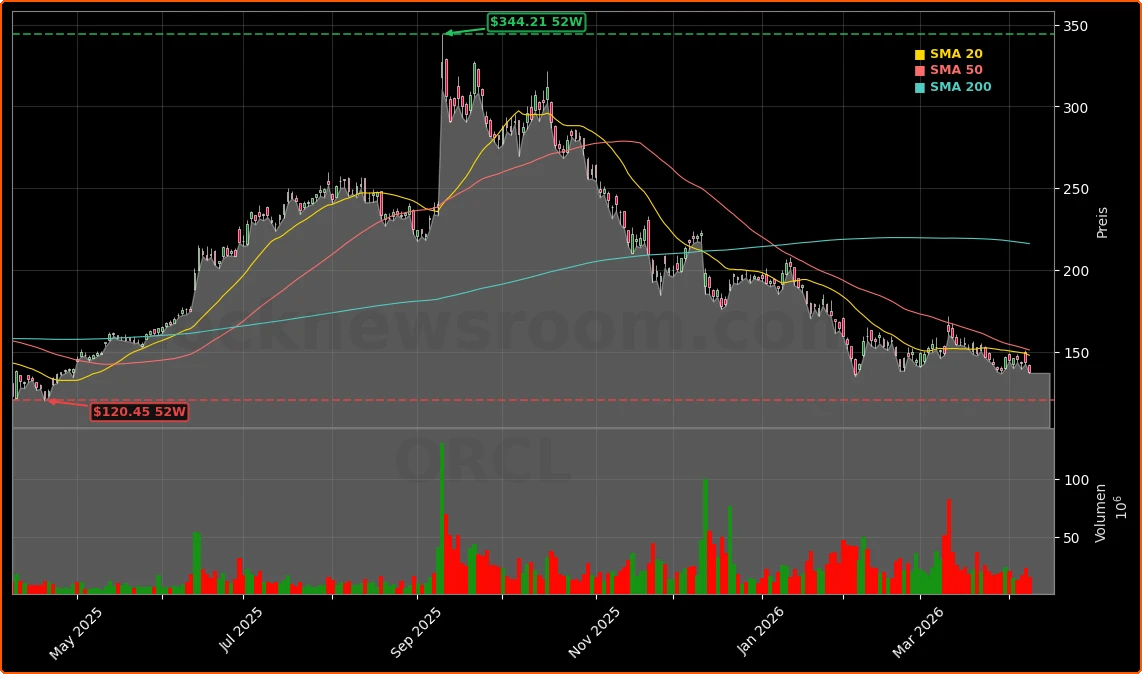
Shares of Oracle Corporation have recently underperformed peers, with the stock falling again on Thursday after prior weakness highlighted by MarketWatch, even as the broader S&P 500 trades near record territory. Barron’s previously flagged ORCL as a high‑beta AI play with significant upside if its AI cloud strategy works, but also elevated risk given exposure to OpenAI’s trajectory.
What role do Michigan and layoffs play?
To support the Oracle AI Strategy, the company is pushing ahead with a massive new data center complex in Michigan. Fixed‑income giant PIMCO is anchoring about $14 billion in debt financing for the project, in a transaction led by Bank of America, with Blackstone set to provide roughly $2 billion in equity. Parts of that debt package are already being syndicated into the market, highlighting the scale and leverage involved in Oracle’s infrastructure bet.
At the same time, Oracle is cutting costs aggressively. Regulatory filings in California show more than 700 jobs eliminated across Redwood City, Santa Clara and other locations, part of a wave that local media report could ultimately scale to tens of thousands of roles worldwide. Layoffs at Oracle, Meta and Qualcomm have fueled anxiety that AI investment will displace traditional software and support functions even as it creates new engineering and data center jobs.
From a Wall Street lens, these moves suggest Oracle is rebalancing its workforce from legacy on‑premise and support roles into cloud operations, AI engineering and go‑to‑market for Fusion cloud applications. The company also recruited the global CFO of Schneider Electric to take over its finance function, a sign that management wants tighter capital allocation and balance‑sheet discipline as AI capex ramps.
How do Fusion Agentic Applications fit Oracle AI Strategy?
On the software side, the Oracle AI Strategy is centered on what the company calls “Fusion Agentic Applications”—enterprise apps powered by coordinated teams of AI agents that can reason, decide and execute work, not just provide recommendations. Running on Oracle Cloud Infrastructure and built into Oracle Fusion Cloud Applications, these agents operate within existing security, policy and approval frameworks.
New Fusion Agentic Applications for customer experience (CX) include Contract Compliance Workspace, Cross‑Sell Program Workspace, and AI‑driven Sales and Marketing Command Centers designed to autonomously progress deals, optimize cross‑sell and run always‑on growth campaigns. For finance and supply chain, Oracle is rolling out 12 agentic workspaces across ERP and SCM, from Claims Settlement and Collectors Workspaces to Logistics Execution and Warehouse Operations Workspaces, all aiming to accelerate close cycles, cash collection and fulfillment.
In HR, eight new agentic applications—from Career Advancement Command Center to Workforce Operations Command Center—are meant to automate scheduling, talent reviews, learning and employee support. All of these are orchestrated via Oracle AI Agent Studio, which lets customers build and connect custom agents with observability, ROI measurement and safety controls. For investors, this shifts part of Oracle’s growth story from pure database and infrastructure toward higher‑margin, AI‑enhanced SaaS that competes more directly with Salesforce, ServiceNow and Workday.
What about databases and financial crime tools?
Underpinning the Oracle AI Strategy is Oracle AI Database 26ai, which introduces Platinum‑ and Diamond‑tier availability on Exadata systems. Gold‑tier deployments can be upgraded to Platinum with typical disaster failover under 30 seconds, while Diamond‑tier architectures combining Oracle RAC, Active Data Guard, Zero Data Loss Recovery and Oracle GoldenGate or Globally Distributed AI Database target sub‑three‑second failover and zero data loss for ultra‑critical workloads like real‑time payments and AI agents operating 24/7.
Security is another pillar. Oracle AI Database 26ai brings Deep Data Security to enforce fine‑grained authorization for AI agents across relational, vector and lakehouse data, plus post‑quantum cryptography and centralized on‑premises security management. These features are pitched to heavily regulated sectors such as banking, healthcare and public sector, where compliance and AI risk governance are central buying criteria.
Oracle is also extending AI into its Financial Crime and Compliance Management (FCCM) portfolio by embedding AI agent‑driven investigation capabilities acquired from Lucinity into the Oracle AI Investigator platform. AI agents will help investigators surface relevant context, automate repetitive steps and orchestrate case workflows for anti–money‑laundering and other compliance tasks, positioning Oracle against niche regtech vendors and giving banks a single, integrated stack.
Beyond AI, Oracle recently received double “Leader” recognition in Gartner’s 2026 Magic Quadrant reports for Discrete and Process Supply Chain Planning, validating the competitiveness of its Fusion Cloud SCM offering that now incorporates AI and advanced analytics to manage volatile demand and disruptions. Large enterprise wins, such as DXC Technology’s contract to migrate the UK’s Metropolitan Police to Oracle Fusion SaaS ERP, illustrate the cross‑sell potential when infrastructure, database and applications are bundled together.
Related Coverage
For a deeper dive into how massive data center bets could reshape the Oracle AI Strategy, readers can explore Oracle AI Strategy Boom With $16B Data Center Shock, which examines whether these projects can transform Oracle from a legacy vendor into a top‑tier AI infrastructure winner. Investors interested in sector peers can compare this with Meta’s own infrastructure offensive and model roadmap detailed in Meta AI Strategy +4.0%: Muse Spark and $21B CoreWeave Boom, highlighting how another mega‑cap is balancing AI spending, partnerships and shareholder expectations.
With agentic applications that can reason, decide, and act against defined objectives, finance and supply chain teams can move from passive productivity to systems that proactively carry work forward.— Steve Miranda, EVP Applications Development, Oracle
The Oracle AI Strategy now spans mega‑scale cloud capacity deals, heavily leveraged data center expansion and a broad suite of agentic applications and databases aimed at automating mission‑critical enterprise workflows. For US and global investors, ORCL has become a high‑risk, high‑reward AI infrastructure and software hybrid rather than a mature, low‑growth database incumbent. The next catalysts will likely come from confirmed OpenAI and Meta workloads on OCI, adoption curves for Fusion Agentic Applications and how effectively Oracle manages debt and layoffs as AI capex accelerates.