
Can Oracle’s massive AI cloud bets and $50 billion capex plan turn today’s earnings surge into durable growth—or just higher risk?
How did Oracle Earnings beat expectations?
Oracle Corporation posted adjusted earnings per share of $1.79 for its fiscal third quarter, ahead of the $1.70 consensus on Wall Street. Revenue came in at $17.19 billion, beating expectations of roughly $16.9 billion and marking a robust 22% year‑over‑year increase. Net income rose to $3.72 billion, or $1.27 per share, up from $2.94 billion, or $1.02 per share, a year earlier, helped by slightly better‑than‑expected operating margins.
Cloud remains the clear growth engine. Total cloud revenue, including infrastructure and SaaS, climbed 44% to $8.9 billion, outpacing analyst estimates. The standout was Oracle Cloud Infrastructure (OCI): infrastructure revenue surged 84% year over year to $4.9 billion, beating the roughly $4.7 billion consensus and accelerating from 68% growth in the prior quarter. Management highlighted wins with large enterprise and AI customers, positioning OCI as a core supplier of compute capacity for training and running advanced AI models.
This strong top‑line performance makes the latest Oracle Earnings report the first quarter in over 15 years where both organic total revenue and organic non‑GAAP EPS grew 20% or more, underscoring how AI demand is reshaping the business profile.
What do the new Oracle Earnings targets signal?
For the current fiscal fourth quarter, Oracle guided to adjusted EPS of $1.96 to $2.00, modestly above the $1.94–$1.95 range embedded in analyst models. Management expects revenue growth of 19% to 21%, broadly in line with consensus near 20%. More importantly for long‑term investors, Oracle raised its fiscal 2027 revenue outlook to $90 billion, about $3 billion above prior Wall Street estimates and $1 billion above its own previous target.
The company also reiterated its plan to spend about $50 billion in capital expenditures in fiscal 2026 to expand its global AI data center footprint. It has already secured more than 10 gigawatts of power and data capacity to come online over the next three years, with over 90% of that capacity financed alongside partners or prepaid by customers. Management stressed it does not expect to take on additional debt this year to support newly signed mega AI contracts.
Oracle’s remaining performance obligations (RPO) – the backlog of contracted but not yet recognized revenue – climbed to $553 billion, up from $523 billion in the prior quarter and more than quadruple year‑over‑year. Much of the sequential increase stems from very large AI cloud deals with customers such as OpenAI and major internet platforms, underscoring why many on Wall Street now view Oracle as an AI infrastructure pure‑play rather than just a software company.
How risky is Oracle’s AI and debt strategy?
Despite the upbeat Oracle Earnings print, investors remain focused on the balance sheet and free‑cash‑flow drag from the AI build‑out. Over the last 12 months, Oracle generated roughly $23.5 billion in operating cash flow but reported about $13.2 billion in negative free cash flow, as data center investments and GPU purchases outpaced incoming cash. The company still carries a sizable debt load used to fund prior acquisitions and its current capex cycle, making it riskier than larger hyperscale rivals like Apple, NVIDIA or Microsoft in the eyes of many portfolio managers.
Management argues the risk is mitigated by the structure of its AI contracts: in many cases, customers either prepay for capacity so Oracle can purchase GPUs, or they buy accelerators and supply them to Oracle to host. That approach should limit the need for incremental borrowing even as spending remains elevated. At the same time, Oracle is planning thousands of layoffs and reorganizing product development teams around AI‑assisted coding to lower its long‑term cost base and protect margins.
On the competitive front, Oracle is positioning OCI as a multi‑chip, multi‑cloud alternative. Executives said the company’s infrastructure now supports not only leading GPUs from NVIDIA and AMD but also specialized AI processors from Cerebras, aiming to attract next‑generation AI workloads and differentiate its offering from hyperscalers such as Tesla’s in‑house AI clusters or cloud portfolios at Amazon and Google Cloud.
What do Oracle Earnings mean for Wall Street and portfolios?
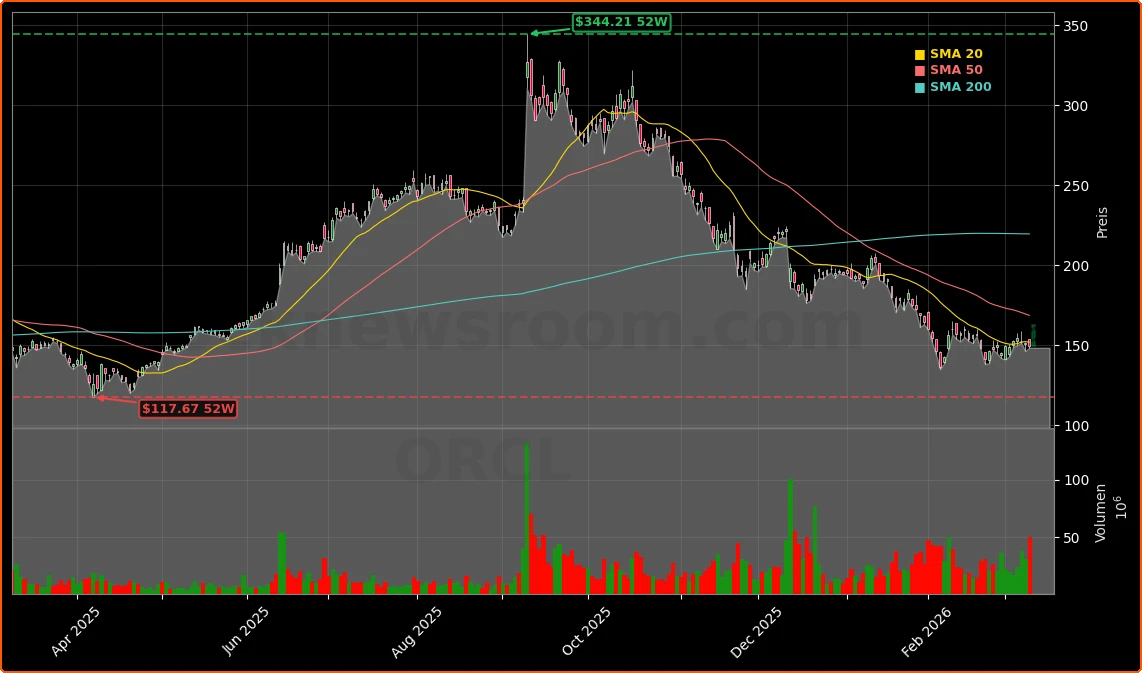
For U.S. investors tracking the S&P 500 and NASDAQ, the latest Oracle Earnings report helps ease fears that aggressive AI spending might not be matched by demand. The strong beat and raised guidance pushed ORCL sharply higher in late trading and provided a sentiment boost to AI‑linked names across Asia and U.S. tech indices. With the stock now around $162 after hours versus a 52‑week high well above current levels, Oracle is no longer priced for disaster but still trades at roughly the mid‑20s to high‑20s multiple on forward earnings, a discount to faster‑growing cloud peers.
Several research desks have pointed to an attractive risk‑reward setup. Some analysts argue that at current valuation, the market is effectively assigning limited value to Oracle’s long‑dated AI backlog while fully pricing in debt and execution risks. Others remain cautious, emphasizing the uncertainty around future capex beyond 2026, potential margin compression as depreciation ramps, and the company’s heavy exposure to a handful of large AI customers, including OpenAI and big internet platforms.
For diversified U.S. portfolios, Oracle now screens as a high‑beta AI infrastructure play rather than a classic defensive software holding. The stock could benefit disproportionately if the AI investment cycle remains strong and if management executes on its plan to convert RPO into high‑margin revenue – but it also carries above‑average downside if AI spending slows or financing conditions tighten.
We think we are the disruptor, not the disrupted, because we’re embedding AI directly into our applications and automating entire industry ecosystems.
— Larry Ellison, Oracle co-founder and executive chairman
Conclusion
In summary, the latest Oracle Earnings show a company executing well against enormous AI demand while taking on equally enormous investment commitments. For long‑term investors willing to tolerate volatility, Oracle offers leveraged exposure to the build‑out of global AI compute capacity, and the next few quarters will be critical in proving that its $50 billion capex bet can translate into sustainable free cash flow and durable shareholder returns.
Further Reading
- Oracle Corporation (ORCL) on Yahoo Finance (Yahoo Finance)
- Oracle’s cloud revenue surges 44%, easing pressure on its stock (SiliconANGLE)
- Oracle Posts Strong Cloud Revenue Growth Following AI Bookings (Bloomberg)
- Oracle’s Backlog Now Sits at $553 Billion. Is the Stock a Buy? (The Motley Fool)