
Are blockbuster Oracle Earnings and massive AI cloud bets the start of a new growth era or a balance-sheet stress test?
How are Oracle Earnings reshaping sentiment?
Oracle Corporation has delivered one of the more surprising tech earnings stories in recent quarters. In its most recent reported quarter, revenue climbed about 22% year over year to roughly $17.2 billion, while net income rose to $3.7 billion from $2.9 billion a year earlier. Earnings per share came in at $1.79, ahead of Wall Street expectations near $1.70 and well above the $1.47 posted in the comparable period a year prior. That beat on both the top and bottom line helped trigger a sharp relief rally in the stock after a deep sell‑off.
Cloud has become the core growth engine behind Oracle Earnings. Total cloud revenue reached about $8.9 billion, above consensus estimates, with cloud infrastructure sales nearly doubling to around $4.9 billion, an 84% year‑over‑year increase. Management simultaneously lifted its fiscal 2027 revenue target to $90 billion, underscoring how central AI‑driven workloads and enterprise cloud migrations have become to the long‑term thesis.
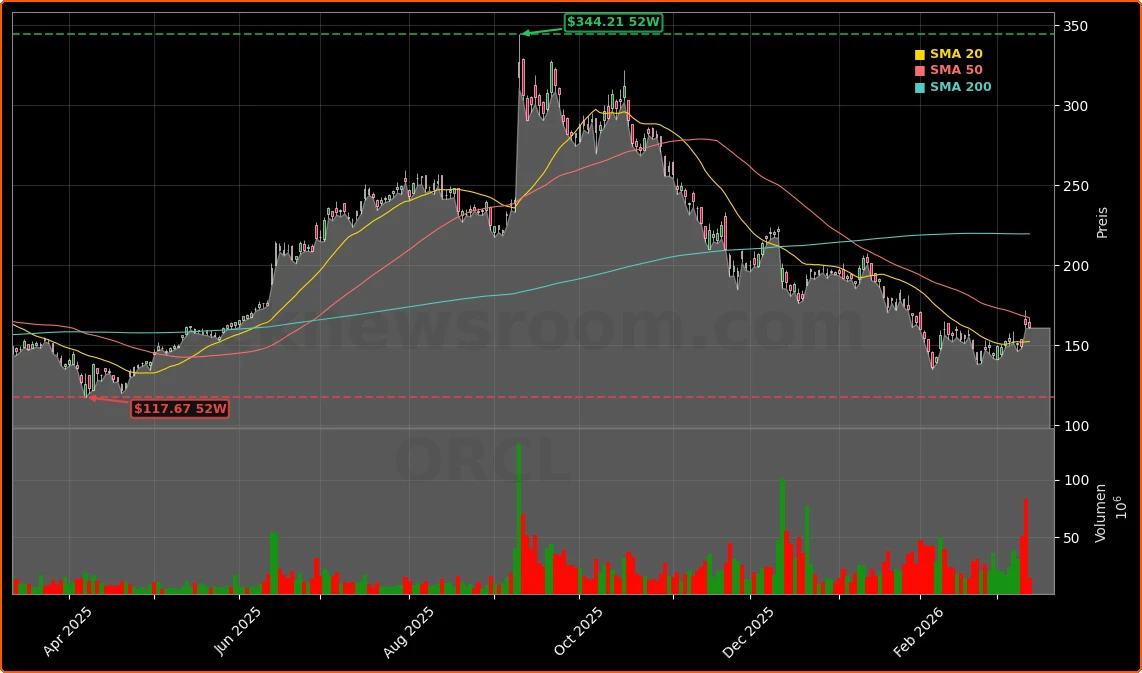
On the market side, Oracle (ORCL) was recently trading around $161.62, modestly below the prior close of $160.15 after intraday swings, leaving the stock well off last year’s high but stabilizing as investors reassess growth, valuation and balance‑sheet risk.
Can Oracle fund its AI data center land grab?
The biggest strategic question for U.S. investors is whether Oracle can finance an aggressive global AI infrastructure expansion without stretching its balance sheet too far. The company has committed to building data centers on a massive scale, targeting AI compute for large language models and enterprise workloads. This includes sizable multi‑year capacity deals that effectively position Oracle Cloud Infrastructure (OCI) as a key backbone for generative AI projects.
Management has tried to calm fears about overreach by emphasizing that Oracle can expand capacity without resorting to excessive new financing and that free cash flow should remain positive. A crucial element here is the company’s huge remaining performance obligation (RPO), which has reportedly surged to around $553 billion, roughly four times the level of a year earlier. Many customers are prepaying for long‑term cloud capacity, which both de‑risks some growth capex and provides more visibility into future cash flows.
That customer prepayment model helps distinguish OCI from more traditional software plays and supports the bullish case that Oracle Earnings will increasingly be driven by recurring infrastructure revenue rather than one‑off license deals.
How does Oracle stack up in the AI race?
For Wall Street, Oracle is now being analyzed less as a legacy database vendor and more as an AI infrastructure contender alongside NVIDIA, Microsoft, Amazon, and Google. OCI is tightly integrated with cutting‑edge GPU suppliers such as NVIDIA and AMD, allowing Oracle to spin up specialized clusters for training and running large AI models. The company has also landed major, long‑duration cloud contracts running into the hundreds of billions of dollars, effectively locking in demand for compute capacity over a multi‑year horizon.
Enterprise AI adoption remains in early stages, with many customers still in proof‑of‑concept or pilot mode. However, Oracle is leaning hard into its role as a “system of record” for mission‑critical data and layering AI tools across its Fusion Cloud applications. Recent wins like the City of Miami’s selection of Oracle Permitting and Licensing and Oracle Fusion Cloud for finance and HR show how governments and enterprises are starting to embrace AI‑enabled workflows built on Oracle’s stack.
At the same time, geopolitical risk has crept into the narrative. Iran’s Revolutionary Guard has listed major U.S. tech names — including Oracle, Apple, Microsoft, Alphabet and Palantir — as potential cyber or physical targets amid rising Middle East tensions. While there is no direct operational impact yet, the headline risk adds another variable for global tech holdings across the NASDAQ and S&P 500.
What are analysts and investors watching next?
Analyst sentiment after the latest Oracle Earnings has skewed constructive. TD Cowen recently reiterated a Buy rating on Oracle with a price target of $250, implying substantial upside from current levels, and the broader Street consensus leans toward Strong Buy. Bullish commentators highlight the combination of 20%‑plus revenue growth, expanding margins as cloud scales, and a massive contracted backlog.
However, there are caveats. Multiple class‑action securities suits have been filed in U.S. courts, focusing on disclosures around AI spending and growth expectations. While these cases are still in early stages and common in megacap tech, they remain an overhang for some institutional investors. In addition, Oracle’s stock has been extremely volatile, at one point falling more than 50% from a high in the mid‑$300s to the $140s before recovering toward the $160 area.
Against this backdrop, valuation looks more reasonable than many high‑profile AI names. On recent numbers, Oracle trades near a forward P/E around the low‑20s, below some faster‑growing AI software peers yet backed by a larger backlog and significant infrastructure exposure. For investors already concentrated in mega‑cap AI names like Tesla or Apple, Oracle offers a different way to play the theme via data center and enterprise software economics rather than pure device or model bets.
Looking ahead, the key metrics to watch in upcoming Oracle Earnings reports will be cloud infrastructure growth, free cash flow after capex, and updates on the 2027 revenue trajectory. If OCI can sustain high double‑digit growth while capex gradually normalizes as a percentage of sales, the multiple could rerate higher. Conversely, any sign that AI demand is slowing or that financing costs are rising faster than expected would likely pressure the stock again.
Conclusion
For now, Oracle sits at the intersection of software, cloud, and AI infrastructure, with its latest Oracle Earnings reinforcing that this pivot is gaining traction. The next few quarters will determine whether the company can convert its enormous backlog and data center commitments into durable cash generation, but for long‑term investors seeking diversified AI exposure on Wall Street, the evolving Oracle story is becoming increasingly hard to ignore.
Further Reading
- Oracle Corporation (ORCL) Quote on Yahoo Finance (Yahoo Finance)
- Oracle Q3 Earnings Review: The Rally May Be Just Beginning (Seeking Alpha)
- Analysts conflicted on Fortinet, Septerna and Oracle (The Globe and Mail)
- Palantir, Nvidia, Oracle, Microsoft, Alphabet, IBM listed as Iran targets (Yahoo)
- City of Miami modernizes services and AI innovation with Oracle (PR Newswire)