Can an eye-watering $300 billion AI cloud deal really turn Oracle into a $1 trillion giant—or break its balance sheet first?

Can Oracle’s AI bet really justify $400?
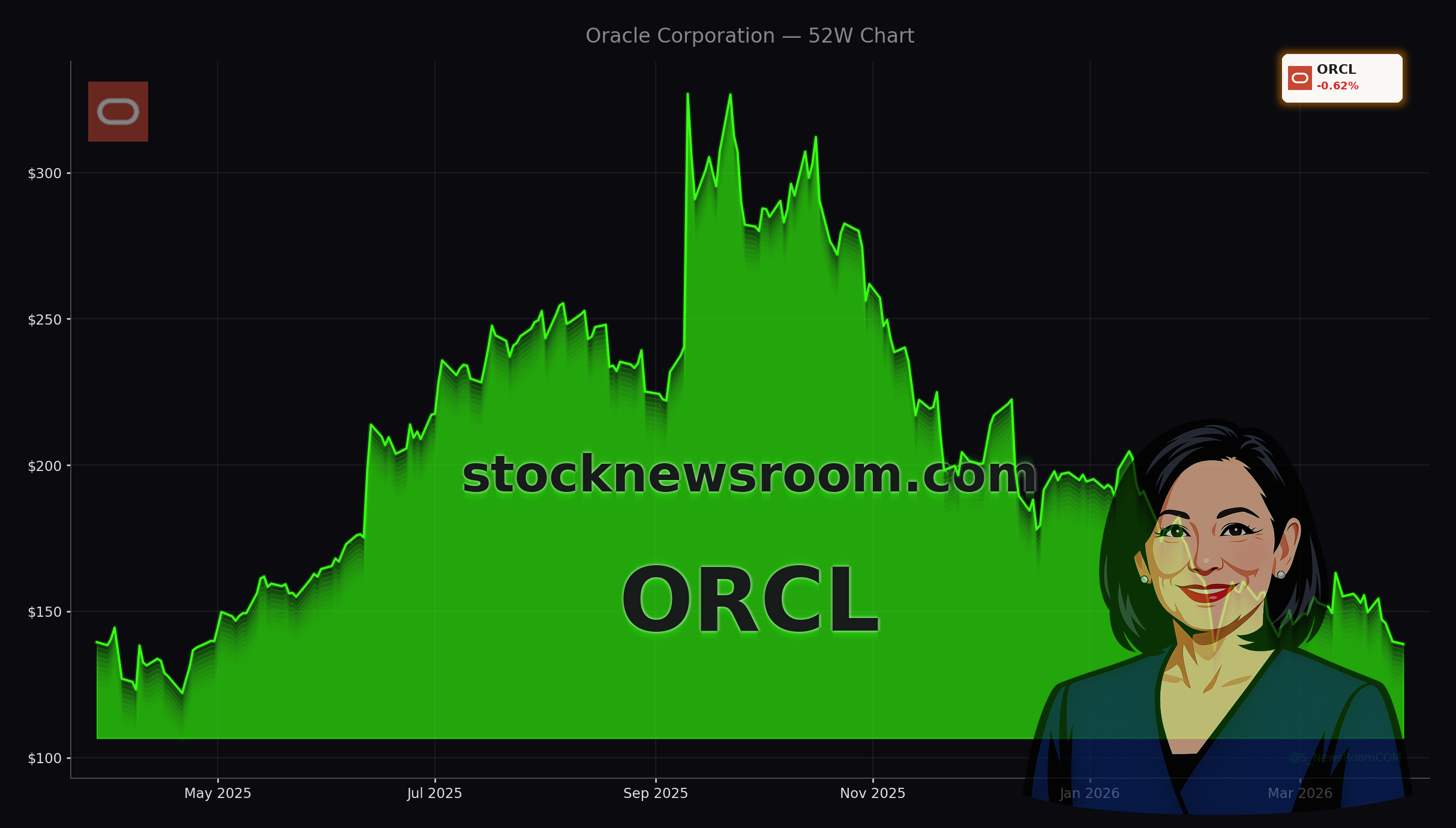
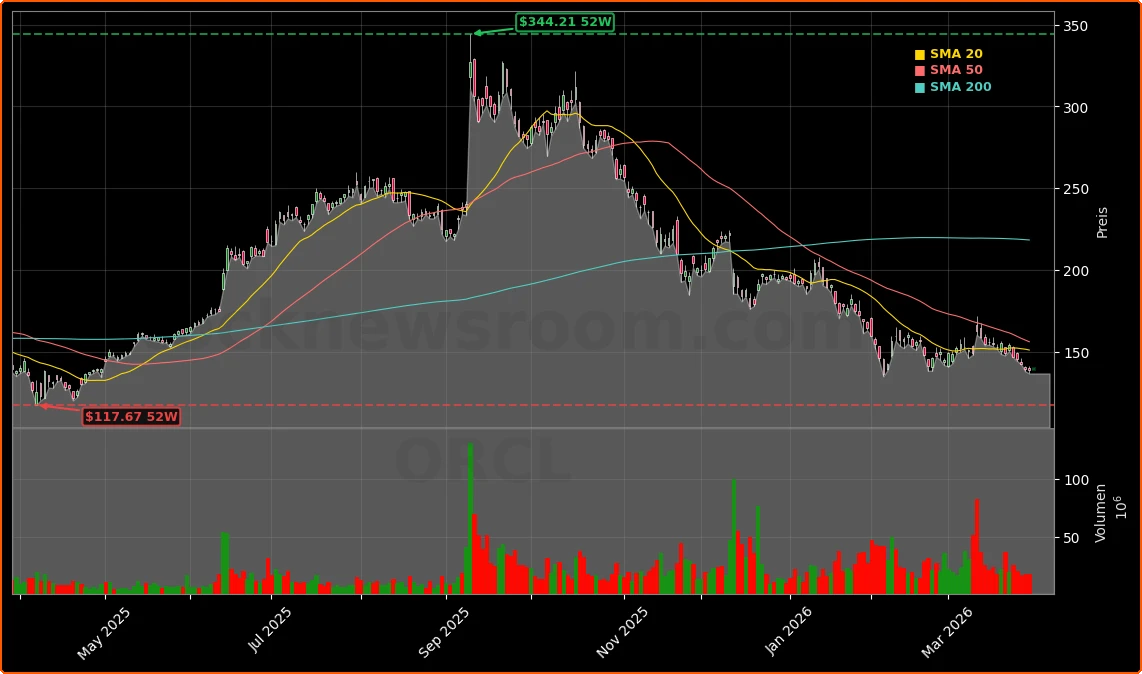
Oracle Corporation has become one of Wall Street’s most polarizing AI infrastructure plays. After a blistering AI-fueled rally in 2025, the stock was roughly cut in half over six months before stabilizing near $140. Yet Guggenheim analyst John DiFucci has pinned a bold $400 price target on Oracle, implying nearly 170% upside and a path to a $1 trillion market cap alongside NVIDIA, Apple and Meta Platforms. That aggressive Oracle Forecast rests on a massive AI data-center buildout, anchored by a multiyear agreement with OpenAI reportedly worth about $300 billion in contracted cloud capacity.
Oracle’s management has pointed to a swelling backlog of remaining performance obligations (RPO), which recently hit approximately $553 billion, as evidence that contracted AI and cloud demand far exceeds current capacity. Internal projections for Oracle Cloud Infrastructure (OCI) revenue are similarly ambitious, with targets of $18 billion in fiscal 2026, $32 billion in 2027, $73 billion in 2028, $114 billion in 2029, and $144 billion in 2030. If even a majority of this Oracle Forecast is realized, OCI would transform Oracle from a legacy enterprise software vendor into a central backbone of global AI workloads.
Why the 300-billion OpenAI deal alarms credit markets
The same AI narrative that underpins the bullish Oracle Forecast is driving a spike in perceived credit risk. Prices for Oracle’s credit default swaps have climbed to fresh highs, signaling that bond investors are demanding more protection against a potential default. The key concern: Oracle has taken on as much as $50 billion in new debt to finance a rapid expansion of energy-hungry, capital-intensive AI data centers, even as free cash flow has turned negative in recent quarters.
Much of Oracle’s eye-popping RPO is concentrated in that single OpenAI contract, estimated at $300 billion out of $1.4 trillion in total eight-year data-center commitments across the industry. That concentration risk raises an uncomfortable question for bondholders and equity investors alike: can OpenAI generate enough cash, or raise enough external capital, to honor such enormous infrastructure obligations if AI adoption or monetization slows? Recent reports of OpenAI reaching a $25 billion annualized revenue run rate, completing a $120 billion private funding round, and preparing a potential IPO provide some comfort, but do not fully eliminate the execution risk embedded in the Oracle Forecast.
Oracle Forecast vs. layoffs, lawsuits and cost pressure
Short-term headlines are also complicating the picture. Oracle has begun laying off employees as it looks to curb costs during the AI buildout, a sign that management is feeling pressure to preserve margins while simultaneously pouring billions into data centers. At the same time, multiple securities-fraud class actions have been filed, alleging the company overstated or misrepresented its AI data-center capabilities and cloud opportunities during the 2025 run-up. Bernstein Liebhard LLP, among other law firms, is soliciting shareholders who bought stock between June and December 2025 to join suits accusing Oracle of misleading investors.
These legal overhangs arrive just as some institutional investors, such as Foster & Motley Inc., have trimmed positions despite Oracle beating recent quarterly EPS estimates and maintaining a $0.50 quarterly dividend. For U.S. investors benchmarked to the S&P 500 or Nasdaq, this friction between bullish AI growth narratives and rising governance and legal risks is central to interpreting any bullish Oracle Forecast.
How does Oracle stack up against U.S. AI peers?
On Wall Street, Oracle now sits in a middle lane between ultra-high-growth AI winners and mature software cash machines. NVIDIA remains the purest hardware beneficiary of AI demand, while the likes of Tesla are trying to monetize AI through autonomous driving and robotics. Oracle’s angle is primarily infrastructure and data platforms: OCI, database technology, and mission-critical cloud applications. Recent product launches underscore that strategy. Oracle and NetSuite just rolled out an AI-powered restaurant operations platform that unifies inventory, procurement, scheduling, and cash management into one SaaS suite. In Washington, Oracle is pushing deeper into the federal space, unveiling Oracle AI Data Platform for U.S. government agencies and a Defense Industrial Base Isolated Cloud for secret and top-secret work, directly targeting secure workloads that hyperscalers like Microsoft and Amazon also covet.
These moves reinforce the logic behind the optimistic Oracle Forecast: a higher mix of recurring, high-value AI and cloud contracts across commercial, hospitality, and federal markets could meaningfully expand Oracle’s margin profile over time. The company was also recently named a Leader for the ninth straight year in Gartner’s Magic Quadrant for Sales Force Automation platforms, supporting the case that its application stack can cross-sell into the expanding cloud base. However, skeptics point out that Oracle’s AI data-center margins have been reported as relatively thin so far, limiting immediate earnings leverage even if top-line demand is robust.
Related Coverage
For a deeper dive into the recent share-price volatility, another analysis on StockNewsroom titled “Oracle Forecast -4.1% Plunge: Can Its AI Cloud Boom Last?” explores whether the latest guidance is overly dependent on a single AI cloud narrative just as the stock suffers another sharp pullback. Investors comparing AI infrastructure plays across the supply chain may also want to read “ASML EUV Technology -3.7% Plunge as AI Demand Soars”, which looks at how ASML’s chipmaking tools fit into the broader AI boom and what recent stock weakness means for semiconductor exposure in diversified portfolios.
In the end, the Oracle Forecast of a potential $400 share price rests on a high-wire act: scaling AI data centers fast enough to satisfy enormous contracted demand, while keeping debt, legal risk, and margin pressure under control. For U.S. investors, Oracle now represents a higher-risk, higher-reward AI infrastructure play compared with more diversified mega-cap tech, and the next few quarters of cloud growth and cash-flow trends will determine whether it can credibly march toward the $1 trillion club.