
Will Oracle’s billion-dollar AI initiative become the next big tech boom – or a risky debt experiment?
Oracle Forecast: How Risky is the AI Initiative?
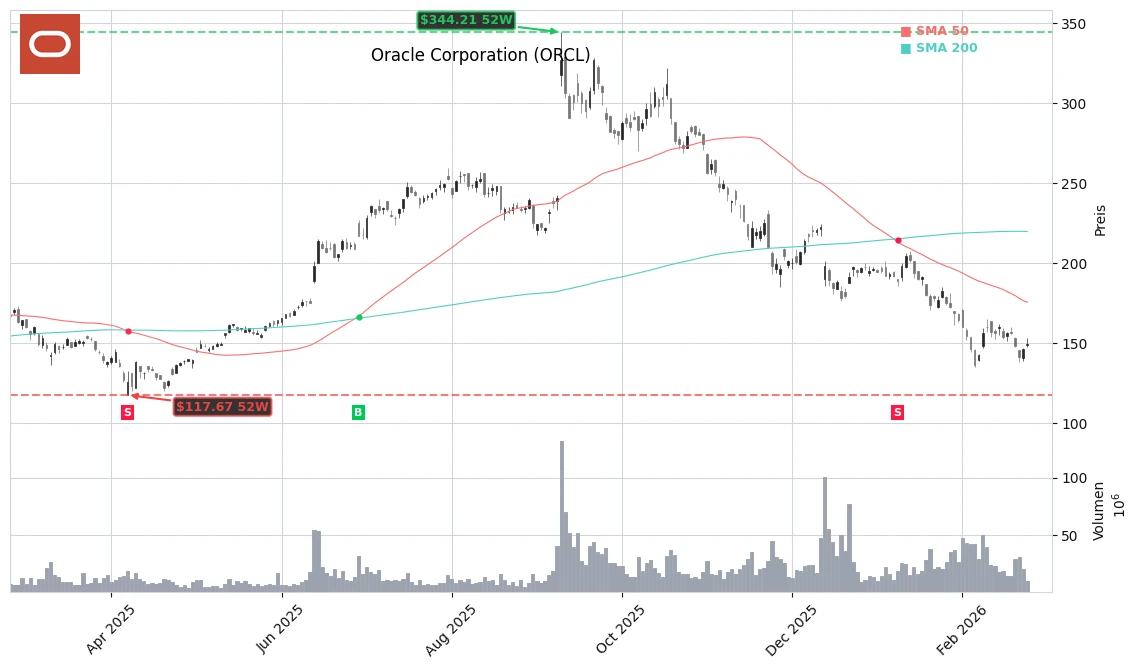
Few technology stocks currently reflect the extremes of growth fantasy and risk as strongly as Oracle Corporation. The software and cloud company has transformed from a “legacy” provider to a symbol of aggressively financed AI investments. The stock is currently trading at $149.73, up 2.46% from the previous day. At the same time, Oracle is seen in the credit market as a kind of “canary in the coal mine” for default risk in the AI sector: Rising prices for credit default swaps indicate growing skepticism among bond investors.
The core business of database and data management software remains high-margin and generates solid free cash flow streams. However, this cash flow is insufficient to finance the massive expansion of Oracle Cloud Infrastructure (OCI) and the underlying data centers solely through internal resources. Therefore, the Oracle forecast increasingly relies on external capital to drive the expansion of AI infrastructure in the race against Amazon, Microsoft, and Alphabet.
Oracle: Can OCI Really Catch Up to the Top Clouds?
Strategically, Oracle Corporation aims to expand the “Big Three” of cloud – Amazon Web Services, Microsoft Azure, and Google Cloud – into a “Big Four” lineup. OCI is intended to establish itself as the preferred platform for high-performance computing and AI applications. At an investor day, Oracle presented an extremely ambitious roadmap: From approximately $18 billion in OCI revenue in fiscal year 2026, the figure is expected to rise to $144 billion by 2030.
For comparison: Amazon Web Services generated $128.7 billion in revenue in 2025. The Oracle forecast implies that OCI should reach a volume that exceeds the current market leader within a few years. If OCI comes close to these targets and achieves margins at the level of AWS (around 35% operating), significant stock gains are conceivable. This “millionaire story” drives many growth-oriented investors, despite the considerable uncertainties regarding implementation, financing, and competition.
Oracle: What Lies Behind the Mega RPO?
A central argument from the bulls is the massive order backlog of Oracle Corporation. The remaining performance obligations (RPO) stood at around $523 billion at the end of the second quarter of fiscal year 2026. Notably, about $300 billion of this backlog comes from contracts with OpenAI. This mega RPO fuels hopes that the data centers being built now will generate significant revenue and cash flow in the coming years.
However, in this story, it is not only the sheer size of the RPO that matters, but also the speed at which Oracle ramps up capacity and actually invoices the contracted services. Investors should closely monitor the implementation of projects, the development of free cash flow, and the ratio of AI profits to interest costs in the upcoming quarterly reports. Because until the revenues from the OpenAI contracts become fully visible, Oracle must continue to tap the capital market with new bonds and possibly equity issuances.
Oracle: How Are Analysts Responding to the Oracle Forecast?
While the credit market is pricing in the risks of the debt strategy more heavily, some stock analysts are now seeing opportunities again. Oppenheimer recently upgraded Oracle Corporation from “Perform” to “Outperform” and set a price target of $185. The analysts argue that while the call may seem premature, as it takes time for the financial success of the capital-intensive business model to be reflected in the numbers, the risk-reward ratio has become more attractive following the significant valuation decline.
According to Oppenheimer, the stock’s valuation multiples have fallen by more than half since the peak in September. For risk-conscious investors, this opens up leverage on the Oracle forecast: If the company achieves its cloud goals at least partially and keeps its debt under control, there would be significant upside potential. Conversely, those seeking a more conservative AI bet are likely to turn to Microsoft or Amazon, which are funded much more robustly with high cash reserves.
Because the company is so heavily indebted, investors cannot simply wait and hope that the bet pays off.
— Independent market observer
Bottom Line
The Oracle forecast combines enormous AI and cloud opportunities with a noticeably increasing financing risk. For aggressive investors, Oracle Corporation stock can be an exciting leverage play on the expansion of OCI and the gigantic RPO backlog, provided that interest burdens and debt remain manageable. The key will be whether the upcoming quarterly numbers confirm a credible path to profitable scaling of the AI infrastructure, thereby reinforcing confidence in the Oracle forecast.
Related Sources
- Oracle bets big on AI cloud with massive capex push (Bloomberg)
- Oracle’s growing debt load worries credit markets (Reuters)
- Oppenheimer upgrades Oracle to Outperform with $185 target (MarketWatch)
- Oracle Corporation on Yahoo Finance (Yahoo Finance)