
Can the expanding Palantir AI Partnership network with Nvidia, defense players, and industrial giants justify the stock’s new AI-infrastructure narrative?
How big is the Palantir AI Partnership with Nvidia?
The most closely watched Palantir AI Partnership right now is the new alliance with Nvidia (NVDA). The companies are rolling out turnkey AI data center solutions aimed at sovereign AI customers, bundling Nvidia’s latest Blackwell Ultra GPUs and Spectrum‑X networking with Palantir’s AI OS Reference Architecture, Foundry, Apollo, and AIP. The goal is to give governments and large enterprises a ready‑to‑deploy, production‑grade AI stack for training and inference on sensitive data.
For Nvidia, the tie‑up strengthens its push into a sovereign AI market that some estimates see reaching roughly $600 billion by 2030. For Palantir, the partnership extends its long‑standing role as an AI operating layer for national security and regulated industries into full‑stack infrastructure. U.S. investors increasingly see this as a way for Palantir to move from being viewed as a niche government software vendor to a core AI infrastructure play that can sit alongside established NASDAQ leaders like Apple and other mega‑cap tech names.
Palantir’s Q4 2025 numbers show why the market is paying attention. Revenue jumped 70% year over year to about $1.4 billion, with U.S. commercial revenue up 137%. Adjusted EPS rose 79% to $0.25, highlighting the operating leverage in the model as AI deployments scale.
What do defense partnerships mean for growth?
Beyond data centers, the Palantir AI Partnership pipeline in defense is expanding quickly. Palantir has teamed up with Andas and WorldView to build a next‑generation multi‑domain intelligence platform that integrates autonomous drones, ground robots, and high‑altitude imaging with Palantir’s software stack. These Andas drones effectively become extra sensor “eyes” feeding Palantir’s platforms, designed to enhance intelligence, surveillance, and reconnaissance (ISR) missions.
The full integration of the Andas and WorldView technologies is expected by late 2026, but the strategic impact is immediate. The combined offering is being positioned to help win larger, multi‑year defense and border security programs, a segment where Palantir has historically executed well. Given heightened geopolitical tensions and rising defense budgets, many U.S. traders on the NASDAQ and options desks are treating Palantir as a hybrid AI‑plus‑defense stock rather than a pure software name.
Palantir’s leadership emphasizes that these systems are reshaping how modern wars are fought by fusing real‑time sensor data with AI decision support. That positioning could underpin more resilient revenue during periods when broader tech sentiment weakens, and may help explain why PLTR is one of the few AI names holding gains on days when the S&P 500 and NASDAQ trade lower.
How do GE and Centrus expand the Palantir AI Partnership story?
The Palantir AI Partnership strategy is also extending into industrial and energy infrastructure. GE Aerospace has broadened its work with Palantir to use advanced AI for U.S. Air Force fleet readiness and GE’s own production system. The joint effort aims to predict failures, optimize maintenance, and streamline supply chains for both military aircraft and new engine manufacturing. For GE, that supports efforts to work through an engine backlog; for Palantir, it’s a case study in applying its AI stack to complex, high‑value industrial operations.
In nuclear energy, Centrus Energy is deploying Palantir’s Foundry and AIP platforms to expand U.S. uranium enrichment capacity. Early projects have already identified close to $300 million in potential cost savings, while also helping reduce America’s reliance on foreign enrichment providers. This reinforces the narrative that Palantir’s AI is not just about dashboards but about real operational impact in critical infrastructure and energy policy.
Together, these industrial and energy deals broaden Palantir’s addressable market beyond government and traditional enterprise IT, giving Wall Street more diversified growth drivers to model. They also position the company squarely inside U.S. national‑interest domains such as aviation readiness and nuclear security.
How is Wall Street reacting to Palantir’s AI pivot?
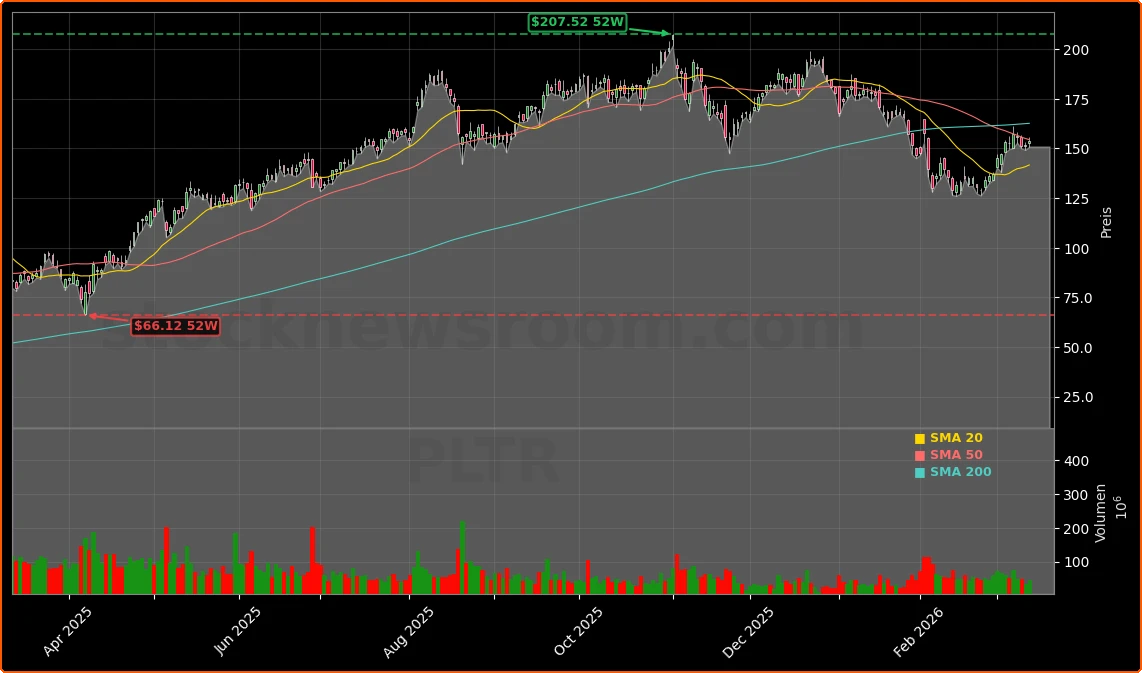
On the valuation side, PLTR is not cheap on headline metrics, trading at a lofty forward multiple relative to near‑term earnings. However, some analysts point out that on a price/earnings‑to‑growth (PEG) basis, the multiple screens closer to 1, which is often interpreted as fair or even undervalued for a company with accelerating growth.
Truist Securities recently reiterated a Buy rating on Palantir and maintained a $223 12‑month price target, implying meaningful upside from current levels near $153.56. The firm’s stance reflects growing confidence that the Palantir AI Partnership ecosystem across sovereign AI, defense, aerospace, and nuclear can sustain above‑market growth even if broader NASDAQ momentum cools.
Not everyone on Wall Street is convinced. High‑profile investor Michael Burry has labeled Palantir a fraud and remains vocally bearish, pointing to the sharp past run‑up, elevated implied volatility, and ongoing controversy around its government work. Options traders note an implied volatility near 60%, with strategies such as iron condors around the current price being used to harvest rich premiums while betting on a broad trading range.
Another overhang has been Palantir’s use of Anthropic’s Claude models despite the Pentagon branding the startup a “supply chain risk.” CEO Alex Karp has acknowledged that Claude remains integrated for now, even as the Department of Defense plans to move away. The episode underscores both Palantir’s deep entanglement with cutting‑edge AI vendors and the regulatory and political risks around defense‑related AI deployments.
We are seeing a new world order in defense and infrastructure, and Palantir is positioning itself as the AI operating system at the center of it.
— Alex Karp, CEO of Palantir Technologies Inc.
Conclusion
Still, many growth investors argue that Palantir is now in a different league than most AI peers, pointing to UiPath’s much slower 16% growth rate as a contrast with Palantir’s 70% revenue expansion and surging U.S. commercial uptake. For investors building AI exposure alongside core holdings like Tesla and other high‑beta tech names, PLTR is increasingly viewed as a leveraged play on the institutionalization of AI in government and critical industries.
Further Reading
- Palantir Technologies Inc. (PLTR) on Yahoo Finance (Yahoo Finance)
- Palantir and Nvidia Join Forces to Tackle This $600 Billion Opportunity (The Motley Fool)
- GE Aerospace Palantir AI Push Targets Readiness And Production Efficiency (Simply Wall St)
- Centrus Taps Palantir’s AI To Supercharge America’s Nuclear Comeback (Benzinga)