
Can the Palantir AI Platform’s $1 billion deal and explosive growth really justify the stock’s sky-high valuation?
Is Palantir outpacing the broader market?
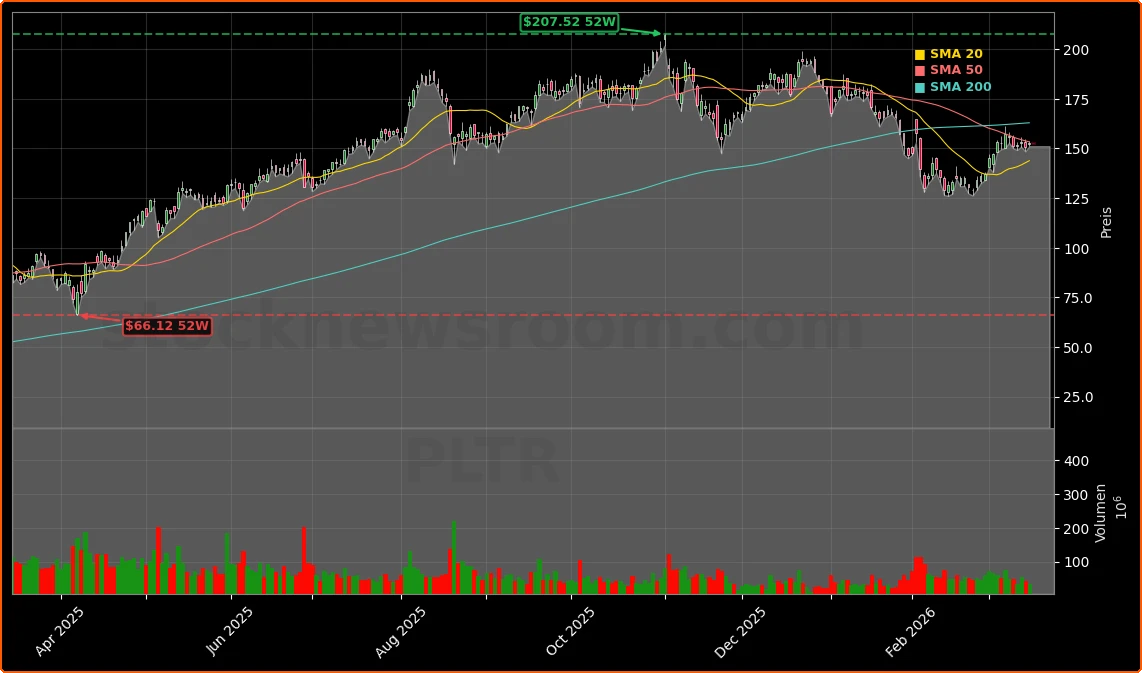
Palantir shares have massively outperformed the S&P 500 in recent years, rising more than 500% while the index gained about 69% over the same stretch. Even after a software-sector pullback earlier in 2026, PLTR’s market capitalization of roughly $361 billion implies a premium multiple on every conventional metric. Monday’s close at $152.72, just off an after‑hours quote of $152.42, keeps the stock well below some bullish analyst targets but still embeds aggressive expectations for future AI demand.
That optimism is grounded in surging fundamentals. In Q4 2025, Palantir posted revenue of about $1.41 billion, up 70% year over year, with net income of roughly $609 million, up 43%. U.S. commercial revenue jumped 137% to $507 million, and U.S. government revenue climbed 66% to $570 million. Management expects U.S. commercial sales to exceed $3.14 billion in 2026, implying growth of at least 115% as companies shift from AI experiments to full‑scale deployments on the Palantir AI Platform.
How critical is the new $1 billion contract?
The latest $1 billion U.S. government award underscores Palantir’s positioning as a defense‑linked AI leader. The company has long pitched itself as an essential data and decision‑support layer for the United States and its NATO allies, and the new deal reinforces that narrative at a time when geopolitical tensions are high. For long‑term shareholders, the contract extends revenue visibility and supports the thesis that Palantir’s software fabric – combining Gotham, Foundry and Apollo – is becoming embedded in core government workflows.
At the same time, the concentration in sensitive defense and security use cases keeps Palantir at the center of ethical and political debate. Contracts with agencies like ICE have sparked controversy, yet federal contract value nearly doubled to about $970.5 million in 2025. Unlike consumer‑facing names such as Apple or Tesla, Palantir’s brand risk is mostly on the institutional side, where performance and security often outweigh public perception when decisions are made.
What makes the Palantir AI Platform different?
For institutional buyers comparing AI vendors across the NASDAQ and S&P 500, the Palantir AI Platform stands out through its ontology‑driven approach. Palantir specializes in building detailed maps of an organization’s assets, data flows and operations, allowing large language models and other AI tools to interact safely and effectively with real‑time operational data. This capability is difficult to replicate and underpins Palantir’s pricing power and low churn.
Adoption is being accelerated through AIP Bootcamps, short, hands‑on programs where customers build functioning AI applications on their own data in days instead of months. This focus on production‑ready deployments – not just pilots – helps explain why Palantir is increasingly mentioned alongside enterprise heavyweights like Microsoft and Salesforce as a core AI software holding for diversified U.S. portfolios.
How do Dell and NVIDIA change the picture?
The recently expanded collaboration with Dell and NVIDIA adds a powerful hardware dimension to the Palantir AI Platform story. Together, the companies have built what Palantir calls its Ontology Platform: an AI stack that can run fully on‑premises, including in air‑gapped or low‑connectivity environments. By leveraging NVIDIA’s confidential computing capabilities and Dell’s infrastructure, customers can deploy AI systems where data and models remain sealed off even from the infrastructure operator.
This architecture opens doors in highly regulated and sensitive sectors such as defense, intelligence, critical infrastructure and healthcare, where public‑cloud‑only solutions from other vendors may not be acceptable. It also gives investors an indirect way to play Palantir’s momentum through partners that are already core holdings in many U.S. portfolios, such as NVIDIA. MarketWatch has even highlighted these partner stocks as potentially cheaper routes to benefit from Palantir’s AI expansion.
What does Wall Street think now?
Wall Street’s view remains split between enthusiasm for the Palantir AI Platform and concern over valuation. Wedbush Securities has reiterated an “Outperform” rating and a 12‑month price target of $230, implying significant upside from current levels if growth persists. Citigroup is even more bullish, with a $260 target that suggests roughly 70% potential upside based on recent trading ranges.
More cautious voices argue that after a gain of more than 600% in recent years, Palantir is priced for near‑flawless execution and continued dominance against both legacy software rivals and emerging AI specialists like Anthropic. Bears worry that any slowdown in U.S. government spending or shift in enterprise AI priorities could compress Palantir’s multiples sharply.
Conclusion
For investors, the conclusion is clear: the Palantir AI Platform has evolved into a cornerstone of mission‑critical AI for both governments and enterprises, with the new $1 billion contract and Dell/NVIDIA alliances further solidifying that role. The upside case hinges on Palantir extending its lead as AI moves deeper into real‑world operations, while the bear case centers on valuation risk rather than business momentum. The next few quarters of commercial AIP adoption and additional government awards will likely determine whether today’s price is a launchpad or a ceiling for PLTR.
Further Reading
- Palantir Technologies Inc. (PLTR) Stock Price, Quote & News (Yahoo Finance)
- Palantir Technologies maintains growth momentum with new AI partnerships, analysts say (Proactive Investors)
- Why Palantir Technologies Inc. (PLTR) is a Top Stock for the Long-Term (Zacks Investment Research)
- Prediction: Palantir Could Surge If Government AI Spending Explodes (The Motley Fool)