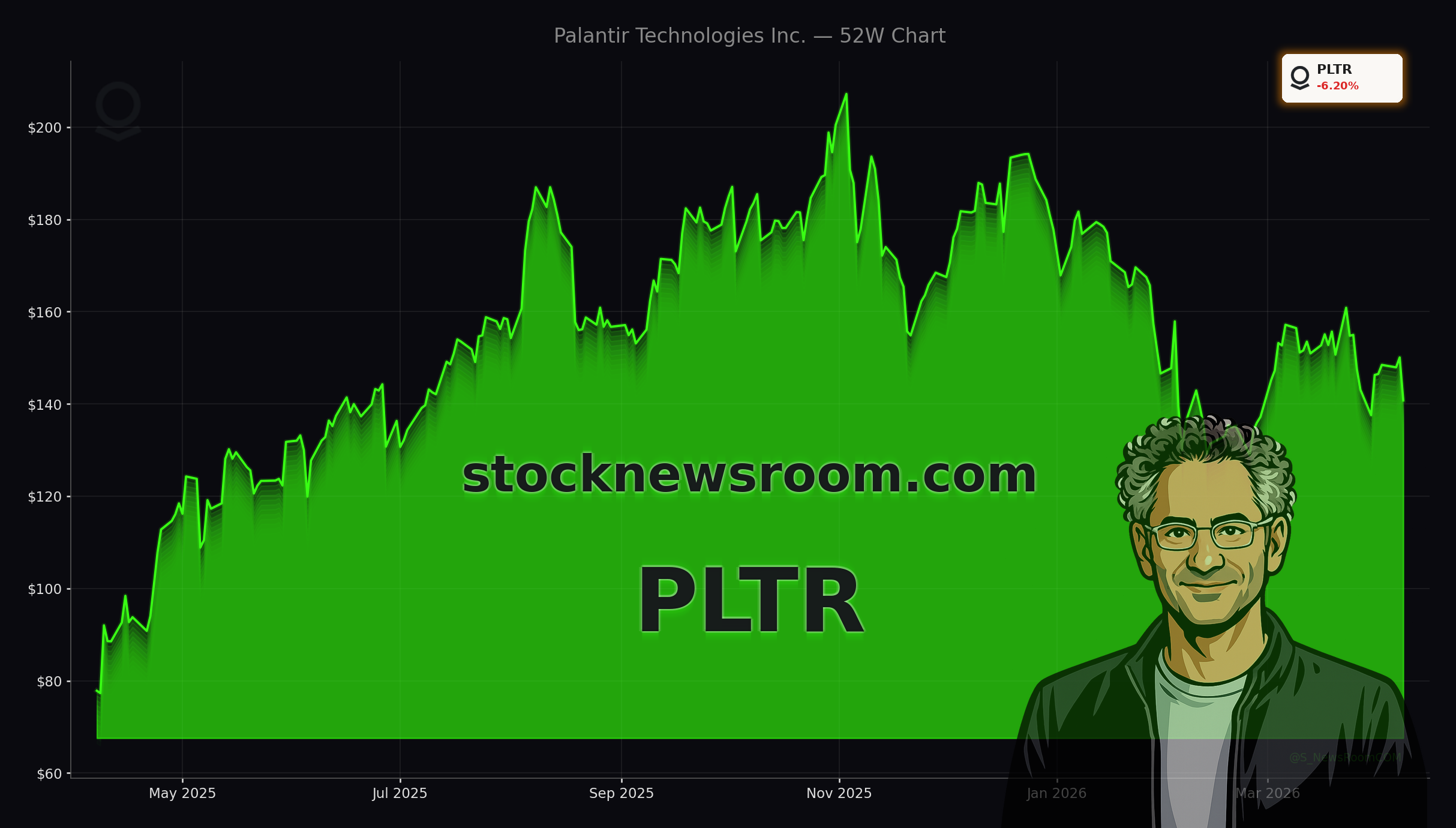

Is the Palantir AI Strategy powerful enough to justify its sky-high valuation as the stock suddenly drops 6.2%?

Is Palantir Technologies losing Wall Street’s nerve?
PLTR closed at $140.76 on Wednesday, down from a prior close of $154.87, with after-hours trading only modestly higher at $141.10. That puts the stock roughly 16% lower year-to-date and well below consensus analyst targets, even though it remains far above its 52-week low of $84.14 and below recent highs. The disconnect is stark: fourth-quarter 2025 revenue grew 70% year over year to $1.406 billion, capping full-year revenue growth of 56.2% to $4.475 billion and a 251.6% surge in net income to $1.625 billion.
Yet Palantir still trades at valuation levels that many institutional investors view as unforgiving. Recent data put the trailing P/E ratio near 238x and the headline P/E around 261x, with a price-to-sales multiple above 80x. Those figures imply the market is pricing years of flawless execution for the Palantir AI Strategy, leaving the stock highly sensitive to any slowdown, margin pressure or regulatory setback.
Despite the pullback, Wall Street’s published price targets remain bullish overall. A broad analyst set shows a consensus target around $185 per share, with a majority of buy ratings versus holds and only a handful of sells, although specific calls from houses such as Morgan Stanley, Goldman Sachs or Citigroup have recently focused more on valuation discipline than on questioning the core AI franchise.
How do shorts challenge the Palantir AI Strategy?
The latest leg down in PLTR has been fueled by high-profile short interest. “Big Short” investor Michael Burry, through Scion Asset Management, has disclosed substantial short positions in both Palantir and NVIDIA, publicly arguing that new AI players like Anthropic offer cheaper, more intuitive solutions and are “eating Palantir’s lunch.” He has highlighted Anthropic’s fast-growing annual recurring revenue as evidence that model providers may capture the bulk of enterprise AI spend.
Supporters of the Palantir AI Strategy counter that this misses the company’s role as an AI operating system rather than just another model vendor. Platforms like Gotham, Foundry and the Palantir Artificial Intelligence Platform (AIP) ingest, cleanse and fuse vast data sets, then map them directly to real-world operations. That architecture is designed to reduce hallucinations and allow enterprises and governments to deploy AI in mission-critical workflows — from industrial optimization and healthcare analytics to battlefield decision support.
The numbers back that narrative for now: Palantir has reported 10 consecutive quarters of accelerating revenue growth, with U.S. commercial sales up 137% in the latest quarter and a Rule of 40 score of 127%, far ahead of many SaaS peers. Bulls argue that Burry’s thesis underestimates the durability of long-cycle government and defense programs and the stickiness of data-integration platforms once embedded in large organizations.
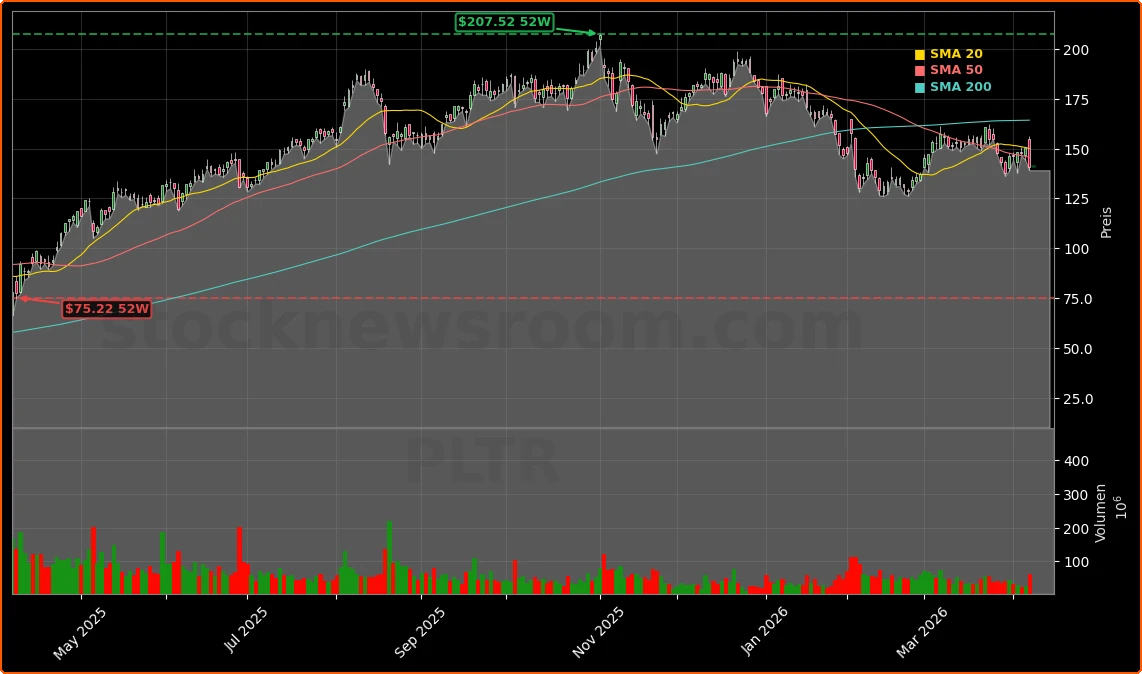
Can Palantir Technologies sustain its defense and healthcare edge?
One cornerstone of the Palantir AI Strategy is deep entrenchment in U.S. and allied defense. Its Maven Smart System has effectively become a central nervous system for parts of the U.S. military, giving commanders real-time situational awareness in the conflict with Iran and for Israeli forces. In parallel, the Pentagon’s push into counter-drone and autonomous defense capabilities has created a rapidly growing niche where Palantir competes and collaborates alongside players like Kratos Defense and emerging platforms such as VisionWave’s ARGUS system.
Beyond the battlefield, Palantir is quietly scaling in healthcare and real-world data. OneMedNet recently reported 329% growth in revenue from its AI-driven iRWD platform, which is powered by Palantir Foundry, underscoring how the Palantir AI Strategy can underpin regulated-data use cases that demand auditability and speed. These deployments reinforce the company’s positioning as infrastructure for AI decisions, not just analytics dashboards.
However, Palantir’s expansion into sensitive public-health and government programs has triggered regulatory and ethical scrutiny in the U.K., where watchdogs are probing how its platforms are used in national health and defense contexts. Investors worry that new guardrails or contract limitations could slow growth in a strategically important region and signal broader political risks for AI infrastructure vendors.
How does Palantir compare to other AI leaders?
Compared with hyperscale chip beneficiaries like NVIDIA or diversified AI adopters such as Apple and Tesla, Palantir offers a purer play on applied AI software. Over the past five years, Palantir’s roughly 560% share price gain lags behind NVIDIA and Broadcom but still turns a $10,000 investment into about $65,000. That performance has pushed the stock into the same valuation stratosphere as elite growth names and made it a staple in AI-themed vehicles including leveraged ETFs and covered-call funds like the YieldMax PLTR Option Income Strategy ETF.
Growth investors point to parallels with earlier stages of companies like Amazon and NVIDIA, where elevated multiples persisted for years as fundamentals caught up. They argue that, with accelerating revenue, rising profitability and expanding use cases, the Palantir AI Strategy could support today’s premium over a long horizon. More cautious voices, including some at firms like Citi and RBC Capital, acknowledge the quality of the business but stress that forward P/E multiples well over 100x leave little cushion if AI budgets normalize or competition intensifies.
Related Coverage
For a deeper dive into Palantir’s role in defense, including how Pentagon demand intersects with talk of an AI bubble, see Palantir Defense AI Boom: Pentagon Demand Meets Bubble Warnings, which explores whether defense contracts can offset valuation risk. Investors tracking the broader AI ecosystem on Wall Street may also want to read AMD AI Forecast +4.6% Rally: Can It Own the $1.3T AI Boom? for context on how chip suppliers are positioned versus software-centric names like Palantir.
In the end, the Palantir AI Strategy combines one of the strongest growth profiles in enterprise software with one of the most demanding valuations and visible short campaigns. For U.S. investors, the stock now represents a high-beta wager that defense, healthcare and industrial AI adoption will keep compounding fast enough to outpace regulatory and competitive risks. The next few quarters of contract wins, margin trends and regulatory clarity will be crucial in showing whether Palantir can grow into its multiple and turn current volatility into a long-term buying opportunity.