
Is Palantir Defense AI a durable Pentagon backbone or just the flashiest name in an overheating AI bubble?

Is Palantir Defense AI now core to U.S. budgets?
The latest U.S. fiscal 2026 budget proposals underscore how central Palantir Defense AI has become to long-term Pentagon planning. Gotham, Palantir’s AI-backed SaaS platform for mission planning, battlefield intelligence, and data fusion, is already wired into U.S. and allied military operations, a position Wedbush analyst Dan Ives calls a “first-mover” advantage in defense AI. In Q4 2025, U.S. government revenue surged to about $570 million, up 66% year over year, helping drive total quarterly revenue to roughly $1.407 billion, a 70% jump.
Management is guiding for 2026 revenue of around $7.18 billion, implying roughly 61% growth and signaling that defense contracts are shifting from pilots to structurally recurring budget lines. Ives argues that Palantir effectively owns the defense software layer, with Oracle and Microsoft providing supporting cloud and enterprise infrastructure. For investors who see defense AI as a multi-decade spending cycle rather than a temporary theme, Palantir Defense AI is increasingly viewed as a core holding alongside infrastructure leaders like NVIDIA.
How strong are Palantir’s growth and margins?
Beyond defense, Palantir’s commercial engine is accelerating. Recent figures show U.S. commercial revenue jumping 109% year over year to about $1.465 billion, while global government revenue climbed 55% to roughly $1.855 billion, giving the company dual growth pillars. Its Rule of 40 metric has reached around 127%, combining high growth with operating margins near 50%, which puts Palantir among the most profitable scaled software names on the NASDAQ.
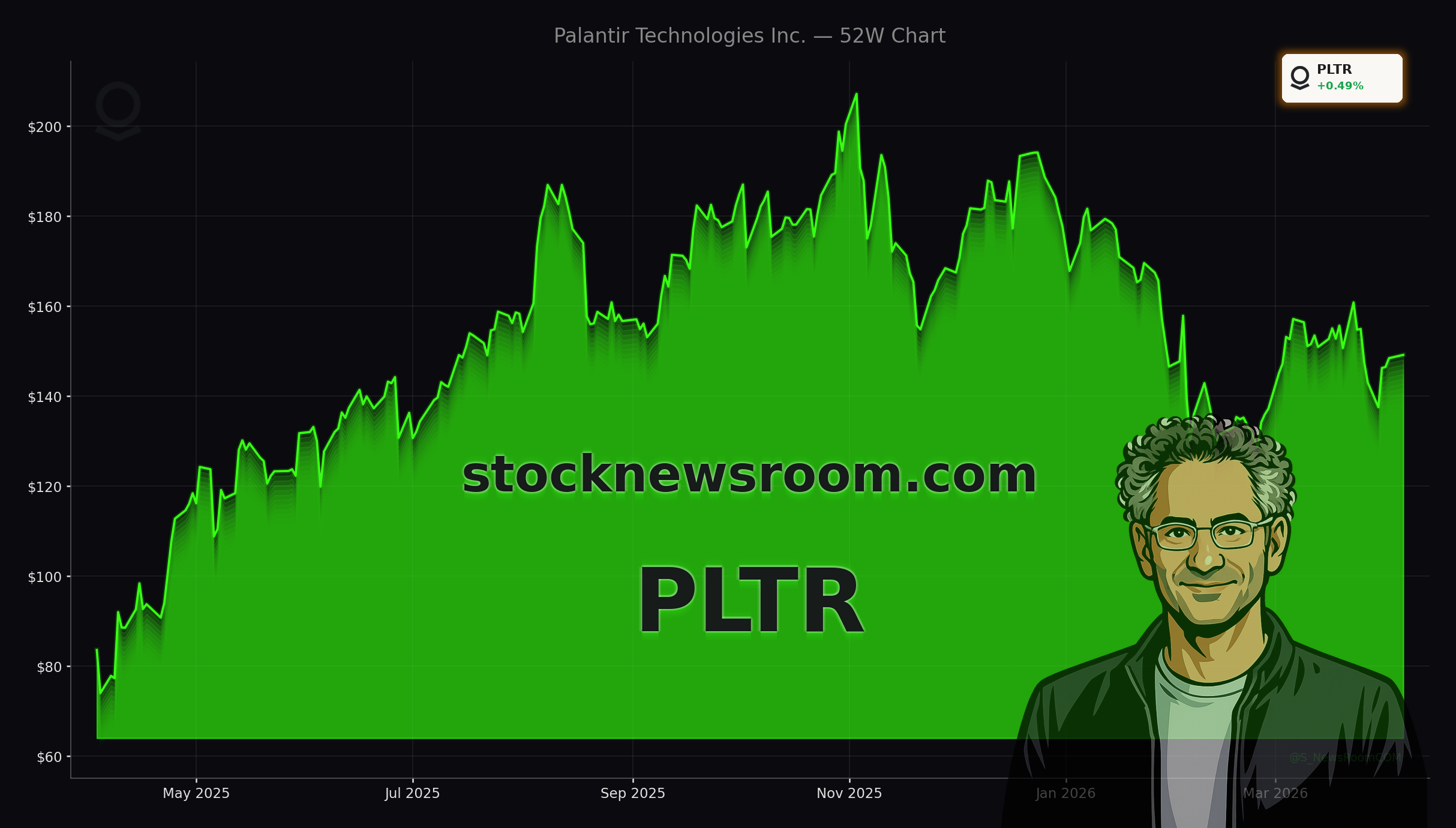
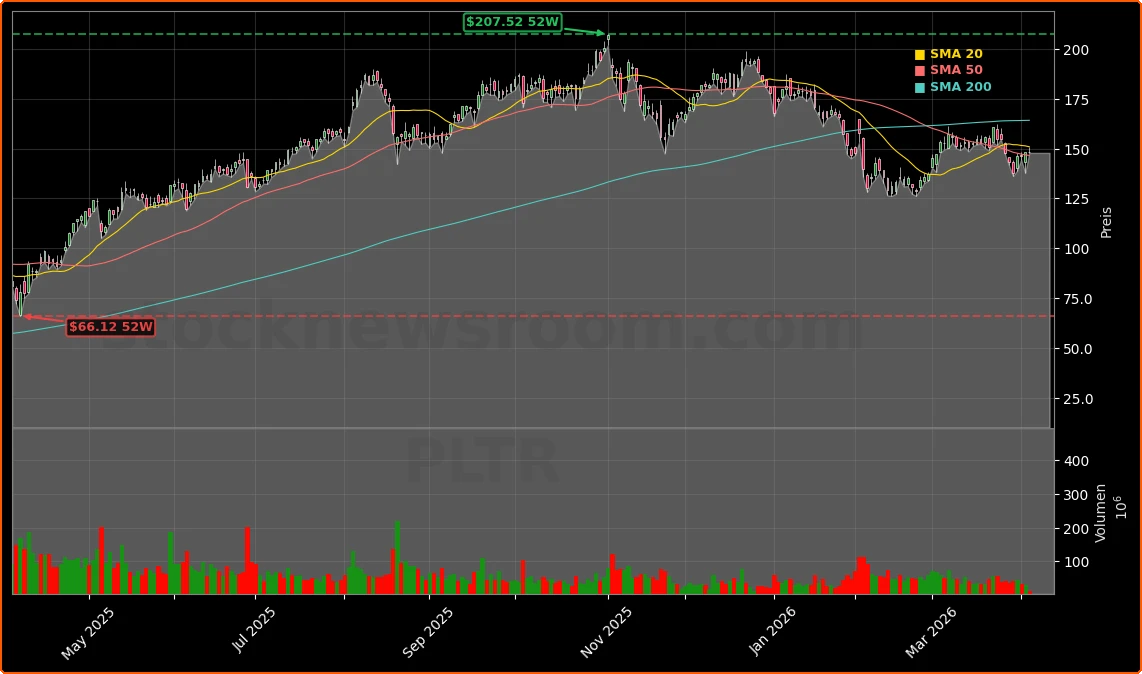
At today’s $148.22 share price, Palantir still trades roughly 29% below a 52-week high near $207, but the move since early 2023—over 2,000%—has dramatically reset expectations. Several Wall Street targets cluster between $185 and $230, suggesting 20% to 55% upside from current levels if execution continues. Zacks Investment Research recently highlighted Palantir as a trending stock, emphasizing its rapid revenue expansion and improving profitability profile as reasons many investors remain bullish despite the volatility.
Why are some analysts warning of a bubble?
Not all coverage is upbeat. A growing camp of skeptics warns that Palantir’s valuation embeds perfection at a time when the broader S&P 500 Shiller P/E ratio is already at its second-highest level in history. On a trailing basis, Palantir entered 2026 at a price-to-sales multiple above 100 and still trades near 86 times sales, far above the 30x threshold that historical data suggests is sustainable even for “next big thing” leaders.
The concern: every transformational tech wave since the early internet has gone through an early bubble-and-bust phase as investors overestimate how quickly businesses can fully monetize new capabilities. If AI enthusiasm cools or a broader market correction hits expensive growth stocks, Palantir could see a sharp drawdown. One detailed bearish view argues the stock could fall below $100 before the end of 2026, citing both valuation risk and the possibility that macro stress or budget negotiations could slow the pace of new defense and commercial deals.
Can Gotham and Foundry scale as promised?
While Gotham anchors the Palantir Defense AI story, Foundry is the key to sustaining high growth beyond the Pentagon. Foundry provides AI-driven data integration and analytics for enterprises in sectors like manufacturing, healthcare, and finance, and has underpinned the surge in U.S. commercial revenue. CEO Alex Karp has described Palantir as an “n of 1,” positioning the company as uniquely focused on scaling operational leverage from advanced AI models, rather than just selling infrastructure or generic tools.
But there are questions about how far Foundry can scale. RBC Capital analyst Rishi Jaluria has long argued that the heavy customization required for each client deployment could limit operating leverage and slow margin expansion over time. If onboarding remains services-heavy, Palantir may struggle to maintain its current profitability profile at much higher revenue levels. For investors comparing options across the AI stack, this makes Palantir a very different proposition from hyperscalers like Apple’s ecosystem or high-volume hardware players, and more akin to specialized software names such as Tesla’s autonomous driving stack in terms of depth versus breadth.
How does Palantir stack up versus other AI winners?
For U.S. investors constructing AI-focused portfolios, Palantir sits at a different layer than chip and cloud leaders. Whereas NVIDIA and other semiconductor names monetize the compute layer, Palantir is a pure-play on applied AI software where mission-critical decisions—on battlefields, factory floors, or in hospitals—are made. Recent commentary comparing Palantir with other high-flying tech names like Tesla highlights that both attract premium multiples based on long-dated narratives that may take years to fully validate.
Short term, the stock remains volatile. FXEmpire notes that high-growth tech names including Palantir are attempting to rebound after sharp pullbacks, while some bearish commentators even place Palantir on lists of stocks to avoid in the near term due to valuation and macro risks. For longer-horizon investors, the key question is whether Palantir Defense AI becomes entrenched enough in U.S. and allied defense, and Foundry broad enough across commercial verticals, to justify today’s multiples through sustained compounding.
Related Coverage
For a deeper dive into how Pentagon contracts are reshaping Palantir’s outlook, including the Maven upgrade, readers can explore Palantir Maven Program Boom: Pentagon Deal Reshapes Valuation, which examines whether these deals can support one of the richest AI valuations on Wall Street. Investors interested in the broader cloud and AI competitive landscape can also read Alphabet AI Strategy Boom: Can Cloud Upside Last?, which looks at how Alphabet’s AI spending and cloud focus compare with peers and what that might mean for application-layer players like Palantir.
We are an n of 1…Palantir is alone in choosing to exclusively focus on scaling the operational leverage made possible by the rapid advancements of AI models.— Alex Karp, CEO of Palantir Technologies Inc.
In the end, Palantir Defense AI sits at the intersection of surging defense budgets, rapid commercial adoption, and one of the most stretched valuations in large-cap software. For U.S. investors, the stock offers leveraged upside to an AI supercycle but also elevated downside if the current enthusiasm fades or execution stumbles. The next few contract cycles and quarterly reports will be crucial in proving whether Palantir’s growth and margins can grow into its price, making the name a high-risk, high-reward swing factor in AI-heavy portfolios.