
After a sharp pullback in Palantir’s stock, is this just a pause in the AI rally or the start of a painful reset?

How does Palantir stack up after the pullback?
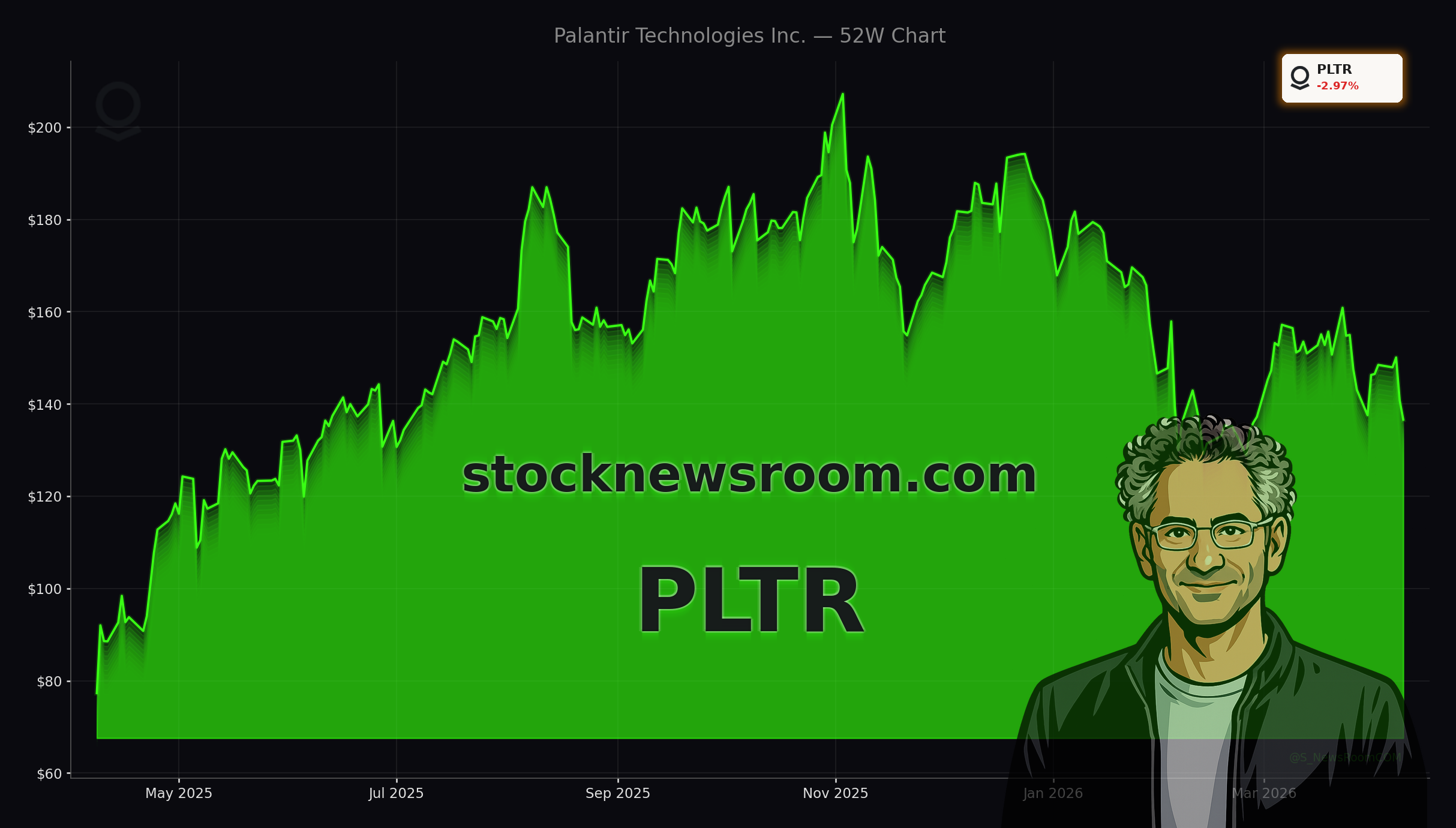
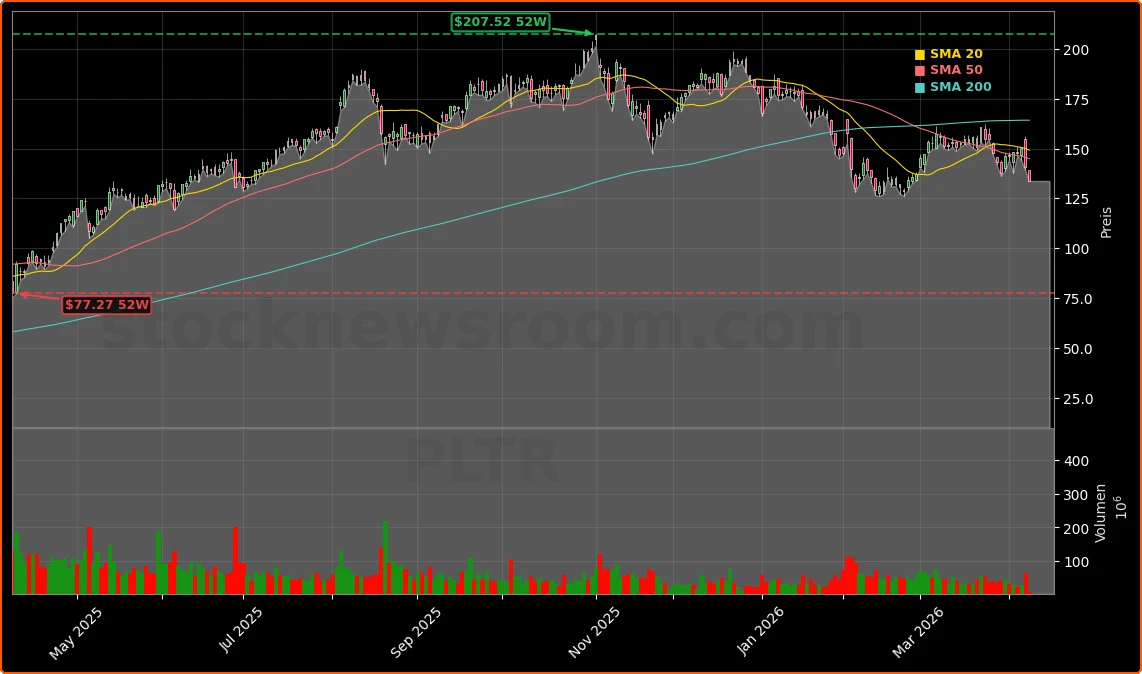
Trading around $133.94 in Thursday’s mid‑day session, PLTR is down roughly 5% from the prior close of $141.13 and remains well below its 52‑week high, putting recent enthusiasm for AI leaders like NVIDIA into perspective. Over the past five years, however, the stock has still advanced more than 500%, turning early believers in defense‑focused AI into significant winners. The immediate question for investors is whether the current reset marks a healthy consolidation or the start of a deeper re‑rating in high‑multiple software names.
Operationally, Palantir continues to deliver. Revenue has been growing at double‑digit rates, commercial and government demand remains robust, and the company closed more than $4 billion in total contract value in its latest reported quarter – a record across its platforms Gotham, Foundry, Apollo and its Artificial Intelligence Platform (AIP). That backdrop is central to any credible Palantir Forecast, because it underpins both the bull case on earnings expansion and the bear case that expectations may have run too far ahead of fundamentals.
Palantir Technologies Inc. in the AI arms race
Unlike consumer AI plays such as Apple or auto‑driven AI narratives around Tesla, Palantir Technologies Inc. is tightly aligned with mission‑critical decision‑making. Its software is embedded with the Israeli Defense Forces and the U.S. military, providing battlefield commanders with real‑time data fusion and targeting insights that many defense strategists describe as a paradigm shift. Importantly, the integration of AI into defense is still in its early innings, leaving a long runway for incremental contracts as NATO allies and other governments modernize their command‑and‑control stacks.
On the enterprise side, AIP has become the centerpiece of Palantir’s growth story. By combining large language models with Palantir’s ontology‑based architecture – effectively a digital twin of a customer’s operations – the platform lets users query complex data in natural language and trigger AI agents to act in live workflows. Forrester recently ranked Palantir as a leader in AI decisioning platforms, and the firm has been running intensive “bootcamps” where prospects test real use cases before signing multi‑year deals. Partnerships like OneMedNet’s iRWD platform, powered by Palantir Foundry to search medical data conversationally in seconds, highlight the cross‑sector potential beyond defense and intelligence.
What does the latest Palantir Forecast imply for valuation?
Palantir’s valuation has always been the pressure point. At one stage the stock traded above 240x forward earnings, a level that left little margin for error. The recent slide – PLTR is about 28% below its peak – has compressed that multiple, at times bringing it under 100x forward earnings for the first time in roughly a year. Even so, shares still command a premium versus the S&P 500’s roughly mid‑20s earnings multiple and richer than many high‑growth peers in the NASDAQ 100.
Some growth‑oriented analysts argue the premium is deserved. A widely discussed Palantir Forecast pegs the stock at $225 per share by early 2027, implying around 50% upside from the $150 area where the projection was originally made. The math assumes adjusted earnings per share near $1.50 in 2026 and a forward price‑to‑earnings multiple sliding from roughly 200x today to about 150x. That scenario requires Palantir to keep beating Wall Street earnings estimates – something it has done by an average of about 15% over the past six quarters – while sentiment stays supportive enough to maintain a triple‑digit multiple.
Bears, including prominent short sellers who view Palantir as a bubble heavily reliant on government contracts, warn that even small disappointments in growth or margins could trigger a swift multiple compression. If the P/E falls below 100x while earnings hit $1.50, the share price could actually decline from current levels despite fundamental progress.
How are Wall Street and ETF investors positioned?
Across Wall Street, opinions on PLTR range from high‑conviction growth buy to valuation‑cautious hold. While recent research has highlighted Palantir among high‑growth U.S. tech names to watch, several banks have tempered near‑term price targets as geopolitical risk, rising rates and sector‑wide AI fatigue weigh on sentiment. Options‑based products like the Roundhill PLTR WeeklyPay ETF, which distributes weekly income, show that institutional and retail investors are increasingly using derivatives and covered calls to harvest volatility rather than simply buying and holding the stock.
Palantir has also become a meaningful position in AI‑focused portfolios and leveraged ETFs tracking data and semiconductor ecosystems, where it sits alongside names like NVIDIA and other infrastructure players. That positioning can amplify both upside and downside: broad AI rotations or risk‑off moves in tech ripple quickly through ETFs, forcing mechanical buying or selling of PLTR regardless of company‑specific news.
Related Coverage
For a deeper dive into the recent 6.2% daily drop and what it means for valuation risk, the article “Palantir AI Strategy -6.2% Crash Tests the Bull Case” analyzes whether the company’s AI narrative is strong enough to support its elevated multiples. Investors comparing enterprise AI plays may also want to read “Oracle AI Strategy Boom With $16B Data Center Shock”, which explores how Oracle’s massive infrastructure build‑out stacks up against software‑centric models like Palantir’s.
In the end, the current Palantir Forecast hinges on two opposing forces: explosive AI and defense demand on one side, and a still‑lofty valuation on the other. For long‑term investors comfortable with volatility, Palantir remains a leveraged bet on AI‑driven decision software becoming as indispensable as cloud computing. The next few quarters of contract wins, earnings surprises and macro headlines will determine whether today’s pullback was a rare buying window or an early warning that expectations have overshot reality.