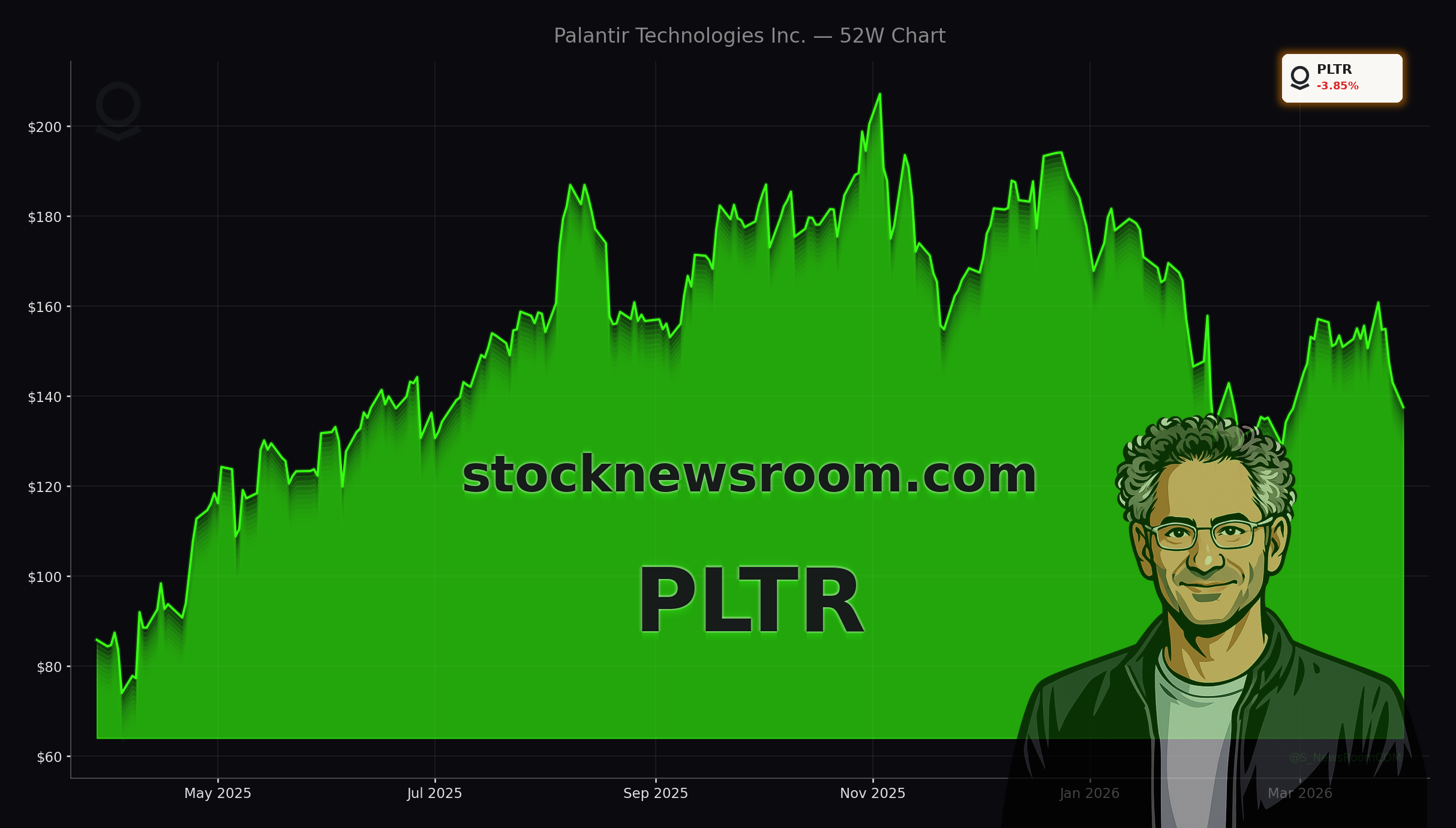

Is the latest Palantir Forecast strong enough to justify its sky-high AI valuation after the stock’s sharp pullback?

Is Palantir still an AI leader after the selloff?
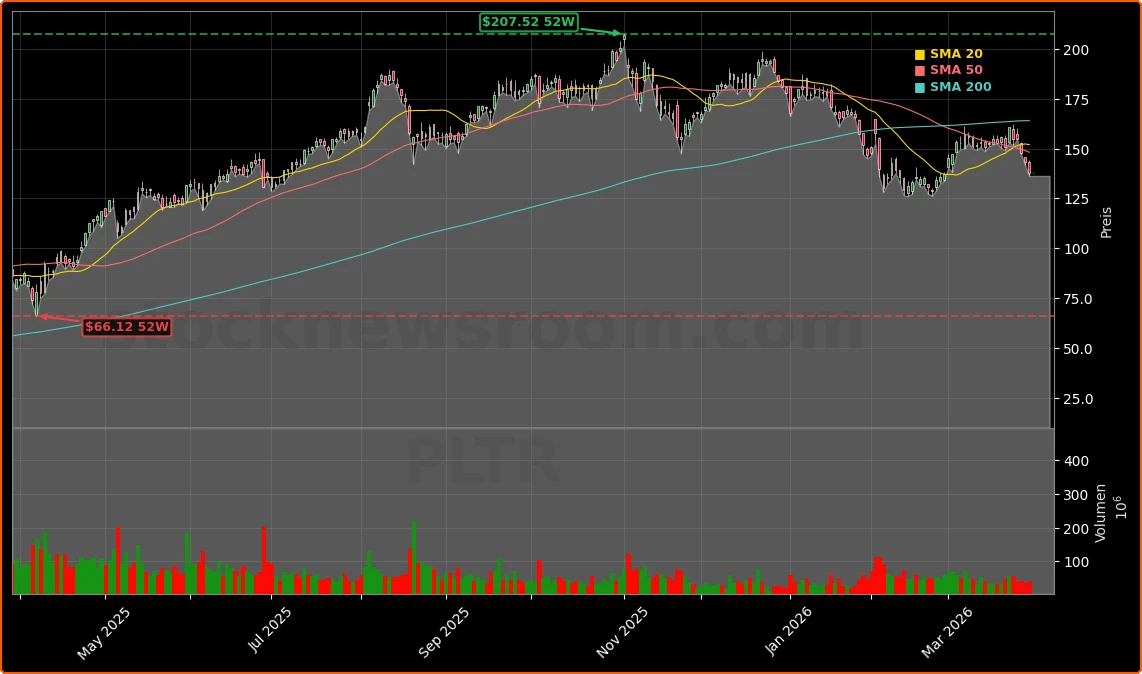
Palantir Technologies Inc. closed the prior session at $137.55, down 3.85% from the previous close of $135.30, before ticking slightly higher in early pre‑market trading to $137.61. The move came as the NASDAQ and the wider group of AI stocks retreated, extending a risk‑off rotation that has pushed the S&P 500 roughly 7% lower year to date. High‑multiple tech names have been hit particularly hard, with Palantir shares off close to 20% since the end of 2025.
Despite that correction, Palantir remains one of the most richly valued software names on Wall Street. The company commands a market cap around $330 billion on trailing 12‑month revenue of under $5 billion, implying a revenue multiple north of 60x and an earnings multiple above 200x. That valuation is being stress‑tested as investors reassess AI leaders including NVIDIA and mega‑caps like Alphabet and Apple amid concerns about over‑crowding in the theme.
Yet on fundamentals, Palantir is delivering the kind of metrics many software peers can only envy. In its most recently reported quarter (Q4 2025), total revenue grew around 70% year over year, with U.S. commercial revenue accelerating 137% and U.S. government revenue up 66%. Management highlights a Rule of 40 score of 127%, combining rapid top‑line growth with strong adjusted operating margins and expanding profitability.
What does the current Palantir Forecast say on growth?
At the heart of the bullish Palantir Forecast is the company’s position as an enabling layer for enterprise AI. Platforms such as Gotham and Foundry, plus its newer Artificial Intelligence Platform (AIP), help governments and corporations integrate siloed data, build models and push AI into live decision‑making. Q4 metrics showed net dollar retention of 139% among top customers and total contract value of $4.3 billion, signaling that existing clients are ramping spend rapidly.
For full‑year 2026, guidance points toward roughly $7.2 billion in revenue with about $4 billion in operating income and similar levels of free cash flow, underscoring the scalability of Palantir’s software‑driven model. Mizuho recently reaffirmed an Outperform rating and a $195 price target, arguing that Palantir could be a stock that potentially 10x over a decade if current adoption trends hold. The bank’s conversations with a Palantir finance advisor and customers highlighted a perceived lack of comparable alternatives in the market.
Beyond the numbers, Palantir keeps announcing new deals that support a constructive Palantir Forecast. Recent collaborations include an AI‑powered mortgage operations application with Moder, using Freedom Mortgage as a pilot client, as well as partnerships with Ondas Holdings and World View Enterprises to build AI‑enabled surveillance and intelligence‑gathering capabilities. These initiatives extend Palantir’s reach from defense and government into financial services, industrial IoT and edge analytics.
How critical is defense AI to Palantir Technologies?
Any realistic Palantir Forecast has to factor in defense and national security, where the company is deeply entrenched. CEO Alex Karp has been outspoken that AI must be integrated into Western defense systems because adversaries such as Russia and China are already moving in that direction. Modern warfare increasingly relies on drones, satellite imagery and ISR (intelligence, surveillance, reconnaissance) systems, exactly the domains where Palantir’s software powers data fusion and targeting decisions.
Geopolitical tensions, from Eastern Europe to the Middle East, are driving hundreds of billions of dollars in global R&D and procurement related to AI‑enabled defense. Palantir is winning sizable contracts in missile defense and battlefield intelligence and is included in specialized ETFs that target AI and modern warfare. While some investors prefer diversified exposure through vehicles like those funds rather than single‑name risk, Palantir stands out as a pure‑play software backbone for this spending wave, alongside hardware‑centric names such as NVIDIA.
This defense “optionality” fuels part of the valuation debate. Bulls argue that, if AI‑driven defense platforms become standard across NATO and allied nations, Palantir could scale into a de facto operating system for Western military decision‑making. Bears counter that regulatory scrutiny over government contracts, ethical concerns around lethal autonomy and budget cycles could all inject volatility into what looks like a straight‑line growth story.
How does Palantir compare to other AI stocks?
On Wall Street, Palantir trades among a cohort of high‑growth AI names that includes cloud hyperscalers, chipmakers and data software vendors. While giants like Microsoft and Alphabet trade at far lower earnings multiples, their AI revenue is also less transparent, spread across broader cloud and advertising businesses. Palantir, by contrast, is a more direct bet on AI‑driven data platforms, but with significantly higher single‑stock risk.
Some institutional investors, such as Stanley Druckenmiller, have exited positions in Palantir and Tesla to focus on diversified AI beneficiaries like Alphabet and Amazon. Others, including Mark Gibbens of Gibbens Capital Management, view the recent AI correction as a buying opportunity in select names, explicitly citing PLTR alongside NVIDIA and Google parent Alphabet as attractive after the pullback. Short‑term traders remain wary of momentum unwinds and persistent insider selling, yet technical analysts point to strong long‑term uptrends supported by robust fundamentals.
Overall, the investment case hinges on whether Palantir can maintain 30%–40%+ compound growth while gradually normalizing its valuation multiples. If the Palantir Forecast for sustained double‑digit revenue expansion and rising margins proves correct, today’s premium could compress organically as earnings catch up. If growth stumbles, the downside from such elevated levels could be painful.
Related Coverage
For a deeper dive into how surging defense spending and new missile defense contracts are shaping Palantir’s risk‑reward profile, readers can explore this detailed look at Palantir’s government contracts and the defense AI boom. Investors interested in capital allocation and buyback dynamics across high‑beta growth names may also want to review our analysis of Robinhood’s $1.5 billion share repurchase program and whether it represents genuine value or a potential trap.
In the end, the Palantir Forecast comes down to how investors balance extraordinary AI‑driven growth and defense leverage against one of the market’s most demanding valuations. For long‑term shareholders comfortable with volatility, Palantir remains a high‑beta, high‑potential AI infrastructure play, and the next few quarters of commercial adoption and government contract wins will be decisive in confirming whether the premium is sustainable.