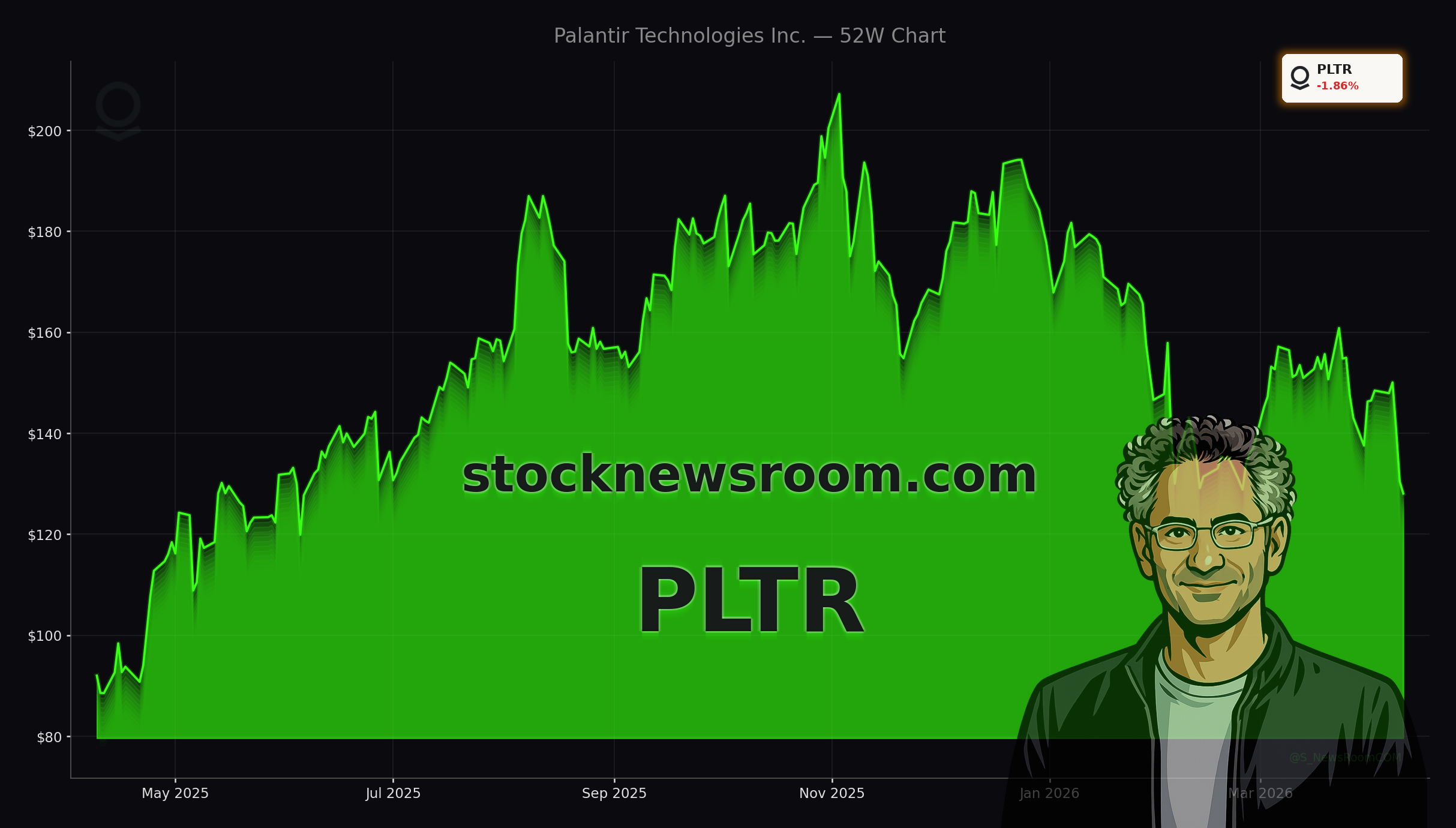

Can Palantir Military AI keep justifying its sky-high valuation as political hype, ESG backlash and new AI rivals collide?

Is Palantir Military AI still priced for perfection?
The bull case is built on explosive growth and near‑monopoly positioning in Palantir Military AI. Federal contract data show U.S. government revenue nearly doubling in recent years, with Project Maven – the Pentagon’s flagship AI targeting system – becoming a formal Program of Record. Palantir’s software fuses drone feeds, satellite imagery and intelligence reports, using AI to generate target recommendations and cut sensor‑to‑shooter times from hours to under a minute, a capability CEO Alex Karp has described as shifting the balance of power on the battlefield.
That war‑time pedigree is feeding into Palantir’s commercial Artificial Intelligence Platform (AIP), where Q4 2025 revenue grew 70% year over year to $1.406 billion and full‑year sales reached $4.475 billion. Management has guided for 61% revenue growth in 2026, including 115% growth in U.S. commercial, a pace few software names can match. Yet the stock’s valuation already embeds a lot of that future: Palantir recently traded at around 100 times sales at its peak and still sits at roughly 109 times forward earnings, far above software peers and AI leaders like NVIDIA.
This premium is precisely what skeptics like Michael Burry are targeting. Burry disclosed long‑dated puts (June 2027 $50 and December 2026 $100) and has called PLTR “wildly overvalued,” arguing that the company behaves more like a consulting firm that requires armies of forward‑deployed engineers than a pure software platform with infinite scalability.
How did Trump and Anthropic jolt Palantir Technologies?
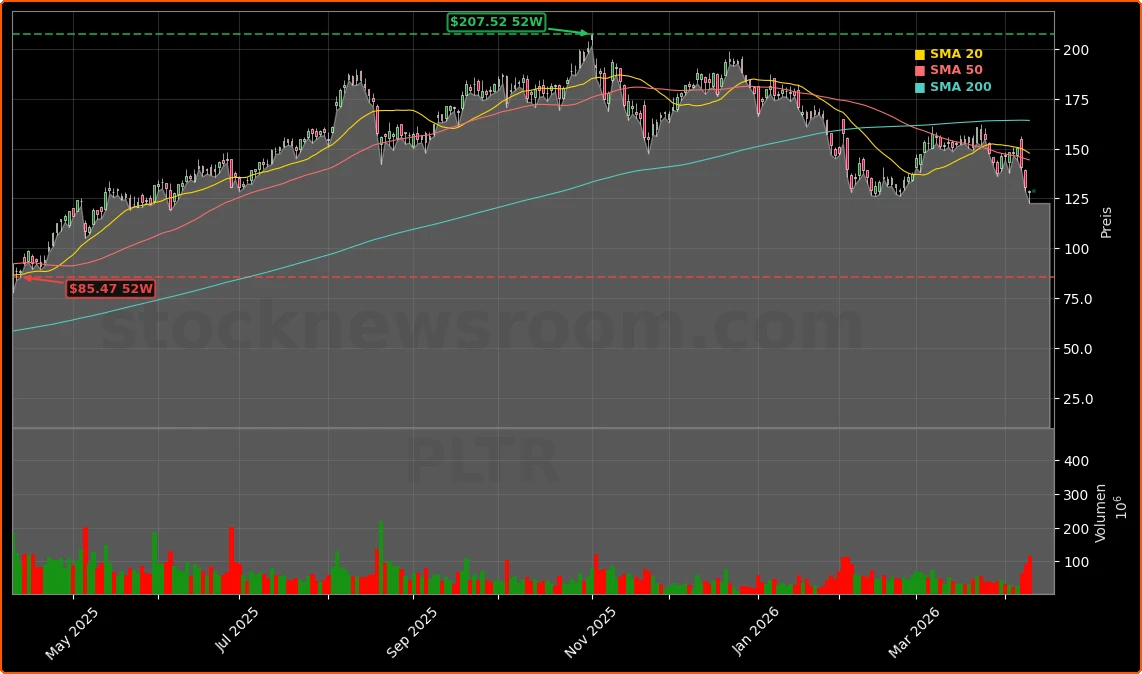
Volatility in Palantir Military AI escalated this week as two narratives collided. On the one hand, Anthropic’s new Claude Mythos Preview model and its broader agentic AI push have spooked investors across the software complex. PLTR sold off sharply after signs that enterprise AI budgets are tilting toward foundation‑model providers like Anthropic, a shift that helped drag the iShares Expanded Tech‑Software ETF (IGV) to its worst quarterly return since 2008.
Compounding the fear, the Pentagon recently blacklisted Anthropic for refusing to loosen safety guardrails around autonomous weapons and mass surveillance, forcing Palantir to strip Claude models out of its Maven Smart Systems stack and rebuild parts of its defense platform. The episode exposed how dependent Palantir Military AI had become on a single external model vendor just as investors were paying infrastructure‑like multiples for its software.
Then Trump intervened. In a Truth Social post that named Palantir by its ticker, the former president wrote that “Palantir Technologies (PLTR) has proven to have great war fighting capabilities and equipment. Just ask our enemies!!!” The stock immediately bounced about 3% intraday from roughly $123, before closing still down on the session at $128.06. The post triggered questions from lawmakers about potential market manipulation and highlighted Palantir’s deep ties to Trump‑aligned donors, but it also reinforced for some bulls the centrality of Palantir Military AI to future U.S. defense policy.
Will pension funds and ESG pressure hit Palantir?
Beyond daily price swings, a slower‑burn risk is building inside America’s public pension system. Sludge data show that major plans including the California Public Employees’ Retirement System (CalPERS), California State Teachers’ Retirement System, New York State Common Retirement Fund and New York State Teachers’ Retirement System together hold billions of dollars in PLTR stock. Those positions ballooned as Palantir’s market cap soared and index funds mechanically added shares.
That creates a political headache. Many of these funds publicly champion civil liberties and human rights while being heavily invested in a company powering ICE immigration databases, Gaza‑era battlefield systems and domestic surveillance tools. Activists warn that “pension funds that should someday care for them have their money invested in a company building AI surveillance systems that could be used to harm those same families,” sharpening the reputational risk around Palantir Military AI.
For now, most pension managers invoke fiduciary duty and portfolio diversification to justify holding the stock rather than announcing divestment. The real risk for Wall Street is not an overnight seller stampede, but a longer‑term drag as governance campaigns, ESG screens and political headlines steadily raise the cost of owning such a controversial name at a premium multiple.
How do Palantir and its AI peers compare?
Palantir’s story sits at the intersection of defense tech and high‑growth software, a niche that few other U.S. names occupy at similar scale. Competitors like Anduril and Shield AI remain privately held, while listed software peers such as ServiceNow and Adobe are also trying to convert AI into durable revenue but face their own valuation resets as investors reprice the entire software cohort. A recent comparison on TradingView concluded that semiconductor and infrastructure providers like Broadcom currently offer a better risk‑reward than Palantir, given PLTR’s reliance on government spending and lofty multiples.
Still, some prominent voices on Wall Street remain constructive. Wedbush’s Dan Ives keeps an Outperform rating on PLTR with a $230 target, calling Burry’s bearish thesis a “fictional narrative” and pointing to 70% revenue growth as evidence that Palantir Military AI is becoming embedded across Western defense networks and commercial enterprises. CNBC’s Jim Cramer has likewise argued that the stock is simply digesting a huge prior move while customers “love” the product, setting up what he sees as strong prospects into 2026 and 2027.
Retail sentiment remains intense enough that PLTR ranked among the most talked‑about names this week alongside mega‑caps like Apple and Tesla, while structured products such as the YieldMax PLTR Option Income Strategy ETF are spinning off sizable weekly distributions based on options premiums. For investors, that mix of fan‑driven demand and derivative activity can amplify both rallies and drawdowns.
Related Coverage
The latest shock from Anthropic’s rapid rise and its impact on PLTR’s valuation is examined in detail in this analysis of Palantir’s -5.9% Anthropic-driven plunge, which asks whether the AI rivalry exposes a deeper weakness in Palantir’s story or sets up a high‑risk entry point. For a broader sector angle, this look at ServiceNow’s recent AI selloff explores whether the AI premium across workflow software is cracking, context that matters for any investor comparing Palantir to other high‑multiple enterprise names.
Sometimes stocks just get overheated, and sellers come out. Palantir is basically building a new base because their business is strong.— Jim Cramer on Palantir, April 2026
In the end, Palantir Military AI has turned Palantir into one of Wall Street’s most polarizing growth stocks, combining hypergrowth, war‑time contracts and political noise in a single ticker. For U.S. investors, the core question is whether defense‑grade AI and commercial AIP adoption can outrun valuation, competitive and ESG headwinds. The next few quarters of contract wins, commercial deployments and margin trends will show whether Palantir Military AI justifies its premium or whether today’s volatility is an early warning sign.