
Can the new Palantir Mortgage Platform with Moder turn complex home lending into Palantir’s next big AI growth engine?

How could the Palantir Mortgage Platform move the stock?
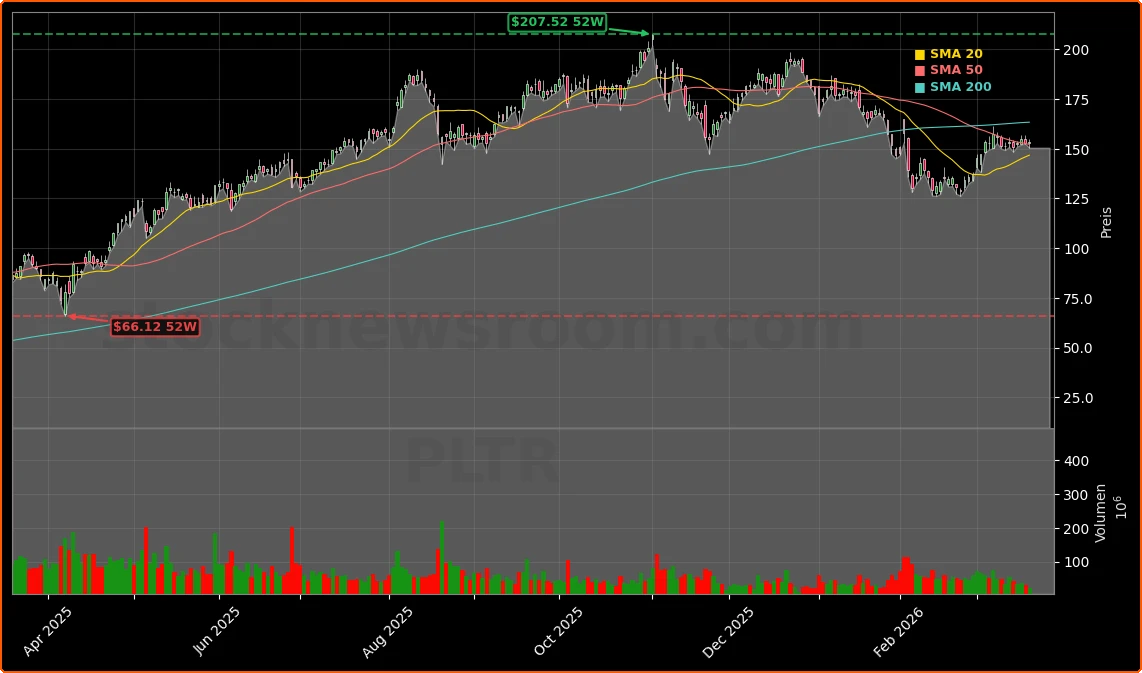
Palantir Technologies Inc. (PLTR) edged up about 0.45% to $153.46 on Thursday in New York, modestly extending a 12‑month rally of more than 77%. The company’s unveiling of the Palantir Mortgage Platform with Moder lands at a time when the shares trade 4.3% above their 20‑day simple moving average yet 8.8% below the 100‑day SMA, signaling short‑term strength but lingering medium‑term volatility. With the stock near the upper half of its 52‑week range and a neutral relative strength index (RSI) around 55, the new mortgage push may serve more as a narrative and pipeline catalyst than an immediate technical breakout trigger.
Momentum indicators remain constructive: the MACD sits comfortably above its signal line, hinting at underlying bullish sentiment even as traders digest prior gains. Against this backdrop, the Palantir Mortgage Platform offers Wall Street another proof point that the company’s AI orchestration layer can address large, highly regulated markets beyond defense and government — a theme that many institutional investors have been hoping to see scale.
What exactly are Palantir and Moder building?
The partnership with Moder centers on an AI‑powered mortgage operations suite designed to sit on top of existing loan‑origination and servicing systems. Using Palantir’s Ontology and an agentic AI framework, the Palantir Mortgage Platform translates complex mortgage guidelines and internal policies into configurable, testable and auditable rules. That allows lenders and servicers to automate tasks such as eligibility checks, document review and servicing workflows while maintaining strict governance and compliance.
Early deployments at Freedom Mortgage, one of the largest U.S. non‑bank lenders, are already live across several key processes. Management on both sides report measurable gains in speed and accuracy, enabling front‑line mortgage operators to handle more volume with fewer errors while improving response times for borrowers. Moder’s leadership argues that by cutting operating friction, lenders can lower unit costs and potentially pass some savings through as more competitive rates or fees, expanding access to homeownership.
Strategically, this gives Palantir another flagship commercial reference in consumer finance, a sector historically dominated by core‑banking vendors and specialized fintechs rather than AI platform companies. It also reinforces Palantir’s pitch that its software is not just a tool for defense intelligence or industrial analytics, but a horizontal layer that can unify data across the full mortgage lifecycle, from application and underwriting to servicing and loss mitigation.
How does this fit into Palantir’s AI growth story?
Wall Street’s broader view of Palantir remains bullish. The company is expected to update investors again around May 4, 2026, with consensus estimates calling for earnings per share of $0.26, up from $0.13, on revenue of roughly $1.54 billion versus $883.86 million previously. That growth profile helps explain why the stock trades at a lofty price‑earnings multiple near 242x, a premium even among high‑growth software names in the S&P 500 and on the NASDAQ.
Analyst sentiment has strengthened in recent days: UBS raised its price target to $200 with a Buy rating, Rosenblatt also lifted its target to $200 while maintaining Buy, and Wedbush reiterated an Outperform rating with an even more aggressive $230 target. Independent research pieces have highlighted Palantir as one of the most consequential AI infrastructure players globally, emphasizing its ability to orchestrate complex data and AI workflows in real‑world environments. The Palantir Mortgage Platform extends that thesis into the housing market, where automation and compliance are both mission‑critical.
ETF exposure amplifies the stock’s macro sensitivity. Palantir commands weights of roughly 8–9% in AI‑focused and software ETFs such as the iShares Expanded Tech‑Software Sector ETF (IGV), REX AI Equity Premium Income ETF (AIPI) and NestYield Dynamic Income ETF (EGGY). Any sizable inflows or outflows from these funds could mechanically increase volatility, especially as news around new verticals like mortgages drives sentiment.
How does Palantir compare with AI rivals?
For U.S. investors, the mortgage move also matters in the context of rising competition in applied AI. Firms like BigBear.ai are pitching alternatives in defense and analytics, but still struggle with profitability and revenue pressure, leaving Palantir in a stronger financial and operational position in that niche. On the broader AI landscape, hyperscalers and chip leaders such as NVIDIA remain core holdings for exposure to infrastructure and compute, while data‑rich consumer platforms like Apple and Tesla pursue vertical AI strategies inside their ecosystems.
Palantir’s edge sits in the orchestration of secure, governed, end‑to‑end workflows rather than raw model training or hardware. By embedding into highly regulated, sticky operations like mortgage servicing, the Palantir Mortgage Platform could deepen switching costs and lengthen contract durations. That pattern mirrors its success in defense and industrial analytics, where once Palantir’s software is integrated, customers are reluctant to unwind it. If the Moder partnership scales across other banks, insurers and asset managers, Palantir could broaden its commercial mix and reduce dependence on lumpy government deals.
Related coverage to watch
Investors tracking this development may also want to look at how Palantir’s broader AI business is evolving. A recent deep dive, “Palantir AI Platform $1B Deal and Growth Boom Explained”, breaks down the company’s $1 billion contract wins and examines whether its rapid growth justifies today’s valuation multiples. Together with the new Palantir Mortgage Platform initiative, these developments illustrate how the company is trying to convert its AI leadership into durable, multi‑vertical revenue streams.
“This strategic partnership will reshape the future of our industry, helping improve affordability, lower borrowing costs, and expand access to homeownership for millions of Americans.”— Michael Middleman, Chairman of Moder
In sum, the Palantir Mortgage Platform gives Palantir Technologies Inc. a fresh, scalable foothold in U.S. consumer finance, pairing its AI infrastructure with Moder’s mortgage expertise and Freedom Mortgage’s national footprint. For shareholders, the project reinforces the long‑term growth story but also underlines the high expectations already embedded in a richly valued stock. The next few quarters will show whether this mortgage bet can meaningfully expand Palantir’s commercial revenue base and help sustain its momentum on Wall Street.