
Is Palantir’s Pentagon AI dominance a durable defense moat for investors or a fragile bet on one customer and one program?
Palantir Technologies Inc.: What the Market Is Pricing In
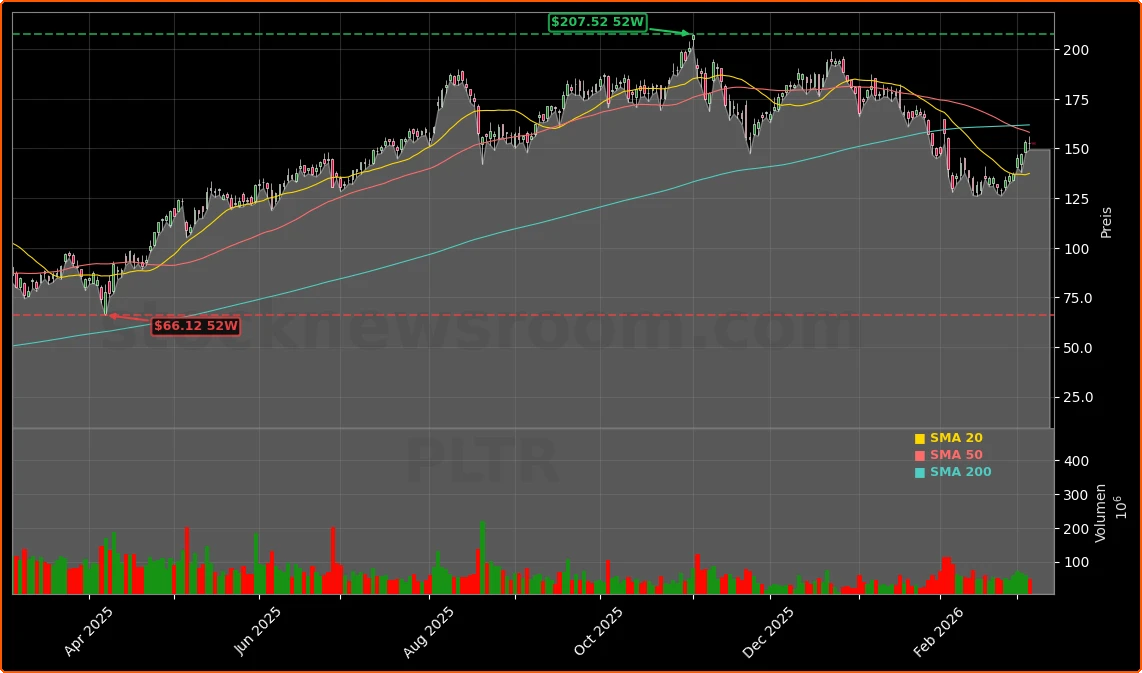
Palantir Technologies Inc. has become one of the poster children of the current artificial intelligence cycle. At a share price of about $152.67 at the regular close on March 5, 2026 (slightly lower in after-hours trading), the stock is roughly 30% below its all-time high near $207 but still reflects enormous growth expectations. The company has compounded revenue at high double digits, pushed operating margins to 50%, and turned into a cash-rich, debt-light AI platform vendor. Yet with a trailing price-to-earnings ratio near 230 and a forward P/E still around 119, the market is clearly assuming that this growth persists for years.
This setup makes Palantir a quintessential high-beta AI name: a unique mix of defense contractor, data platform vendor, and AI orchestration layer. Its core platforms—Gotham, Foundry, and particularly the Artificial Intelligence Platform (AIP)—allow customers to connect disparate data sources and deploy AI agents into real operations, from battlefields to oil fields to retail logistics. For U.S. investors, the question is not whether Palantir is strategically important; it is whether the current price adequately compensates for the risks that come with Palantir Pentagon AI exposure, customer concentration, and aggressive expectations embedded in the stock.
Palantir Pentagon AI: How Deep Is the Defense Moat?
Palantir’s relationship with the U.S. government—especially the Department of Defense—remains the cornerstone of its business model. In 2025, the company generated $4.48 billion in revenue, up 56% year over year. U.S. government revenue grew 55% to about $1.85 billion, still representing a major share of total sales. The Gotham platform is deeply embedded in intelligence, counterterrorism, and battlefield command applications, giving military decision‑makers a unified operational picture from soldiers’ bodycams up to satellites.
The key reason Palantir Pentagon AI matters so much for the investment case is the MAVEN program. MAVEN is a critical Pentagon initiative to use AI for target detection, prioritization, and battle management. Palantir operates the core platform for MAVEN, which effectively makes its software a brain for parts of modern AI-enabled warfare. This has created a powerful moat: switching out Palantir’s data integration, security controls, and mission workflows would be extremely difficult for the Pentagon without disrupting operational readiness.
However, this also concentrates risk. Defense budgets and priorities can shift with administrations and geopolitical developments. While the current environment—heightened tensions and active conflicts—tends to support higher defense AI spend, investors should not treat Palantir’s government pipeline as risk‑free. Recent channel checks have even suggested that contract value in the U.S. government segment may have softened in some areas, raising questions about the sustainability of the growth rate.
Anthropic, Maven and the New Supply‑Chain Risk for Palantir
The recent Anthropic controversy adds another layer to Palantir Pentagon AI risk. For parts of MAVEN, Palantir’s platform has been using Claude, the large language model from Anthropic, as one of the underlying models to help build and prioritize targeting lists. Defense operators reportedly appreciated Claude for its ease of use, adaptability, and reliability in theater.
The situation escalated when the Pentagon informed Anthropic that it now views the company and its products as a supply‑chain risk. Anthropic declined a counteroffer from the U.S. side to resolve disputes around access and data, and was subsequently flagged as a risk by defense officials. Because Claude has been integral to the MAVEN setup operated by Palantir, this decision forces the Pentagon and Palantir to plan for replacement or diversification of models inside critical systems.
For Palantir, this cuts both ways. On the one hand, it underscores how indispensable its platform is: MAVEN is run on Palantir’s infrastructure, and the Pentagon still needs that system even if specific models change. On the other hand, it shows that Palantir Pentagon AI deployments are not insulated from the broader politics and fragility of the AI model ecosystem. If one key model provider is suddenly treated as a security risk, Palantir must quickly re‑architect workflows, retrain operators, and certify new models, all under intense public scrutiny.
Investors should therefore think about supply‑chain diversification as a core part of Palantir’s defense strategy. The company’s strength is that AIP is model‑agnostic: it can orchestrate OpenAI, Anthropic, open‑source models, and proprietary models on top of the same secure data layer. But the Anthropic episode demonstrates that Palantir’s long-term success will depend on maintaining trusted relationships not just with the Pentagon, but across an evolving network of AI model providers.
Commercial AIP Growth: The Counterweight to Defense Dependence
While defense still dominates the narrative, the commercial side of the business has quietly become Palantir’s fastest growth engine. In 2025, U.S. commercial revenue more than doubled, rising 109% year over year to $1.47 billion. Globally, commercial customers accounted for 780 of Palantir’s 954 total customers, with that commercial base growing 37% in just one year. The company closed 180 deals worth $1 million or more in the fourth quarter of 2025 alone, including 84 deals above $5 million and 61 deals above $10 million.
This surge is driven primarily by the Artificial Intelligence Platform. AIP allows enterprises to plug in large language models and operational AI agents directly into their existing Palantir data stacks, with guardrails, auditing, and workflow automation built in. Customers as varied as BP, Lowe’s, Lockheed Martin, and the U.K. Ministry of Defence have adopted AIP to automate complex operations, from energy asset management to supply chains to predictive maintenance.
Management expects momentum to accelerate, guiding for 61% overall revenue growth in 2026 and adjusted operating margin expansion from 50% in 2025 to 57% in 2026. That implies strong operational leverage as the company scales without equivalent increases in headcount or overhead. It also highlights why boards and CIOs increasingly consider Palantir alongside hyperscale cloud players and dedicated AI chipmakers like NVIDIA when designing next‑generation AI architecture.
Analyst Views: From Dan Ives’ Bull Case to RBC’s Stark Warning
Wall Street opinion on Palantir is deeply polarized. On the bullish side, Dan Ives of Wedbush recently described Palantir, alongside Microsoft, as trading at “garage sale” prices relative to the long-term AI and data center opportunity. That reflects the camp that sees Palantir as a long-duration compounder at the core of data infrastructure, benefiting structurally from the need to operationalize AI in real-time environments.
Research from Zacks highlights upward revisions to earnings estimates and points to Palantir’s combination of strong earnings growth and price momentum as grounds to keep the stock on radar. Consensus price targets compiled by some services even suggest potential upside of around 30% from current levels, assuming that revenue and margin trends hold.
The bear camp, however, is vocal. RBC Capital Markets analyst Rishi Jaluria reiterated a sell rating on Palantir with a $50 price target, implying roughly 63% downside from around $135 at the time of his call and still substantial downside from the current $150s. Jaluria flags several issues: signs that U.S. government contract value may be under pressure, concerns that commercial clients might be shifting away after initial excitement, and above all a valuation he views as disconnected from realistic growth scenarios. JPMorgan analysts have also warned of near‑term risks and questioned whether the multiple can remain elevated if growth decelerates even modestly.
For investors, these diverging perspectives boil down to one question: is Palantir primarily a hyper‑growth story priced for perfection, or a durable infrastructure winner in AI that can grow into its valuation as earnings compound?
Valuation: Can Palantir Grow Fast Enough to Justify the Multiple?
By almost any traditional yardstick, Palantir looks extremely expensive. A trailing P/E of about 230 and a forward P/E around 119 put it in rarefied territory, even among high‑growth AI peers. The stock also trades north of 40 times expected 2026 sales, an area usually reserved for smaller, earlier‑stage software names rather than a company approaching $5 billion in annual revenue.
On a price/earnings‑to‑growth (PEG) basis, the picture is slightly more nuanced. With revenue up 56% in 2025 and guidance for 61% growth in 2026, the PEG ratio sits around 3.2, lower than the roughly 5 level it carried through 2024 and 2025. That means the multiple has not expanded as fast as earnings, and some of the prior froth has come out as the stock corrected from its highs. Still, a PEG above 3 signals that the market is paying a premium even after accounting for growth.
The bull argument is that Palantir can justify this valuation by compounding both revenue and operating income at elevated rates for many years. With a 50% operating margin already in place and guidance for 57% next year, each incremental dollar of sales falls heavily to the bottom line. The company also boasts $7.2 billion in cash, cash equivalents, and Treasuries with negligible debt, giving it optionality to invest, weather downturns, or repurchase shares.
The bear argument aligns with RBC’s stance: to earn today’s multiple, Palantir must deliver years of nearly flawless execution in both government and commercial markets. Any slowdown in U.S. commercial momentum, unexpected Pentagon budget shifts, or regulatory challenges tied to Palantir Pentagon AI deployments could force a painful re‑rating. This is the same dilemma investors have faced in other richly valued AI names such as NVIDIA and Tesla when expectations outran fundamentals—though those companies operate in very different segments of the AI stack.
Technical Picture and Risk Levels for Traders
From a technical standpoint, Palantir has been through a significant run‑up, followed by a consolidation. After peaking near $207, the stock corrected and later broke out again around $138, with six consecutive days of net buying recently. The price remains about 30% below its record high, leaving room for further recovery if fundamentals and sentiment stay supportive.
However, technicians point to a “death cross” pattern that appeared in late February, where the short-term moving average crossed below the longer-term average, often interpreted as a bearish signal. Key support levels are being watched around $120 and $90. Several market commentators have flagged the possibility of a pullback toward the $90 area if growth expectations are disappointed or if risk‑off sentiment hits high‑multiple AI names.
For short‑term traders, this creates a classic tug‑of‑war: strong momentum driven by upgrades to earnings estimates and AI enthusiasm versus an elevated chart structure and clear downside air pockets if sentiment reverses. For long‑term investors, the technicals mainly highlight entry‑timing risk rather than changing the fundamental thesis.
Competitive Landscape: Where Palantir Fits in the AI Stack
In the broader AI ecosystem, Palantir occupies a different niche than hyperscalers and chip vendors. It does not compete directly with Apple in consumer devices or with NVIDIA in GPUs; instead, it sits above infrastructure, acting as a data fusion and decision layer. In defense, that makes Palantir Pentagon AI offerings a complement to hardware players that build drones, sensors, and communication systems, as illustrated by smaller names working on AI-enabled hardware platforms.
In commercial markets, Palantir competes more directly with cloud-native analytics and data platforms, and with internal build efforts from large enterprises. The company’s advantage lies in its ability to deploy quickly into high-stakes environments—war zones, energy infrastructure, national healthcare systems—where reliability, security, and governance matter as much as model performance. That creates a higher barrier to entry than generic analytics or chatbot solutions.
Looking forward, the main competitive risk is commoditization of underlying AI models and increased willingness of enterprises to rely on improved native cloud offerings. But Palantir’s model‑agnostic architecture and deep integration into operational workflows give it a defensible position, especially where compliance and mission-critical uptime are paramount.
Investors weighing Palantir against other AI vehicles—whether chipmakers, cloud providers, or software giants—should consider portfolio role. Palantir provides concentrated exposure to applied, mission‑critical AI in defense and regulated industries, not broad exposure to the full S&P 500 AI basket. That distinction affects both return potential and risk profile.
Conclusion
In the end, Palantir Pentagon AI prominence, high‑growth commercial AIP adoption, and exceptional profitability make the stock one of the purest plays on operational AI. But they also make it one of the most valuation-sensitive names in the sector. For aggressive investors willing to stomach volatility and policy risk, staggered entry and position‑sizing discipline may be the best way to participate without overexposing a portfolio to a single, highly charged AI story.
Further Reading
- Palantir Technologies Inc. (PLTR) Stock Price, Quote & News (Yahoo Finance)
- Prediction Markets Are All the Rage, but This AI Stock Is a Much Better Investment (The Motley Fool)
- Earnings Estimates Moving Higher for Palantir Technologies (PLTR): Time to Buy? (Zacks Investment Research)
- 2 Popular Artificial Intelligence (AI) Stocks to Sell Before They Drop by as Much as 94%, According to Select Wall Street Analysts (The Motley Fool)