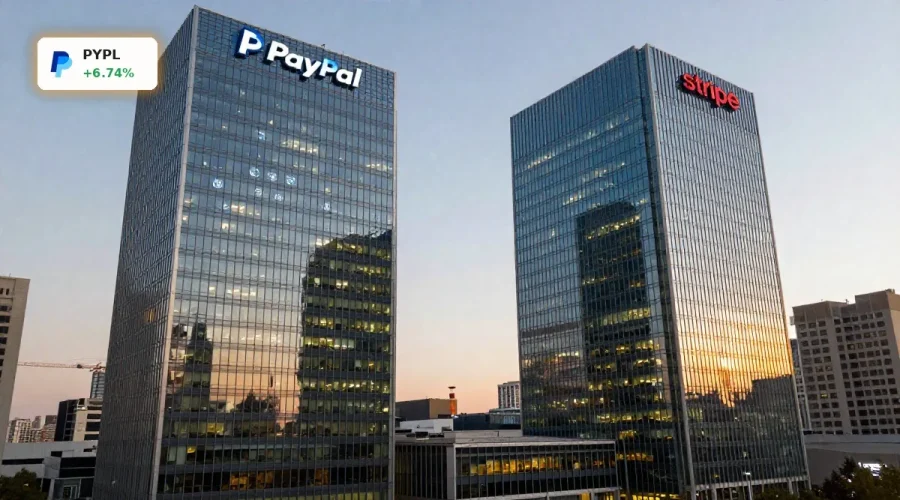
Does a potential PayPal acquisition by Stripe lift the struggling fintech pioneer back up – or is it just market speculation?
PayPal Acquisition: How Strongly Does Stripe Drive the Speculation?
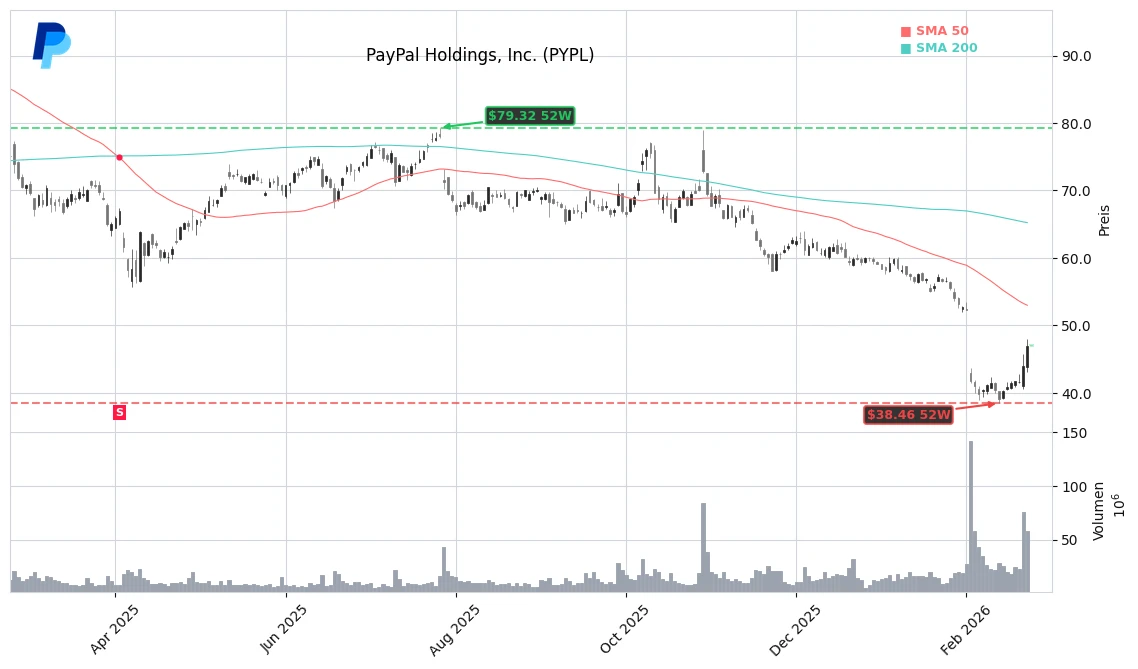
Reports of Stripe’s potential interest in acquiring PayPal have significantly boosted the stock. The price of PayPal Holdings, Inc. rose to $47.02, up from $44.05 the previous day – a daily gain of 6.74%, while after-hours trading confirmed the level at $47.07 (+0.11%). Although PayPal is still well below its 52-week high of $79.50, it has noticeably moved away from its yearly low of $38.47.
The rally was triggered by a report indicating that the payment service provider Stripe is exploring a full or partial acquisition of PayPal. According to insiders, the discussions are still in the early stages, and no binding offer has been made. Concurrently, other scenarios are circulating in the market – from interested banks to technology and crypto companies looking to secure individual platform components like Venmo, Braintree, or the buy-now-pay-later (BNPL) business.
With a market capitalization of around $42 billion and more than 400 to 440 million active accounts, a PayPal acquisition would be a megadeal in the global fintech sector. The annual payment volume of nearly $2 trillion and the strong brand are considered key assets, even though growth has significantly cooled recently.
PayPal Holdings, Inc.: Fundamentals Between Opportunity and Skepticism
Operationally, PayPal Holdings, Inc. presents a solid picture, but is far from its previous growth rates. For the current year, revenue of around $34 billion and earnings before interest and taxes of nearly $6 billion are expected. The valuation level is low following the price decline: The market now values PayPal at a single-digit earnings multiple, which further fuels acquisition speculation.
At the same time, the company is facing structural headwinds. The growth of active accounts has slowed to 1-2% per year, and transaction volumes are growing only in the low single digits. The transaction margin (take rate) has remained stable at around 1.6-1.7% for several quarters. The former growth engine Braintree is being scaled back to stabilize margins, while PayPal is focusing more on higher-value payment streams through its own checkout, Venmo, and BNPL.
The weaker Q4 2025 numbers have recently revealed this: Revenue in the final quarter rose by only about 3-4% to $8.68 billion, missing expectations, as did the EPS of $1.23. Analysts like Jason Kupferberg from Wells Fargo reacted cautiously, maintaining a “Hold” rating while lowering the price target from $58 to $48. Matthew Coad from Truist Financial even downgraded PayPal to “Sell” and reduced his price target from $58 to $39 – a clear signal that not all experts share the acquisition speculation.
PayPal Acquisition vs. New CEO: Which Weighs Heavier?
Alongside speculation about a PayPal acquisition, the company is strategically restructuring. The board has appointed Enrique Lores, former head of HP, as the new CEO and President. He is set to drive the transformation starting in early March, leverage efficiencies, and revitalize the innovation pipeline in the core business. Some analysts point out that the recent setbacks are more due to implementation issues than a structural industry problem.
This creates a tension for investors: On one hand, there is the enticing possibility that a strategic buyer like Stripe, a major bank, or a tech giant could eliminate the valuation discount with a premium. Price targets of $50 to $70 are being discussed in the context of an acquisition, with a renewed attempt toward the price gap of around $61 appearing technically possible, should the recent interim high of $45.70 be sustainably surpassed.
On the other hand, there is the risk that concrete bids may not materialize or that speculation regarding a PayPal acquisition may be clearly denied. In this case, the market’s focus is likely to quickly shift back to the sluggish growth trend, ongoing class-action lawsuits, and intense competition in the payment sector – including pressure from crypto providers and potentially AI-driven payment solutions.
In summary, PayPal represents a classic turnaround and speculative stock: In the short term, speculation around a PayPal acquisition dominates, but in the medium term, the new CEO’s strategy will determine whether the payment giant can return to the growth zone on its own.
Bottom Line
The speculation surrounding a potential PayPal acquisition by Stripe or other strategic buyers has given the struggling stock of PayPal Holdings, Inc. a significant boost in the short term. For investors, the key will be whether loose discussions develop into a genuine offer or if, in the end, the new CEO Enrique Lores must close the valuation gap with a convincing turnaround plan. For risk-tolerant investors, PayPal remains an exciting but volatile fintech stock, where both acquisition scenarios and internal reforms will determine the next price direction.
Related Sources
- PayPal Holdings, Inc. Stock Overview (Yahoo Finance)
- PayPal Jumps on Acquisition Interest and High Trading Volume (The Motley Fool)
- Stripe Considering Possible Acquisition of PayPal (Reuters)
- PayPal Stock Rises After Report of Possible Stripe Bid (CNBC)