
Can a 7.9% post-earnings rally in PDD survive rising costs, shrinking margins and a looming tariff crackdown on Temu’s model?

How did PDD Earnings land versus expectations?
PDD Holdings Inc., the owner of discount platforms Pinduoduo and Temu, posted fourth-quarter 2025 revenue of roughly $18.1 billion, modestly ahead of Wall Street’s consensus near $18 billion. That translates into about 12% year‑over‑year growth in yuan terms and around 20% in dollar terms, a marked cooldown from the 60–70% surge seen in 2024 but still comfortably above most large-cap e‑commerce peers.
On the bottom line, PDD reported earnings per ADS of about $3.06, broadly in line with analyst forecasts but down from the prior year as profit contracted. Net income attributable to shareholders fell 11% to roughly 24.5 billion yuan, and the net margin slipped to around 24–25%. Non‑GAAP net income dropped by a similar percentage, reflecting the impact of sharply higher fulfillment, marketing and R&D spending.
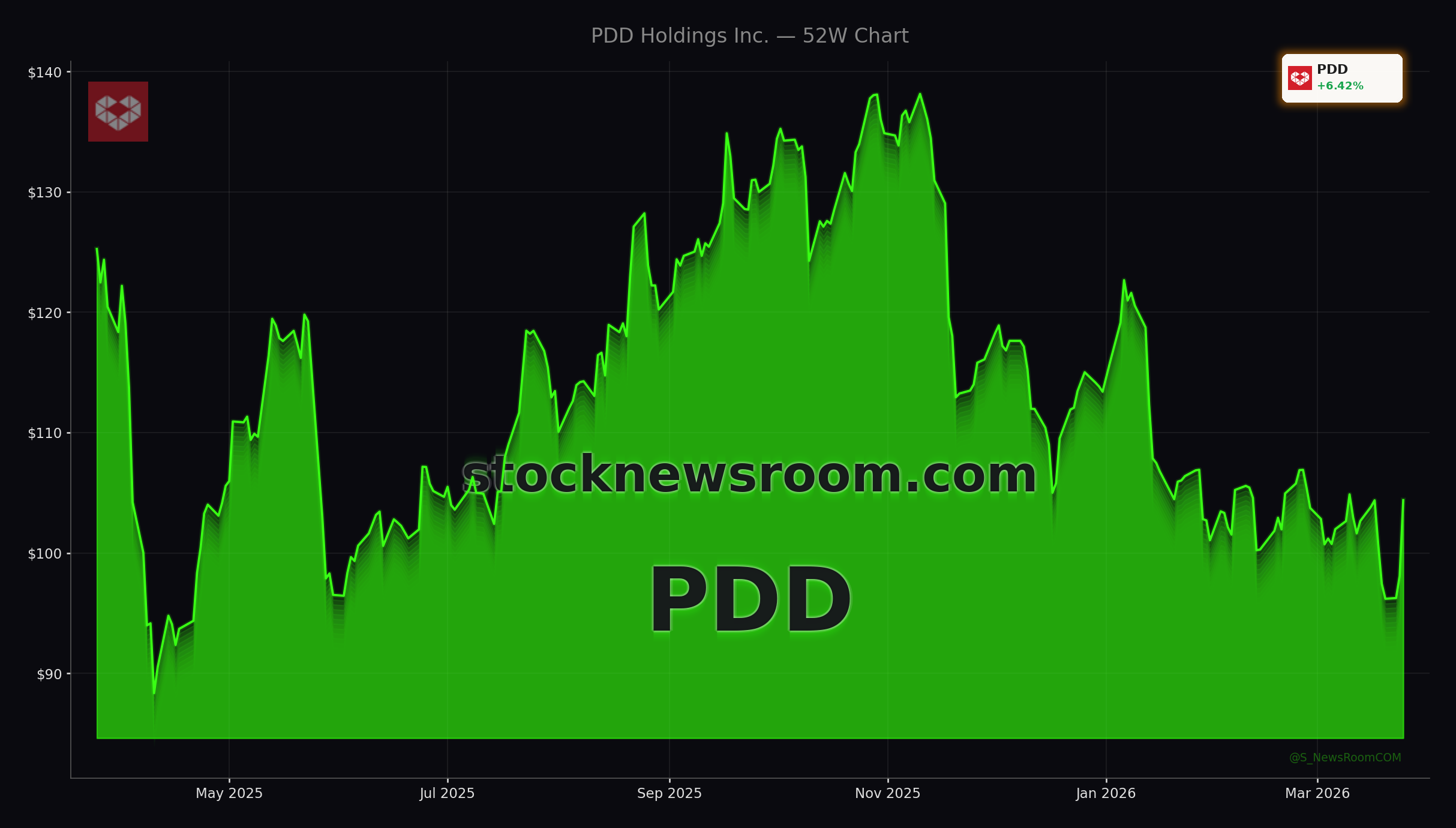
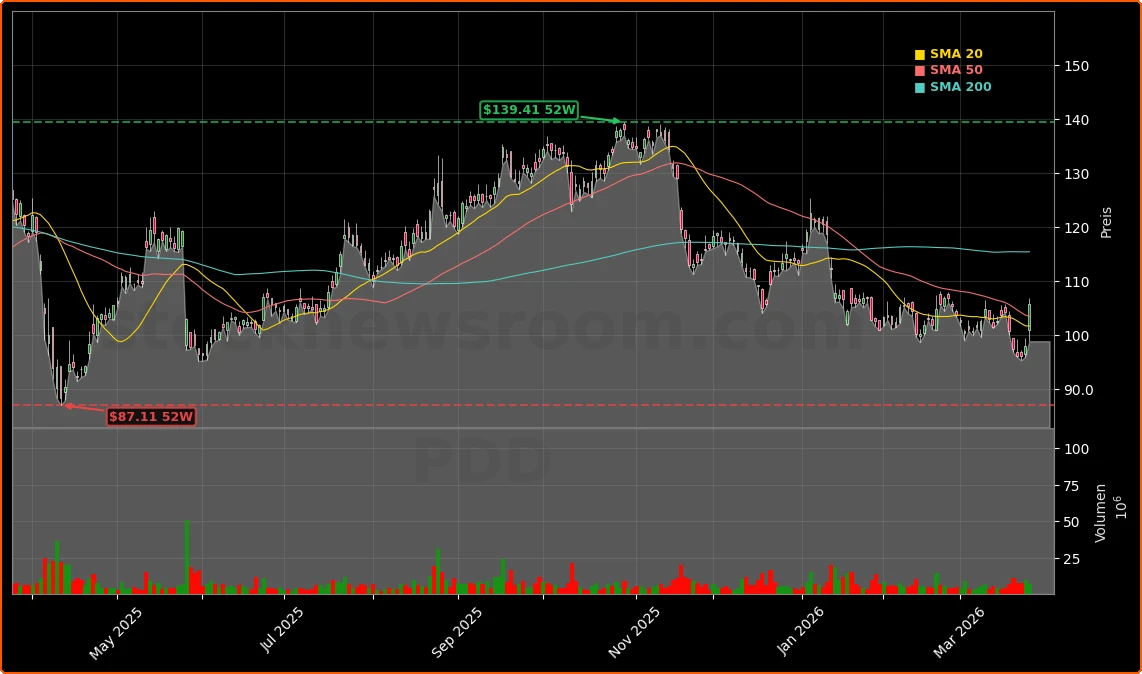
In premarket trading the stock initially came under pressure as traders reacted to the profit miss and margin compression. However, as the market digested the PDD Earnings and focused on the still-strong cash generation and global growth potential of Temu, sentiment improved. By the latest session PDD shares have rebounded to $105.86, up about 7.9% on the day and breaking back above the psychologically important $100 level, though the stock remains well below its 52‑week highs.
What is driving revenue – and the margin squeeze?
The latest PDD Earnings confirm that Temu and the core Pinduoduo marketplace are still expanding rapidly, but that growth is increasingly expensive. Transaction services revenue jumped roughly 19% in the quarter, outpacing the group’s overall top-line and underscoring strong merchandise volume across both domestic and overseas platforms. Online marketing and other services grew at a slower 5%, suggesting brands and merchants are more cautious on ad spend amid intense price competition.
Total cost of revenue climbed about 15%, driven by logistics, fulfillment and payment processing fees associated with Temu’s international push. Operating expenses rose around 10% as sales and marketing outlays swelled to roughly 34.4 billion yuan. Management has made clear that supply chain and ecosystem investments will remain a priority, and finance leadership has warned that these commitments will “inevitably affect” financial performance in the near term.
The result is a paradox familiar to investors in fast-growing platforms like NVIDIA or Tesla during their heavy investment phases: revenue is scaling quickly, but operating leverage is muted as each incremental dollar of sales requires significant upfront spend. PDD’s operating profit still increased year over year, yet net income retreated once higher tax and investment effects were factored in.
PDD Earnings and the impact of new US and EU trade rules
Beyond internal spending decisions, a key overhang on the latest PDD Earnings is regulatory pressure on the cross‑border discount model that powers Temu. In the US, tighter enforcement and partial dismantling of the “de minimis” rule for packages up to $800 is starting to raise effective import costs for ultra‑low‑priced goods shipped directly from China. Market reaction to PDD’s report on some US platforms initially skewed negative as investors connected these changes to the company’s future unit economics.
Europe is moving in the same direction. From July 1, the EU is expected to impose new tariffs and tighter customs scrutiny on low‑value imports under €150, a segment that has been central to Temu’s rapid adoption among price‑sensitive consumers. That puts pressure on PDD to either accept lower margins, renegotiate with suppliers, or raise prices—each with different implications for growth. For US investors used to the dominant positions of Amazon and Apple in their respective ecosystems, Temu’s regulatory exposure introduces a risk profile that looks very different from typical NASDAQ e‑commerce holdings.
Even so, PDD ended 2025 with an enormous cash and short‑term investment pile of about 422 billion yuan (over $60 billion), giving it ample firepower to absorb regulatory shocks, reengineer its supply chain and continue subsidizing customer acquisition. The key question after these PDD Earnings is how quickly the company can translate that war chest into a more durable, regulation‑resilient business model.
How does PDD stack up against US tech and e‑commerce peers?
On traditional valuation metrics, PDD remains strikingly cheap compared with many US growth names. The stock trades at roughly 10 times trailing earnings, a fraction of multiples seen at high‑growth US tech leaders such as NVIDIA or at premium consumer platforms like Apple. However, that discount reflects both geopolitical risk and the structural uncertainty around Temu’s cross‑border model.
For NASDAQ and S&P 500 investors, PDD can offer differentiated exposure: it combines China’s domestic consumption recovery with the global discount e‑commerce theme, a space where US‑listed competitors have limited presence. Yet the latest PDD Earnings make clear that near‑term profit visibility is lower than for more mature platforms, and that margin compression could persist as management pursues an “all‑in” strategy on supply chain and ecosystem investment.
Institutional coverage remains divided. Some US brokers highlight the company’s massive cash balance, still‑robust mid‑teens revenue growth and single‑digit earnings multiple as reasons the risk/reward skew looks attractive after past volatility. Others stress that new US and EU import rules, together with intensifying competition in China’s domestic e‑commerce market, justify a cautious stance until there is clearer evidence that margins have stabilized. Recent commentary from banks such as Goldman Sachs and Morgan Stanley has emphasized exactly this trade‑off between scale and profitability, even as they acknowledge Temu’s strong user momentum.
The external environment and competitive landscape are undergoing rapid changes. To meet the evolving needs of consumers, we must continually explore and make investments.— Jun Liu, VP of Finance, PDD Holdings Inc.
For diversified US portfolios, the takeaway from the current PDD Earnings cycle is that the stock remains a high‑beta satellite position rather than a core holding. The company’s balance sheet and growth profile are impressive, but the regulatory path and margin trajectory are still in flux. The next few quarters will show whether management can convert today’s heavy spending into sustainable global market share without sacrificing the profitability that once made PDD one of China’s most efficient e‑commerce platforms.