Can the latest Plug Power earnings and a surprise swing to positive gross margin really anchor its bold profitability target for 2026?
Plug Power Inc. after Q4: What Exactly Moved the Stock?
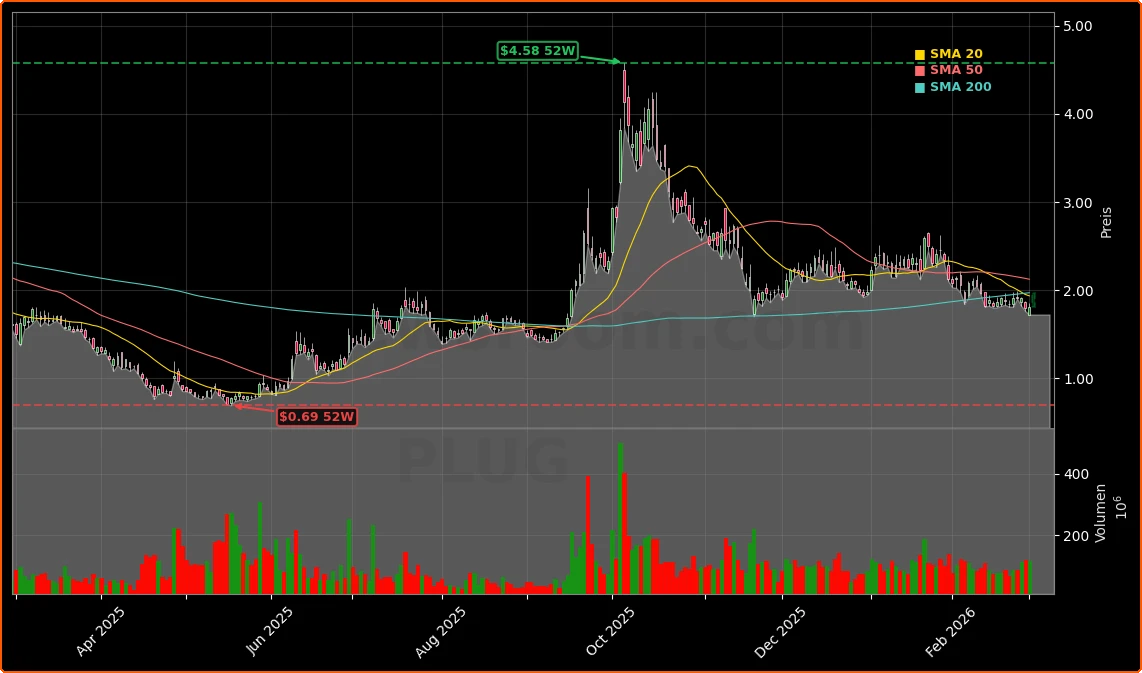
Plug Power Inc. entered its Q4 2025 earnings release as a deeply out-of-favor hydrogen stock, trading around $1.81 at Monday’s close on the NASDAQ, far below its past bull‑market highs. After the Plug Power earnings report crossed the wires, the stock jumped more than 8% in after‑hours trading to roughly $1.96, reflecting renewed optimism that the company may finally be turning the operational corner.
For the fourth quarter, Plug Power reported revenue of about $225.2 million, up 17.6% year over year and above analyst expectations around $217 million. Adjusted EPS improved to a loss of $0.06 per share, dramatically better than the $0.29 loss in the prior-year quarter and also ahead of Wall Street’s consensus for a loss of roughly $0.11 per share. For the full year 2025, the company generated approximately $710 million in revenue and reduced its loss per share from about $2.68 in 2024 to around $1.42 in 2025.
The key qualitative takeaway from these Plug Power earnings, though, is margin direction: management highlighted that the company achieved a positive gross margin in Q4, a stark turnaround from deeply negative levels a year ago. That positive gross margin – helped by the internal “Project Quantum Leap” initiative focused on cost, margin, and cash management – is the centerpiece of the current bull narrative on the stock.
Even so, Plug Power remains an early‑stage, loss‑making clean‑energy company in a highly cyclical and capital‑intensive space. The after‑hours rally must be weighed against the stock’s longer‑term downtrend and heavy dilution over time, leaving the shares largely in speculative territory for most diversified portfolios.
Plug Power Earnings and the 2026 Profitability Roadmap
A central focus of the latest Plug Power earnings update is guidance for 2026. Management is now explicitly targeting positive EBITDAS (earnings before interest, taxes, depreciation, amortization and share‑based compensation) for full‑year 2026, and it has reiterated the goal of achieving positive EBITDAS in Q4 2026 at a minimum. There is also commentary suggesting a “decent chance” of breakeven to slightly positive cash flow in late 2026 if execution stays on track.
To support that ambition, Plug Power expects 2026 revenue growth to be “directionally comparable” to 2025 – roughly in the 30% neighborhood – driven primarily by growth in its material handling and electrolyzer segments. Management claims high confidence in roughly 77%–80% of its projected 2026 revenue, with another 20% in late‑stage negotiations, providing relatively strong top‑line visibility for a company of this size.
On margins, the pivot to positive gross margin in Q4 2025 is a critical proof‑point. Plug Power reported a 125‑percentage‑point swing year over year, from around -122.5% gross margin to +2.4%. This was enabled by better pricing and cost controls across its fuel‑cell systems, optimization of its hydrogen production and logistics network, and improved utilization at plants including the newly commissioned Louisiana hydrogen facility alongside existing Georgia and Tennessee sites.
However, the earnings release also disclosed net charges of roughly $763 million in Q4, mostly non‑cash asset impairments and capital transaction‑related write‑downs. These were linked to slower‑than‑expected growth in certain markets and a reassessment of the recoverable value of some property, plant, equipment, intangibles and power purchase agreement assets. While non‑cash, these impairments underscore that earlier expansion assumptions were overly optimistic and that management is now re‑baselining the asset base.
For investors, the key question is whether positive EBITDAS in 2026 will come primarily from sustainable margin expansion and operating discipline, or from one‑off levers and short‑term cost deferrals. Given Plug Power’s history of ambitious targets followed by under‑delivery, the burden of proof remains high.
Plug Power Business Mix: Where Growth Is Really Coming From?
The Plug Power earnings presentation lays out a clearer picture of the company’s business mix and growth drivers. Management expects, over the next couple of years, that approximately 30%–40% of revenue will stem from the material handling segment – mainly hydrogen fuel‑cell systems used in forklifts and warehouse logistics, where major customers include Amazon, Walmart and newer contracts like Floor & Decor. A slightly smaller, but still substantial, share is expected from electrolyzers, with fuel and cryogenics accounting for the remaining balance.
Electrolyzers are becoming a more central part of the story. Plug Power delivered record electrolyzer revenue of about $188 million in 2025, including project shipments such as 25 MW for Iberdrola and BP, and 100 MW for GALP in Portugal. Management describes an $8 billion electrolyzer pipeline, with 750 MW of new engineering design agreements signed over just two months, implying multi‑year project visibility. Regulation in Europe – including mandates under RED III – is expected to support long‑term demand, with estimates suggesting 4–6 GW of electrolyzer capacity may be needed for transportation markets alone by 2030.
On the hydrogen production side, the commissioning of the Louisiana plant adds scale and improves operating leverage by reducing per‑unit costs and improving logistics. Plug Power aims to further optimize its production and fuel network to enhance margins as utilization and throughput increase. This is crucial, as prior quarters were burdened by expensive third‑party hydrogen purchases and logistical inefficiencies that crushed gross margins.
From a capital allocation perspective, Plug Power ended 2025 with about $368.5 million in unrestricted cash, excluding planned asset monetizations of roughly EUR 275 million expected to close in 2026. Management also flagged a reduction in capital expenditures in Q4 2025, one of the lowest recent quarters for CapEx, and plans further CapEx discipline in 2026, all part of the effort to extend the cash runway and pivot towards self‑funded growth.
Plug Power vs. U.S. Clean‑Tech Peers: How Does It Stack Up?
Within the U.S. clean‑energy and electrification universe, Plug Power sits in a more speculative category than large, profitable names like NVIDIA or Apple, whose AI and consumer hardware businesses generate robust free cash flow and support inclusion in many core S&P 500 portfolios. Compared with EV leaders such as Tesla, which remains profitable despite cyclical pressure, Plug Power is still firmly in the “turnaround” camp with no GAAP profitability and high execution risk.
Instead, Plug Power is more directly comparable to earlier‑stage hydrogen and fuel‑cell names, where investors focus on technology positioning, regulatory tailwinds, and the path to positive cash flow rather than near‑term earnings multiples. Unlike diversified industrials in the S&P 500 that treat hydrogen as one of many growth vectors, Plug Power is largely a pure play on the green hydrogen ecosystem, from electrolyzers to fuel‑cell systems to hydrogen production and distribution.
That specialization cuts both ways. On the positive side, Plug Power is well positioned to benefit from scaling demand in industrial decarbonization, transportation and logistics, especially in Europe and North America as hydrogen infrastructure and regulations mature. Its customer list in material handling already includes blue‑chip names such as Amazon and Walmart, showing tangible industrial adoption.
On the negative side, this concentration exposes investors to sector‑specific risks: policy reversals, a slower build‑out of hydrogen infrastructure, higher‑for‑longer interest rates that hurt capital‑intensive projects, and intensifying competition from other technologies (advanced batteries, hybrid systems) and hydrogen peers. The non‑cash impairments booked in Q4 are a stark reminder that some markets are simply not scaling at the pace originally envisioned.
For U.S. investors constructing diversified portfolios, Plug Power resembles a high‑beta satellite position rather than a core holding – closer to speculative climate‑tech names than to mega‑cap growth stocks like Tesla or diversified chip leaders such as NVIDIA. Careful position sizing and risk management are therefore essential.
Risk Check: Legal Overhangs, Impairments and Execution Challenges at Plug Power
Beyond the operational metrics in the Plug Power earnings report, several risk factors loom large. Multiple law firms – including Rosen Law Firm, the Schall Law Firm, Bleichmar Fonti & Auld, Bronstein Gewirtz & Grossman, and others – have announced securities class actions on behalf of investors who purchased Plug Power shares between January 17, 2025 and November 13, 2025. These suits allege violations of federal securities laws and seek to recover losses stemming from significant stock declines during the class period.
While it is too early to forecast outcomes or settlement sizes, the presence of overlapping class actions adds a layer of legal and reputational overhang. It can also absorb management’s time and attention precisely when execution on the 2026 roadmap is critical. Investors should follow developments and any company disclosures on potential legal liabilities, though historically many such cases resolve via insurance‑backed settlements without crippling the underlying business.
The $763 million in net charges recorded in Q4 – predominantly non‑cash asset impairments – represent another major risk signal. Management explicitly tied these impairments to slower‑than‑expected growth in certain markets and revised expectations for the long‑term profitability of some assets. In effect, the company is acknowledging that earlier capital deployment and growth assumptions were too aggressive.
Combined with Plug Power’s history of under‑delivering on earlier forecasts, this track record calls for a healthy dose of skepticism around its 2026 EBITDAS and cash‑flow targets. Turnarounds often look most attractive right before they hit new roadblocks; investors should continue to monitor quarterly updates closely for confirmation that gross margin expansion is sustainable and that operating losses continue to shrink in line with the roadmap.
From a balance sheet standpoint, while unrestricted cash of $368.5 million plus expected asset monetizations provide some comfort, Plug Power likely remains dependent on external capital or strategic partnerships if growth outpaces internal funding or if macro conditions worsen. In a higher‑rate environment, equity raises are dilutive and debt more expensive, both of which can weigh on shareholder returns.
How Wall Street Might Value Plug Power After These Earnings
Given the lack of GAAP profitability and the company’s evolving business mix, traditional valuation metrics like P/E are not meaningful for Plug Power. Instead, investors typically look at revenue multiples, margin trajectories and long‑term addressable market estimates when benchmarking the stock against hydrogen and fuel‑cell peers. Positive gross margin in Q4 is a key milestone that may support higher revenue multiples than those assigned to companies still losing money on every unit sold.
However, the combination of past guidance misses, large non‑cash impairments, and legal overhangs tends to keep valuation in check. Historically, research desks at major firms such as Citigroup or RBC Capital Markets have taken a cautious stance on the hydrogen space, often rating Plug Power and peers at “Neutral” or “Sector Perform” when enthusiasm got ahead of fundamentals. While specific, up‑to‑the‑minute rating changes were not the main focus of the latest Plug Power earnings commentary, the overall tone on Wall Street has generally shifted from hyper‑bullish growth expectations toward a more measured, show‑me posture.
In practice, that means Plug Power is unlikely to regain its prior peak multiples unless management can deliver several consecutive quarters of positive gross margin, narrowing operating losses and clear progress toward the 2026 EBITDAS target. Investors should track not only headline revenue growth but also segment profitability trends in material handling, electrolyzers, and hydrogen production, as these will determine whether the current business model can scale without constant equity dilution.
2025 was a defining year for Plug Power, with revenue growth, a swing to positive gross margin in the fourth quarter, and a clearer roadmap toward positive EBITDAS by 2026.
— Jose Luis Crespo, CEO of Plug Power Inc.
Conclusion
For growth‑oriented investors willing to tolerate volatility, the pathway is conceptually straightforward: accumulate a small position on signs of real execution, monitor quarterly Plug Power earnings closely for confirmation, and be prepared to cut exposure if the trajectory reverses. More conservative investors may prefer to watch from the sidelines until the company proves that this margin inflection can be sustained through a full economic cycle.
Further Reading
- Plug Power Inc. (PLUG) Q4 2025 Earnings Call Transcript (Seeking Alpha)
- Why Plug Power Stock Popped in After-Hours Trading (The Motley Fool)
- Plug Power Reports Q4 and Full Year 2025 Results with Strong Sales Growth and Margin Expansion (GlobeNewswire)
- Plug Power Inc. (PLUG) stock quote and profile (Yahoo Finance)