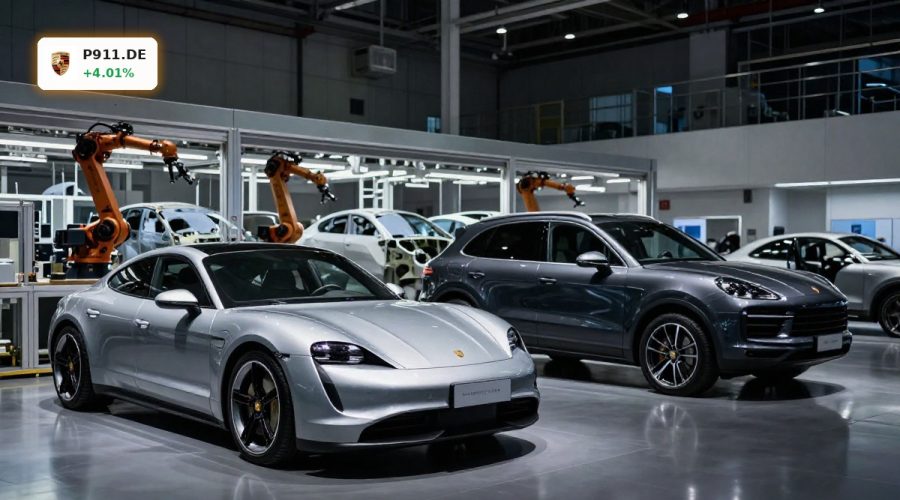
Can a 91% profit collapse, a dividend cut and a strategy U-turn really justify a 4% rally in Porsche shares?
How bad were Porsche Earnings for 2025?
Dr. Ing. h.c. F. Porsche AG reported a brutal hit to profitability for 2025 as billions of euros in special charges wiped out what had been one of Europe’s most profitable carmakers. Group revenue slipped to about EUR 36.3 billion from roughly EUR 40.1 billion a year earlier. Far more striking for investors, operating profit plunged almost 93% to just EUR 413 million, driving the operating margin down to a mere 1.1%, a fraction of historic double‑digit levels.
Net income after tax collapsed by around 91.4% to only EUR 310 million, compared with nearly EUR 3.6 billion in the prior year. In the core automotive business, stripping out financial services, operating profit shrank to about EUR 90 million, highlighting how thin the cushion has become if market conditions deteriorate further. For international investors accustomed to seeing Porsche as a margin benchmark against peers like Tesla or premium German brands owned by Volkswagen, the 2025 Porsche Earnings mark a clear break from the past.
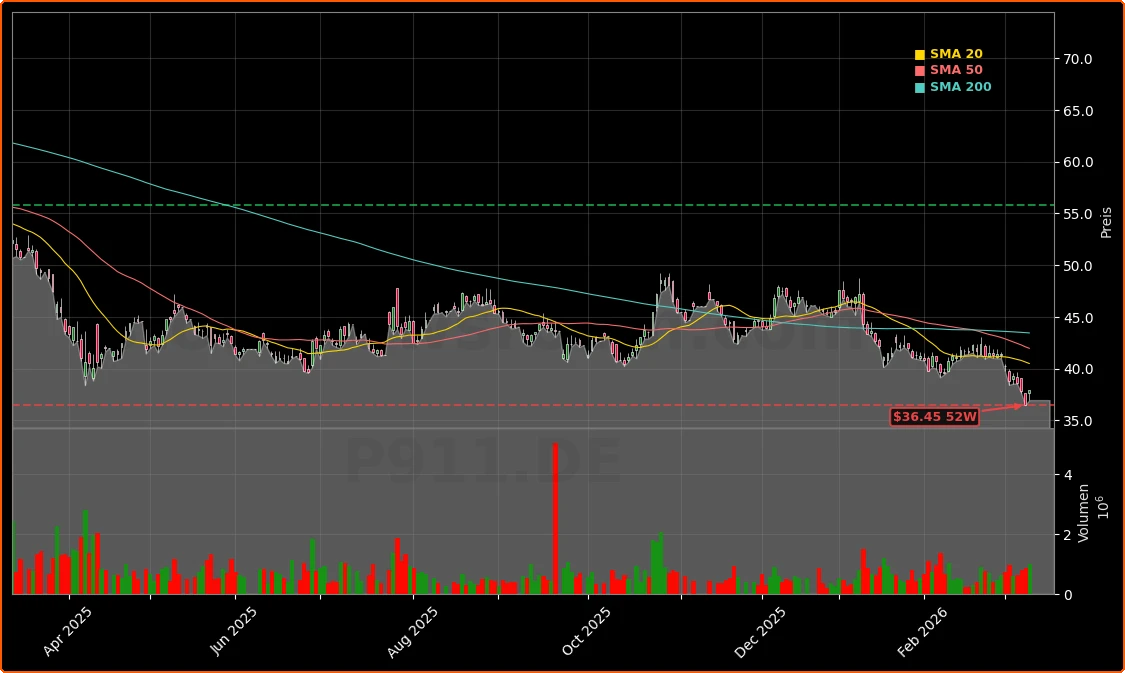
The stock nonetheless closed at EUR 37.91 on Xetra, up roughly 4% versus the previous session, though still far below its 52‑week high near EUR 58.76. That rebound suggests markets had largely priced in weak Porsche Earnings and are now shifting focus toward the restructuring story and the 2026 guidance.
What drove the collapse at Porsche?
The 2025 Porsche Earnings were dominated by extraordinary items linked to a major strategy reversal. The group booked about EUR 3.9 billion in special charges. Roughly EUR 2.4 billion related to extending the life of combustion‑engine product lines after earlier pushing aggressively into pure EVs. On top of that, the wind‑down of a battery subsidiary cost around EUR 700 million, while higher U.S. tariffs added another similar amount.
Operational headwinds compounded the pain. Demand in China, historically one of Porsche’s most profitable markets, slowed significantly as the luxury segment came under pressure and local competition intensified. In the United States, tariff uncertainty inflated costs and muddied pricing power. Meanwhile, pure electric models failed to gain the traction management had anticipated, forcing the brand to lean harder on traditional and hybrid drivetrains for cash flow.
New CEO Michael Leiters, who took over at the start of 2026, framed the reset as a deliberate move to make the company “slimmer, faster and more desirable.” He emphasized a “value over volume” approach, particularly in China, and highlighted a cautious ramp‑up of the fully electric Cayenne to avoid quality issues. While that message may reassure long‑term shareholders, the near‑term cost is unmistakable in the latest Porsche Earnings.
Porsche Earnings and the new dividend policy
One of the most tangible shocks for income‑oriented investors is the dividend. The management board proposed a payout of EUR 1.01 per preferred share, down sharply from EUR 2.31 a year earlier – a cut of roughly 56%. Earnings per share fell even harder, to just EUR 0.48, meaning the proposed dividend significantly exceeds the 2025 bottom line.
Under Porsche’s existing policy, about 50% of net income is meant to be returned to shareholders. Sticking rigidly to that rule would have implied a dividend closer to EUR 0.24 per preferred share – an almost 89% reduction. Management instead opted for a much smaller cut, reflecting the company’s strong net liquidity and the influence of majority owner Volkswagen and the Porsche‑Piëch family, who benefit from robust cash distributions.
For Wall Street portfolio managers comparing European auto dividends to U.S. names like Apple or high‑growth tech such as NVIDIA, the new payout still screens as attractive on a yield basis at current prices. But the disconnect between depressed Porsche Earnings and a relatively generous dividend raises questions about how much financial flexibility the company is willing to sacrifice to keep key shareholders satisfied.
Can Porsche’s strategy pivot restore margins?
Looking ahead, management is signaling that 2026 should mark the first step toward a healthier margin profile, though not a full recovery. The company expects group revenue between EUR 35 billion and EUR 36 billion and targets an operating margin of 5.5% to 7.5%. That would still be well below the mid‑teens margins investors once associated with the brand but would represent a clear improvement from 2025.
Chief financial officer Jochen Breckner warned that 2026 will again be weighed down by one‑off “recalibration” effects in the high hundreds of millions of euros. These will stem from restructuring, portfolio adjustments and further implementation of the new strategy. At the same time, Porsche is examining an expansion of its lineup into higher‑margin segments above today’s two‑door sports cars and above the Cayenne, aiming to reinforce its luxury positioning rather than chase volume, similar to the approach seen at Apple with premium product tiers.
We will comprehensively reposition Porsche, make the company slimmer and faster, and make the products even more desirable.
— Michael Leiters, CEO of Dr. Ing. h.c. F. Porsche AG
Conclusion
The broader market backdrop remains challenging. Management expects continued pricing pressure in EVs, especially in China, ongoing geopolitical risks and persistent uncertainty around U.S. trade policy. Compared with U.S. automakers or EV‑pure plays like Tesla, Porsche is explicitly embracing a diversified drivetrain mix – combustion, hybrid and electric – in an effort to smooth earnings through the transition and defend brand equity.
Further Reading
- Porsche AG posts sharp 2025 profit decline amid restructuring costs (Reuters)
- European autos under pressure as Porsche restructures and cuts dividend (Bloomberg)
- Porsche AG annual report 2025 (Porsche AG)
- Dr. Ing. h.c. F. Porsche AG bei Yahoo Finance (Yahoo Finance)