Is the quiet reshuffle in Puma’s shareholder base about to turn into a full-blown Puma Acquisition battle?
Puma SE: Why Wall Street Is Suddenly Watching Again
Puma SE, long overshadowed internationally by larger peers like Nike and Adidas, has reappeared on global investor screens as its share price and ownership profile shift simultaneously. The stock, trading around $23.01 after a 6.3% single‑day gain, is still well below typical large‑cap sportswear valuations but is now supported by a tight group of anchor shareholders controlling more than one‑third of the company. For U.S. investors who often focus on mega‑caps like Nike on the NYSE or lifestyle names such as Lululemon on the NASDAQ, Puma has been easy to overlook. The recent moves by deep‑pocketed strategic investors suggest that this relative neglect could be changing.
The structural change is notable: a sizeable Chinese sportswear champion is stepping in as the largest shareholder, while a prominent UK retail tycoon is building a significant position around current prices. That combination raises the probability that a Puma Acquisition – either an outright takeover or a staged bid – could materialize if the market continues to undervalue the brand relative to global peers. With the shares still far below any 52‑week or all‑time highs, the setup will look familiar to value‑oriented investors who have profited from European consumer turnarounds before.
Puma SE: What Exactly Is Changing in the Shareholder Base?
The most important structural shift is the exit of the French Pinault family, which for years anchored Puma through its investment vehicle Artemis alongside the luxury group Kering. At the end of January, Chinese sportswear group Anta Sports Products agreed to acquire roughly a 29% stake in Puma for a purchase price reported at about EUR 1.5 billion. That deal effectively hands Anta the role of core strategic shareholder and signals that one of Asia’s most ambitious athletic brands sees material long‑term value in Puma.
Shortly afterward, the market was surprised by the entry of British billionaire Michael Ashley, known for building stakes in European retail and sports businesses through the Frasers Group. Ashley has reportedly accumulated about 5.8% of Puma’s share capital, largely via derivatives, making him the second‑largest shareholder behind Anta. In parallel, the Frasers Group has disclosed a position of roughly 6%, reinforcing the impression that this is not a passive portfolio holding but a deliberate strategic move into the brand.
With Anta’s 29% plus Ashley’s and Frasers’ combined stake, over one‑third of Puma is now in firm, long‑term hands. For equity markets, that has two direct consequences. First, the free float is tighter, making the stock more elastic to incremental buying or short covering. Second, the presence of multiple motivated strategic investors naturally fuels debate about whether a Puma Acquisition is on the table, especially if the share price remains well below perceived intrinsic value for a global sports brand.
Puma Acquisition: How Realistic Is a Takeover Scenario?
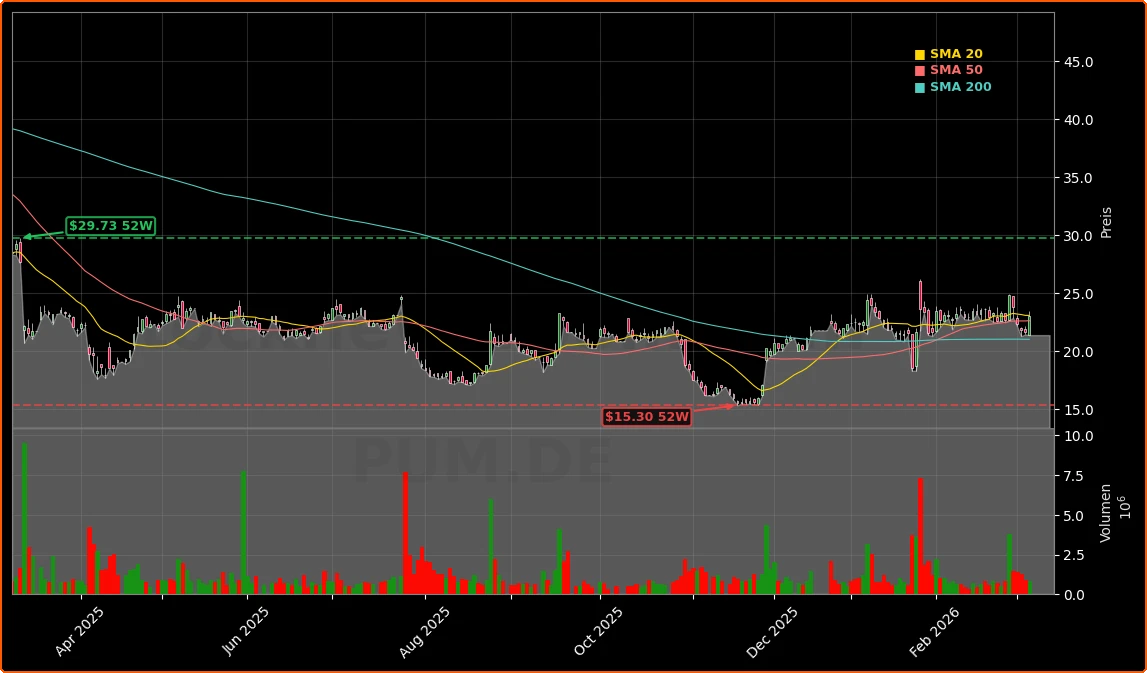
Talk of a potential Puma Acquisition has gained momentum as investors connect three dots: Anta’s sizeable 29% cornerstone position, Ashley’s rapid accumulation of close to 6%, and lingering underperformance in Puma’s share price versus global peers. Market chatter has centered on the possibility that a bid could emerge in the EUR 30–35 range per share. With the stock at around EUR 23 (roughly $23.01 in current trading), that would imply upside of more than one‑third for existing shareholders.
Several technical factors support this speculation. First, chart watchers point to an open price gap between roughly EUR 22 and EUR 28, which could be filled if buying pressure persists. Second, trading patterns around EUR 21.40–21.50 suggest that anchor investors have been defending that zone as a strategic accumulation area, effectively placing a soft floor under the stock. For potential arbitrage or event‑driven investors in New York or London, that profile – defined downside with a credible corporate action catalyst – is inherently attractive.
However, investors should remain clear‑eyed about the mechanics. A full Puma Acquisition would likely require regulatory approvals in Europe and potentially in China, given Anta’s role. It would also need alignment between Anta, Ashley, and other institutional shareholders. While the current structure makes a bid easier to coordinate than when the Pinault family was a long‑term sponsor, there is no binding indication that Anta or any other party intends to launch an offer imminently. For now, the Puma Acquisition narrative is a probability spectrum, not a base case – but one with enough visible pieces to justify a risk‑reward reassessment.
Adidas and Nike: How Does Puma’s Valuation Stack Up?
From a U.S. investor perspective, the key context is how Puma compares to global benchmarks such as Nike in the U.S. and Adidas in Europe. While detailed earnings multiples are not provided here, the market’s long‑term behavior gives some clues. Nike typically commands a premium valuation in the S&P 500 consumer discretionary space thanks to its scale, margins, and brand strength. Adidas usually trades at a discount to Nike but at a clear premium to smaller rivals when growth and profitability are intact.
Puma, by contrast, historically sits another step down the valuation ladder, reflecting its smaller scale, more Europe‑centric exposure, and somewhat more volatile execution. Yet, the brand has global recognition, especially in soccer and lifestyle collaborations, and participates in the same long‑term macrotrend toward athleisure and sportswear. When a company with that profile trades markedly below its larger peers and simultaneously attracts multi‑billion‑euro strategic investments, it naturally invites re‑rating arguments.
For North American portfolios already overweight Nike or lifestyle names like Lululemon, Puma can be viewed as a leveraged European satellite exposure to the same theme. If Anta and Ashley successfully push for operational improvements, better distribution, or more aggressive brand positioning, the gap in valuation versus Nike and Adidas could narrow. In a Puma Acquisition scenario where a bidder pays a control premium, that relative discount might close much faster, which is precisely why event‑driven funds are watching the stock closely.
Puma SE: Technical Picture and Trading Dynamics
The near‑term technical backdrop supports the idea that sentiment has turned a corner. Thursday’s rally of more than 6% to $23.01 came on the back of ownership news rather than fundamental earnings releases, underscoring how sensitive the stock is to corporate developments. Importantly, this move occurred from a base region where key investors appear to have been defending the stock, around EUR 21.40–21.50, helping to establish that range as a reference support zone.
Technicians note a visible chart gap between roughly EUR 22 and EUR 28, a zone that has not yet been fully retraced. If the stock continues to attract incremental buying on any signs of corporate action or positive sales momentum, filling that gap becomes a plausible medium‑term target. That would already align with the lower band of speculative takeover talk and offer meaningful upside to short‑term traders, even without a formal Puma Acquisition proposal.
At the same time, the current price level is well below typical 52‑week highs for leading sportswear names, which should temper enthusiasm about calling any short‑term spike a sustained breakout. Wall Street investors used to deep and liquid S&P 500 components need to respect the fact that Puma trades on a European exchange with more concentrated ownership and thinner volumes. That profile can amplify both rallies and corrections; disciplined position sizing and stop‑loss management are essential.
Puma SE: Strategic Logic for Anta and Michael Ashley
Understanding the strategic motives of Anta and Michael Ashley is crucial to evaluating the likelihood and structure of any future Puma Acquisition. For Anta, the logic is relatively straightforward. As one of China’s largest sportswear companies, Anta has already shown a willingness to expand internationally through meaningful stakes, such as in Amer Sports. Owning a near‑30% share of Puma gives Anta exposure to a globally recognized European brand with deeper roots in soccer and lifestyle categories, while diversifying revenue beyond Asia.
There are also potential long‑term synergies in sourcing, product development, and distribution. While no cross‑company integration has been announced, Anta could over time help Puma access Asian growth channels more efficiently, while leveraging Puma’s brand equity in football to complement its own portfolio. If such synergies prove material, it would strengthen the case for Anta to consider a higher‑stakes commitment, possibly up to or including a Puma Acquisition if valuation remains attractive.
Michael Ashley’s presence introduces a different dimension. Through Frasers Group, he has a long track record of opportunistically buying into underappreciated European consumer brands and retailers, often at moments of market skepticism. Building a 5.8% economic exposure in Puma, largely via derivatives, suggests he sees a compelling risk‑reward at current prices. Ashley is known for being an active, sometimes aggressive, shareholder who pushes for operational and strategic changes. His involvement could accelerate any pressure on Puma’s management to optimize profitability, rationalize distribution, or entertain strategic options if the market continues to discount the stock.
What Could Trigger the Next Re‑Rating in Puma Stock?
For investors on Wall Street, the most practical question is what events could take Puma from being a speculative special situation to a more mainstream holding. A formal bid would obviously be the clearest catalyst in the Puma Acquisition narrative, but several other triggers deserve attention. First, sustained evidence that Anta and Ashley are continuing to add to their stakes on any weakness would reinforce the perception of a de facto floor under the share price.
Second, a visible improvement in Puma’s operating metrics – such as better gross margin resilience, inventory normalization, or mid‑single‑digit revenue growth returning in key markets – would support a valuation re‑rating independent of corporate action. In that scenario, long‑only global funds that currently focus on Nike and Adidas might start allocating a small percentage to Puma as a recovery play within the broader sportswear theme.
Conclusion
Third, any fresh communication from Puma’s management regarding capital allocation, partnerships, or distribution initiatives that align with Anta’s global ambitions could be interpreted by the market as laying groundwork for deeper strategic cooperation. Even short of a full Puma Acquisition, a structured alliance on sourcing or joint ventures in Asia could justify higher earnings expectations and, with them, a stronger share price.
Further Reading
- Puma SE profile and listing information (Reuters)
- Anta Sports Products corporate overview (Bloomberg)
- Frasers Group PLC company information (London Stock Exchange)
- Puma SE Eigentümerwechsel und Uebernahmespekulation bei Yahoo Finance (Yahoo Finance)