Are Rigetti Computing Earnings exposing a fragile quantum growth story behind a multibillion-dollar valuation and mounting technology risks?
How did Rigetti Computing, Inc. perform this quarter?
Rigetti Computing, Inc. reported Q4 2025 revenue of just about $1.9 million, down 17% year over year and below analyst expectations near $2.3 million. The shortfall immediately pressured the stock, with shares sliding after the Rigetti Computing Earnings release as Wall Street reassessed growth assumptions. For a company commanding a market capitalization above $5 billion, such a small and shrinking top line is a clear red flag for fundamental investors.
Profitability metrics moved in the wrong direction as well. Gross margin narrowed sharply from 44% to 35%, reflecting higher costs relative to sales and limited operating leverage at the current scale. Operating expenses climbed 19% to roughly $23.2 million, driven by R&D and ongoing commercialization efforts, leaving Rigetti with an operating loss of about $22.6 million for the quarter.
On the bottom line, Rigetti posted an adjusted net loss of $11.3 million, or around $0.03 per share, cushioned somewhat by higher interest income on its substantial cash balance. Even so, the Rigetti Computing Earnings report underlined that the path to profitability remains distant and highly dependent on both technological breakthroughs and commercial adoption of its systems.
What are the key technology and execution risks?
The Rigetti Computing Earnings call highlighted that technology execution, not just revenue, is under scrutiny. Quantum hardware is inherently error‑prone, and Rigetti has been lagging some rivals on error rates, a critical benchmark for real‑world applications. In January, the company delayed shipments of its Cepheus‑1‑108Q quantum computer due to technical issues, a setback that raised fresh questions about reliability and time‑to‑market.
Rigetti now expects to deploy Cepheus‑1‑108Q with a 99.5% median two‑qubit gate fidelity and has reported achieving 99.9% two‑qubit fidelity in the lab. That looks impressive in isolation, but it trails the performance of some competitors such as IonQ, which has announced 99.99% two‑qubit fidelity. In quantum computing, even a tenth of a percentage point can translate into meaningfully higher error rates when computations are scaled up, making Rigetti’s gap non‑trivial for enterprise and government customers demanding robust systems.
To its credit, management has pointed to notable hardware progress, including an 84‑qubit monolithic chip system and a 36‑qubit chiplet‑based architecture aimed at scaling to larger systems. Bulls argue that this modular architecture could ultimately help Rigetti compete with better‑funded players like NVIDIA and Apple that are also exploring quantum‑adjacent acceleration and advanced compute, though Rigetti’s current error performance and slip‑ups like the Cepheus delay temper that narrative.
Does future revenue justify today’s valuation?
Despite the weak Rigetti Computing Earnings print, the company has started to secure more meaningful contracts that should lift revenue in 2026, though still from a very low base. Rigetti sold two Novera systems for about $5.7 million late last year and expects to recognize nearly half of that amount in Q1 2026, with the remainder booked over the rest of the year. In addition, India’s Centre for Development of Advanced Computing ordered an on‑premises 108‑qubit system valued at $8.4 million, planned for deployment in the second half of 2026.
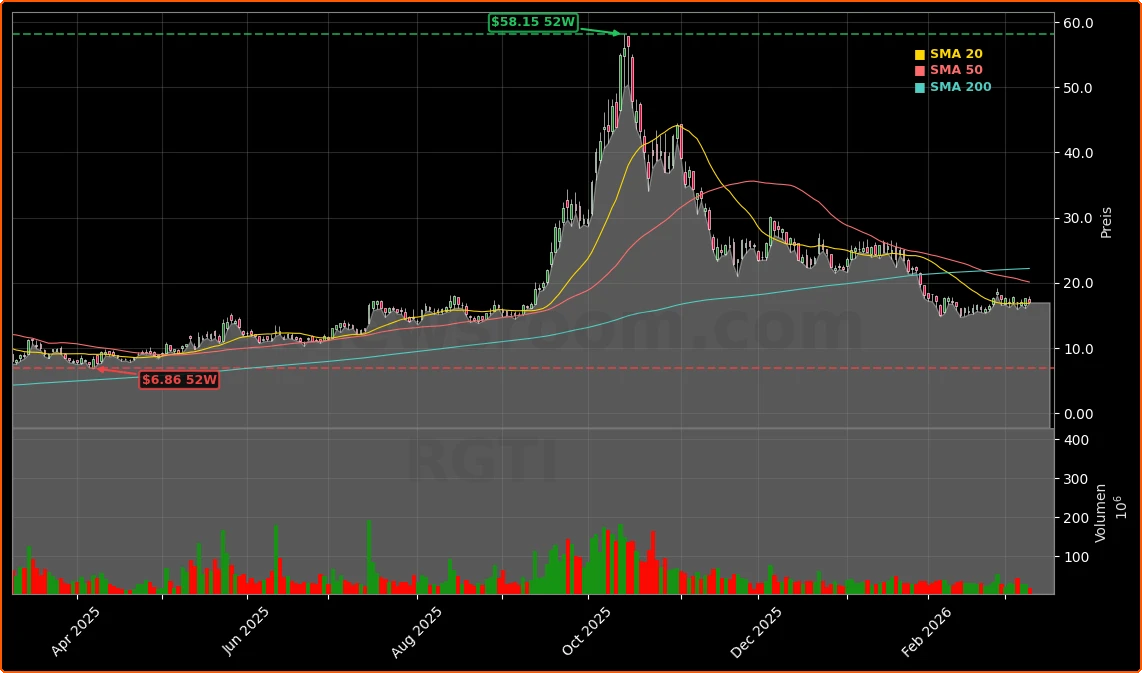
These deals add welcome visibility and validate some customer demand for Rigetti’s hardware. However, even with these wins, consensus expectations look for around $20 million in revenue in 2026. Against a market value above $5 billion, that implies a forward price‑to‑sales multiple in the hundreds, far beyond even high‑growth leaders in the broader NASDAQ technology universe such as Tesla. For comparison, megacap innovators like NVIDIA and Apple trade at far lower revenue multiples despite robust profitability and entrenched market positions.
Some institutional investors have nonetheless been willing to lean into the story. Orion Portfolio Solutions recently initiated a position worth roughly $2.84 million, joining larger holders like Vanguard and State Street that have been adding shares. Bullish commentators highlight Rigetti’s cash balance—around $590 million—as a buffer that could fund several years of R&D and commercialization before another capital raise is needed. Yet skeptics argue that at this valuation, even a generous success scenario may already be fully priced in, leaving little margin of safety if the quantum race takes longer or Rigetti remains a technological follower rather than a leader.
How is Wall Street reacting to Rigetti Computing Earnings?
The mixed Rigetti Computing Earnings and ongoing execution risk have produced a split view on Wall Street. Some research shops describe the stock as a “Moderate Buy” overall, pointing to long‑term upside if Rigetti can turn its technical progress into recurring, higher‑margin system and cloud revenue. Others, including analysts at Jefferies and Needham, have trimmed price targets following the latest quarter while keeping cautious stances around near‑term revenue visibility and competitive positioning.
Bullish research published in recent days upgraded Rigetti to a buy on a risk‑reward basis, citing the sector‑wide pullback in quantum names, improved contract backlog, and the company’s sizable cash runway. Those analysts see a credible path toward revenue growth as larger systems ship and as governments and enterprises broaden pilot projects in finance, defense, and materials science.
Bearish voices counter that the core Rigetti Computing Earnings profile still shows falling revenue, deteriorating margins, and high execution risk, all wrapped in an extremely rich valuation. For U.S. investors comparing opportunities across the S&P 500 and NASDAQ, that combination makes Rigetti a speculative satellite position at best rather than a core holding. Until the company can consistently hit technical milestones, grow revenue at scale, and narrow losses, the stock will likely remain volatile and highly sensitive to any setback.
Conclusion
In summary, the latest Rigetti Computing Earnings underscore a classic high‑beta story: impressive long‑term potential in quantum computing but with near‑term fundamentals that look fragile. Investors need to balance enthusiasm for breakthrough technology against a small and lumpy revenue base, rising costs, and formidable competition from larger tech players. The next few quarters—especially the successful deployment of key systems and conversion of the current backlog into sustained growth—will be critical in determining whether Rigetti grows into its valuation or whether today’s price proves to be another quantum bubble.
Further Reading
- Rigetti Computing, Inc. (RGTI) Stock Price, Quote & News (Yahoo Finance)
- Rigetti Computing, Inc. (NASDAQ:RGTI) Q4 2025 Earnings Call Transcript (Insider Monkey)
- Rigetti Stock Falls After Earnings as Revenue Miss Highlights Quantum Challenges (Barron’s)
- Orion Portfolio Solutions LLC Makes New $2.84 Million Investment in Rigetti Computing, Inc. (MarketBeat)