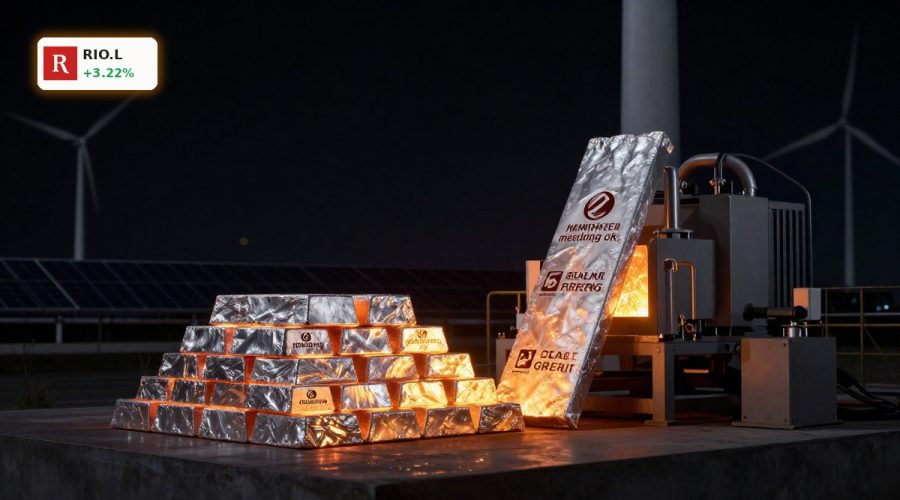
Can the Rio Tinto Energy Deal and its massive renewables push really de‑risk the miner’s future cash flows and valuation?

How is Rio Tinto trading after the news?
Rio Tinto Group shares extended recent gains on Monday, with Rio Tinto (RIO.L) and Rio Tinto (RIO) both quoted around $6,756, up roughly 3.2% from the prior close of $6,529. The move comes as the miner updates the market on operational recovery in Western Australia and unveils a landmark Rio Tinto Energy Deal that secures the future of one of Australia’s largest aluminum assets. The stock’s advance reflects renewed confidence that the company can navigate extreme weather, protect high-margin iron ore volumes, and de-risk its energy exposure at a time when decarbonization is becoming a core valuation driver on Wall Street.
While the stock is still below its 52‑week highs, the combination of resilient guidance and visible government-backed support for a key downstream facility is helping stabilize sentiment in a sector often whipsawed by macro headlines out of China and shifting rate expectations for the Federal Reserve. For U.S. investors comparing cyclicals across the S&P 500 and global mining peers, Rio Tinto’s latest updates provide clearer line of sight on both cash flow and capital allocation over the coming decade.
What is in the Rio Tinto Energy Deal for Boyne?
At the center of the latest headlines is the Rio Tinto Energy Deal for the Boyne aluminum smelter in Queensland, a critical asset within the group’s Aluminium and Lithium division. Operating since 1982, Boyne is Australia’s second‑largest aluminum smelter, with capacity above 500,000 tonnes per year and more than 1,000 direct jobs. The current power contract expires in 2029, and the company had openly questioned the site’s long‑term viability if it could not materially cut emissions and secure competitive electricity pricing.
Under the newly announced framework, the Australian federal government and the state of Queensland will provide A$2 billion (spread over ten years starting in 2030) to keep Boyne running until at least 2040. In return, Rio Tinto Group has committed to invest around A$7.5 billion in new renewable energy generation and storage to support a full transition of the smelter to low‑carbon power. Management describes this as a “transformative partnership” that not only safeguards regional jobs but also helps decarbonize the broader Queensland energy system.
The structure of the Rio Tinto Energy Deal is notable for equity markets: it marries public capital with large‑scale private spending, effectively anchoring a long‑dated industrial load for new solar and wind projects. This improves Rio Tinto’s visibility on future power costs, reduces regulatory risk around emissions, and supports the company’s positioning as a supplier of “green” aluminum into auto, packaging, and electronics supply chains, where downstream names like Tesla and Apple are increasingly demanding lower‑carbon materials.
Why does this matter for U.S. and global investors?
For international investors, the Rio Tinto Energy Deal is more than a regional subsidy story; it is a test case for how heavy industry can align with net‑zero pathways without sacrificing competitiveness. Aluminum is among the most energy‑intensive metals to produce, and power prices have been a major driver of past smelter shutdowns in Europe and elsewhere. By locking in a route to renewable electricity for Boyne, Rio Tinto aims to avoid the kind of margin compression and supply instability that have periodically hit peers.
From a portfolio context, this supports the investment case that mining majors can remain high dividend payers while still funding large decarbonization capex. Rio Tinto is widely followed on Wall Street as one of the large‑cap stocks with an above‑market dividend yield, and the durability of that payout is closely tied to its ability to keep key assets running at low cost across the cycle. If the renewables build‑out succeeds, Boyne could emerge as one of the world’s first major smelters predominantly powered by solar and wind, strengthening Rio Tinto’s ESG profile relative to diversified materials rivals and to big‑cap tech names like NVIDIA that are heavy end‑users of aluminum in data center and hardware infrastructure.
The deal also resonates with U.S. policy trends. It effectively mirrors aspects of the Inflation Reduction Act–style model, where government incentives catalyze private green investment. That raises the prospect that U.S.‑listed industrials and miners might pursue similar partnerships domestically, creating a broader investable theme around decarbonized metals and grid‑scale storage.
How is Rio Tinto handling the Cyclone Narelle impact?
Parallel to the Rio Tinto Energy Deal, management is addressing near‑term operational volatility in its core Iron Ore division. Tropical Cyclone Narelle swept across Western Australia’s Pilbara region in late March, forcing the closure of major export ports from March 24. Operations have now restarted at three of the company’s four Pilbara iron ore terminals, with shipments resuming on March 28 as weather conditions improved and port authorities reopened key channels.
The remaining terminal, Cape Lambert A, is undergoing repairs and is expected to return to service in the coming days. The twin storms in February and March have had a material volume impact: Rio Tinto estimates that iron ore shipments have been reduced by around 8 million tonnes so far this year due to weather‑related disruptions. Importantly for investors, management says it has identified ways to recover roughly half of those lost tonnes through the rest of the year, likely via higher run‑rates and scheduling optimization once all infrastructure is back online.
Markets have been quick to react to this operational resilience. With iron ore prices still heavily influenced by Chinese steel demand and macro sentiment around property and infrastructure stimulus, any prolonged supply outage from the Pilbara could have tightened the seaborne market and eroded Rio Tinto’s unit cost advantages. Instead, the company is signaling that it views the storms as a short‑term setback rather than a structural hit to capacity.
Does Rio Tinto keep its iron ore shipment guidance?
Despite the weather disruptions, Rio Tinto is maintaining its full‑year iron ore shipment guidance for the Pilbara region at 323 million to 338 million tonnes for 2026. That guidance span is closely watched by commodity desks on Wall Street, since the Iron Ore segment is Rio Tinto’s largest profit driver and a key input into dividend and buyback models used by banks like Goldman Sachs and Morgan Stanley.
Holding guidance steady sends a clear message: management believes its mines, rail network, and ports can catch up from weather losses without excessive incremental cost. For equity analysts, this reduces the need to heavily haircut earnings estimates, particularly versus peers whose production profiles may be more vulnerable to climate‑driven weather extremes. The reaffirmed outlook also underpins Rio Tinto’s positioning as a volume‑reliable supplier to Asian steelmakers, which remains a major competitive edge over smaller producers.
In relative terms, this steadiness contrasts with the more volatile narratives seen in other cyclical sectors, such as U.S. semiconductors or electric‑vehicle makers, where demand forecasts for companies like Tesla or NVIDIA can shift rapidly with macro and AI sentiment. For income‑oriented investors, a predictable tonnage base in Pilbara iron ore may be as important as headline price moves when assessing the sustainability of Rio Tinto’s dividend stream.
How does Rio Tinto stack up against global peers?
Within the global mining universe, Rio Tinto competes closely with BHP and Vale in iron ore, while also operating significant positions in aluminum, copper, and lithium. The Rio Tinto Energy Deal gives the group a differentiated story in low‑carbon aluminum, a segment where customers in automotive, aerospace, and tech are increasingly willing to pay a premium for reduced embedded emissions. That could prove an advantage versus more coal‑dependent smelting portfolios.
On Wall Street, large diversified miners are often compared not only to each other but also to high‑cash‑flow mega caps in other sectors, from Apple in consumer tech to big integrated energy names. The key questions are similar: can the company sustain distributions, fund necessary growth and transition capex, and manage political risk? Rio Tinto’s latest announcements suggest it is trying to answer “yes” on all three by partnering with governments, investing ahead of regulatory shifts, and demonstrating robust operational recovery after climate‑related events.
While specific fresh rating changes from banks like Citigroup, RBC Capital Markets, or JPMorgan were not detailed in today’s disclosures, the market’s positive price reaction indicates that institutional investors broadly view the developments as credit‑positive. The durability of that sentiment will depend on execution: delivering the A$7.5 billion renewables pipeline on budget and maintaining Pilbara volumes in the face of increasingly frequent extreme weather.
This transformative partnership with the Queensland and Australian governments will ensure Boyne Smelter remains internationally competitive, strengthens the Australian aluminium sector for the future and supports the transformation and decarbonisation of the Queensland energy system.— Jérôme Pécresse, Chief Executive, Rio Tinto Aluminium & Lithium
For U.S.-based investors building exposure to commodities outside the S&P 500, Rio Tinto remains a core proxy for global steel demand, energy transition metals, and the broader shift toward cleaner industrial production.