Could a full Ripple Banking License turn XRP’s token treasury into a balance‑sheet weapon powerful enough to rival global banks?

How big could Ripple become with a banking license?
The latest wave of speculation centers on whether a full Ripple Banking License could unlock enough balance‑sheet value to push Ripple into the ranks of the world’s top 20 banks by market capitalization. In a recent interview, Teucrium CEO Sal Gilbertie outlined a scenario in which Ripple’s large XRP holdings, including roughly 40 billion tokens held in escrow, would be treated as strategic assets inside a regulated bank framework. At XRP around $3, that stash alone would translate into over $120 billion in notional value, potentially elevating Ripple’s standing into the same league as large listed global banks.
In this view, the Ripple Banking License is not just a regulatory checkbox; it is the catalyst that could re‑rate the company from a pure‑play crypto infrastructure provider to a hybrid bank‑plus‑blockchain platform. Gilbertie suggested that an XRP price near $3 could already be enough for Ripple to rank among the top 20 banks globally, and that “multiples of $3” would proportionally expand its implied valuation. For U.S. investors used to comparing financials like JPMorgan and Bank of America, the idea that a crypto‑native firm could enter that club purely by unlocking the value of its token treasury is a radical shift in perspective.
Where does Ripple stand on regulation today?
Ripple has not yet secured a full Ripple Banking License, but it has moved closer to the U.S. regulatory perimeter. The company previously received conditional preliminary approval from the Office of the Comptroller of the Currency (OCC) for a national trust bank charter. This status, while short of a full commercial banking license, already places Ripple alongside a small group of digital‑asset firms experimenting with bank‑like structures under federal oversight.
The company continues to invest in payment rails through acquisitions, partnerships and share buybacks, positioning its network as a bridge between traditional finance and blockchain settlement. Advocates argue that if the OCC were to move from conditional approval to full authorization, Ripple could offer custody, settlement and possibly other bank‑style services embedded directly into on‑chain infrastructure. That would distinguish it from tech‑heavy peers like NVIDIA or Apple, whose exposure to crypto is mostly indirect via data‑center hardware or app ecosystems, rather than regulated balance‑sheet assets.
Is the XRP price action supporting the story?
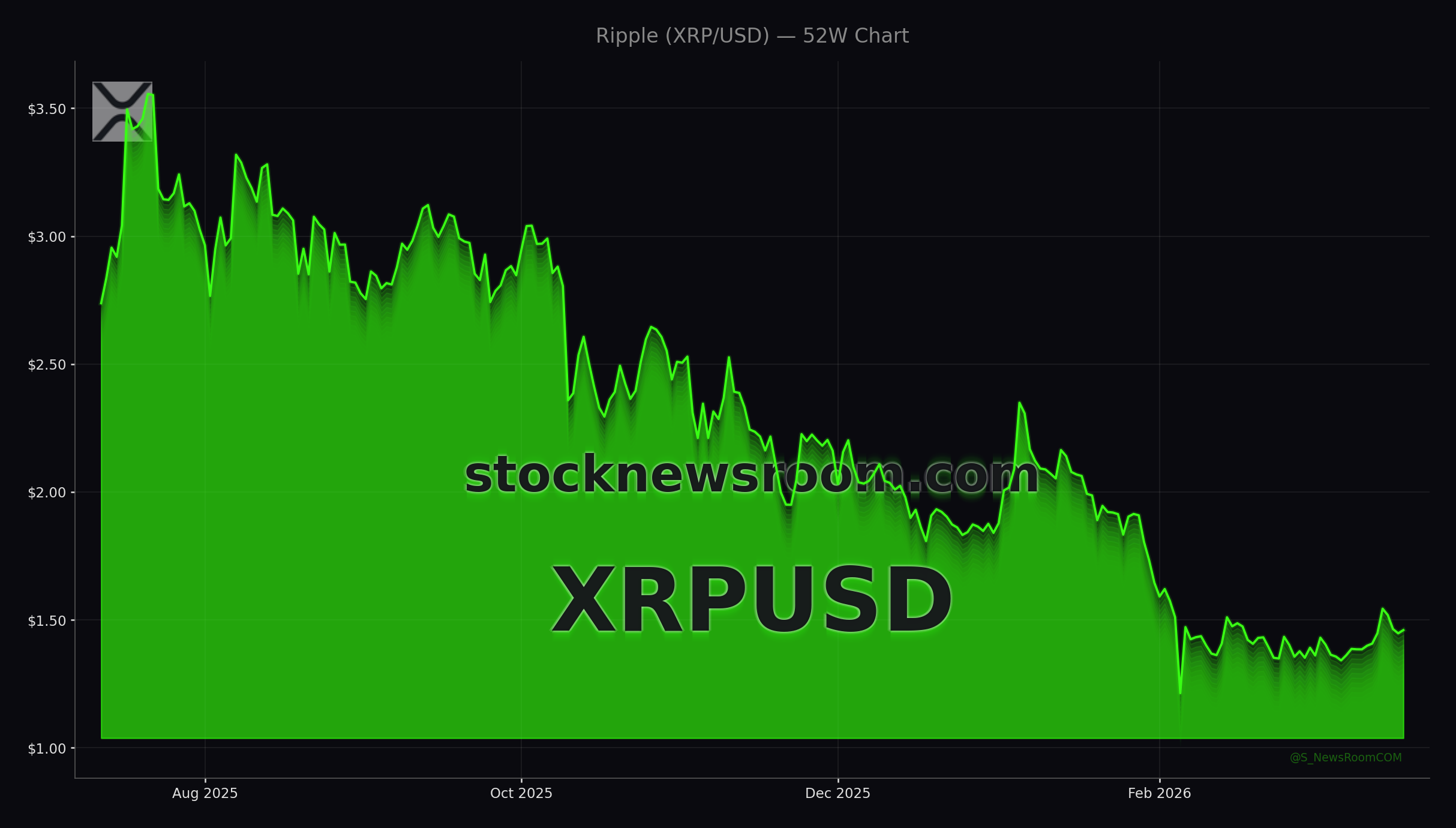
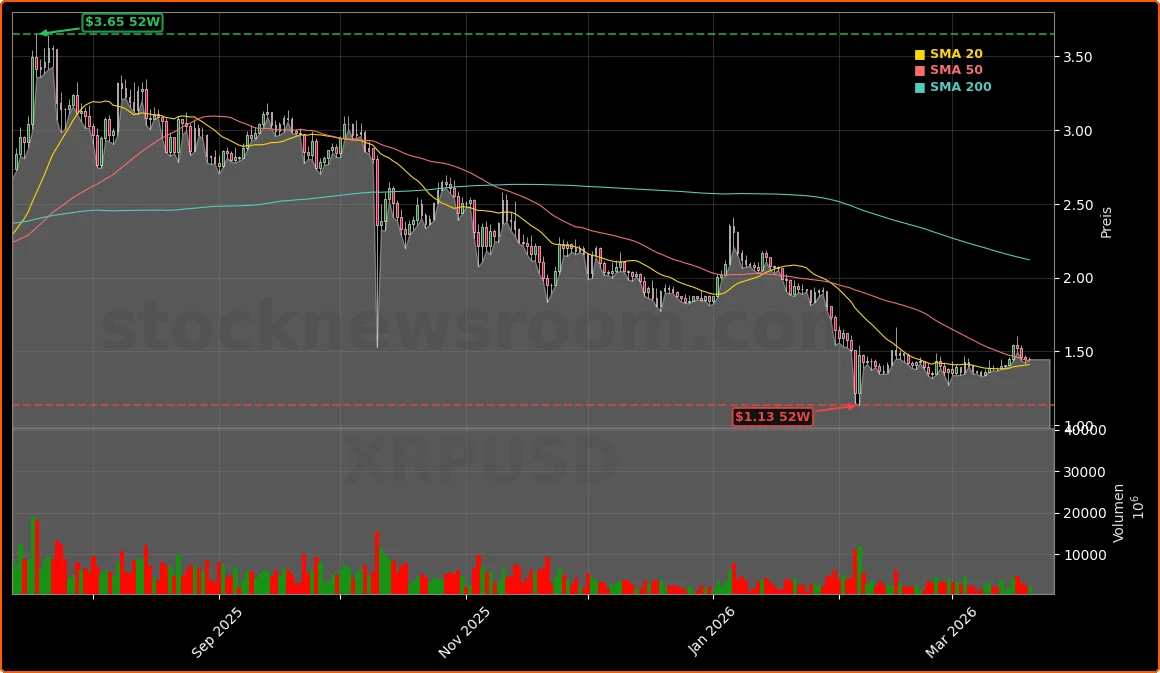
Despite the bullish narrative around a potential Ripple Banking License, XRP’s chart remains mixed. Ripple (XRPUSD) is trading near $1.45, flat versus the prior close but down about 1.4% on the day, after a brief rally earlier in March pushed the token toward $1.60. That move marked a roughly 15% bounce from the February 28 low near $1.27, which followed a sharp risk‑off reaction across digital assets during the Israel‑Iran flare‑up.
Technically, however, XRP is still struggling. The $1.80 area, which acted as a robust floor throughout most of 2025, flipped into resistance in January 2026 when the token closed the month below that level for the first time in the recent cycle. Since then, each attempt to regain $1.80 has stalled, and the broader structure has morphed into a clear downtrend with lower highs and lower lows. Traders now see $1.80 as the key upside trigger: reclaiming it could invalidate the bearish setup and reopen the path toward the prior parallel channel, which had a ceiling around $3.45 and a floor near $1.80.
On the downside, chart watchers focus on the $1.20 to $1.30 zone as a critical support area. During XRP’s explosive November 2024 rally, that band offered virtually no resistance, creating what technicians call a “no‑support zone.” Since then it has acted as a cushion during sharp pullbacks. If XRP fails again at $1.80 and broader risk sentiment deteriorates, a retest of that range cannot be ruled out, regardless of progress toward a Ripple Banking License.
How does this fit into the broader crypto‑finance race?
For U.S. investors, the Ripple Banking License debate is part of a wider question: which platforms will dominate when traditional finance finally moves fully on‑chain? Gilbertie argued that virtually all financial instruments, including leveraged exchange‑traded funds, will eventually operate on blockchain rails. If that thesis plays out, firms that combine regulatory status with deep token liquidity could enjoy a structural advantage.
Here, Ripple competes not only with other crypto networks but also with large listed U.S. companies racing to provide the infrastructure layer. Cloud‑heavy players like NVIDIA and Apple supply the hardware and software backbone, while firms such as Tesla experiment with integrating digital payments and energy‑related data into their ecosystems. Unlike those S&P 500 and NASDAQ giants, though, Ripple’s value is tightly linked to one asset: XRP. That concentration amplifies both upside and downside. A successful banking charter combined with sustained XRP appreciation could rapidly boost implied equity value, but regulatory setbacks or prolonged price weakness below $1.80 would leave the balance sheet far more exposed than diversified tech peers.
Major Wall Street banks and research houses like Citigroup, Goldman Sachs and Morgan Stanley have not yet published formal equity‑style ratings on Ripple itself, since it is not publicly listed in the U.S. Nonetheless, their growing research coverage of digital‑asset infrastructure and token‑based settlement has helped legitimize the space for institutional portfolios, creating a backdrop in which the Ripple Banking License narrative can gain traction among professional allocators.
For now, XRP trades as a high‑beta satellite holding rather than a core allocation for most American investors, but any concrete regulatory step toward a full bank charter would likely force a reassessment of that stance.