Is Ripple’s post‑SEC victory slide just a deep correction or the uneasy calm before a much bigger XRP move?

How fragile is Ripple after the SEC win?
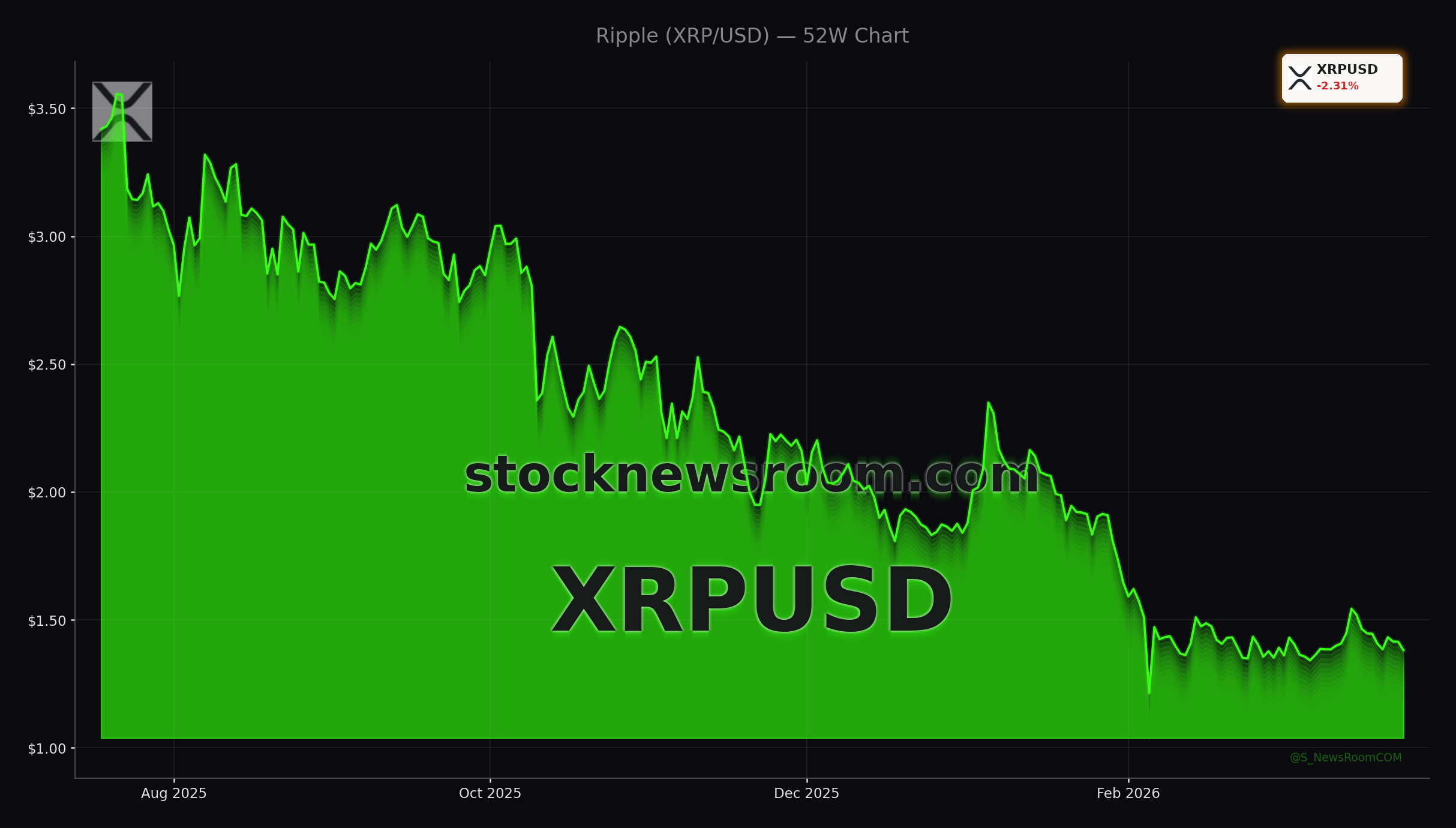
From a Wall Street perspective, the SEC settlement and later decision to treat XRP as a digital commodity removed the largest regulatory overhang on **Ripple (XRPUSD)**. The resolution ended fears that XRP would be regulated like a security, which could have severely limited issuance to financial institutions. The token surged to a new record high in 2025 on that relief but has since dropped roughly 60%, mirroring the broader crypto correction that also pulled down bellwethers like Bitcoin and Ethereum.
At today’s price near $1.37, XRP is well below its post‑settlement peak and is now trading under key short‑term technical markers. Intraday action shows a failed recovery attempt above $1.4220 and a break below a short‑term bullish trendline near $1.4050. The pair now struggles to hold the $1.380 zone, with the hourly Relative Strength Index (RSI) slipping below 50 and the MACD gaining bearish momentum. For U.S. traders used to watching the S&P 500 or NASDAQ through moving‑average lenses, XRP currently looks like a classic asset that has lost upside momentum just as macro conditions have turned more cautious on risk assets.
What does this Ripple Market Analysis say about support and resistance?
Short‑term levels are clearly defined. Immediate resistance sits near $1.4120, with a more important cap around $1.420. A decisive move above $1.450 could open the door toward $1.4840, then $1.520 and potentially $1.5550 if bullish momentum returns. On the downside, initial support is clustered around $1.3965 and then $1.380; a sustained break below $1.380 would expose $1.3620, followed by $1.3450 and $1.320.
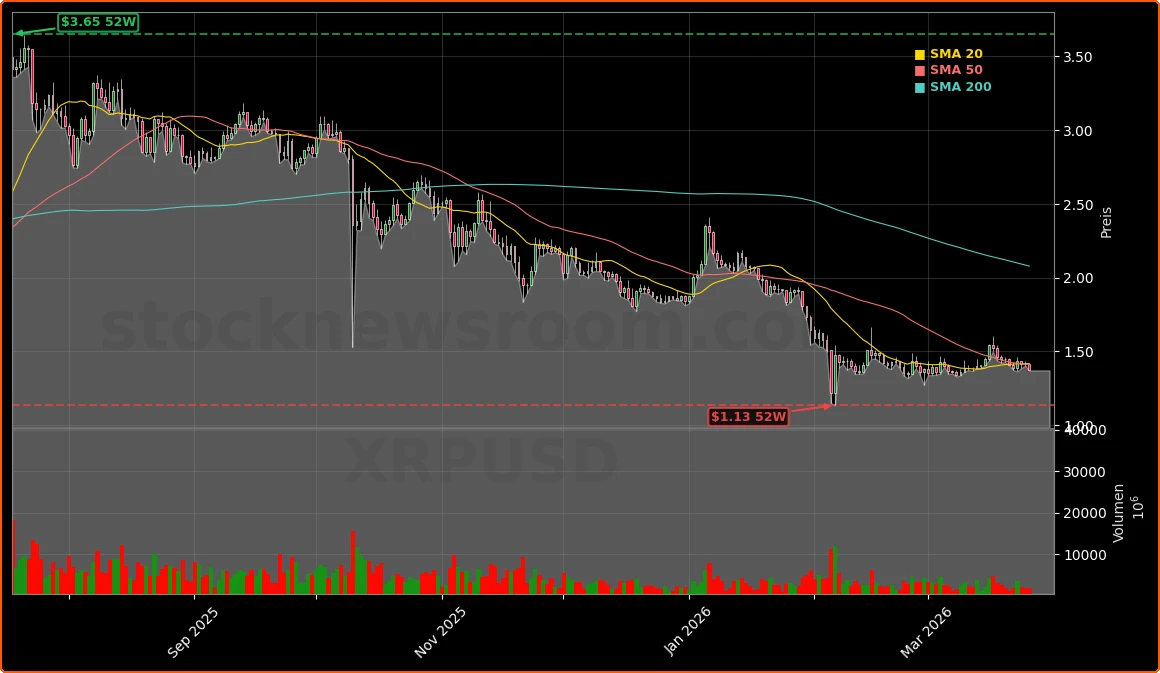
Technically, XRP has also been repeatedly rejected at its 50‑day exponential moving average, while the 100‑ and 200‑day EMAs are trending lower overhead. That pattern typically characterizes a bearish regime where rallies are sold rather than extended. Some chart analysts now point to $1.12 as a potential double‑bottom area, with $0.87 flagged as a longer‑term accumulation zone if selling accelerates. For American crypto traders who have seen similar corrective structures in large‑cap tech names like NVIDIA or Tesla after big runs, the current Ripple Market Analysis suggests the token may still be in a corrective Wave 2‑type retracement, not yet in a sustained new uptrend.
Are futures traders signaling a different story for Ripple?
Derivatives positioning paints a more optimistic picture. Open interest in XRP futures has climbed to about $2.60 billion, rising 7% in a single day even as spot prices slipped. That combination – higher open interest during a dip – typically indicates new positions being opened rather than old ones being closed, and in this case, those positions skew long rather than short.
Notably, short interest in the futures market has not spiked in tandem with the spot decline. Instead, long exposure has edged higher, suggesting traders are using weakness to add bullish bets rather than hedge further downside. For U.S. investors accustomed to reading CFTC futures data on commodities or options flows on mega‑caps like Apple, this is a notable divergence: the chart looks heavy, but the derivatives market is not positioned for a deep bearish breakdown.
Some institutional crypto desks argue this positioning reflects confidence in the regulatory backdrop after XRP’s commodity designation, as well as growing interest in tokenization and blockchain‑based payments more broadly. While there is no major Wall Street house such as Goldman Sachs or Citigroup publishing a formal XRP rating or price target yet, the behavior of futures traders effectively functions as an informal vote of confidence that current levels could represent a buying opportunity rather than a trap.
Does a $10 target for Ripple make sense?
Fueling the debate, crypto exchange Bitrue has argued that XRP is trading at a fraction of its “fair value,” openly touting a $10 target – more than seven times today’s price and implying a market cap above $610 billion. Long‑term bulls also continue to circulate targets in the $5–$10 range, tying them to narratives around institutional adoption, central‑bank reserve interest and Ripple’s payments network reaching global scale.
Yet a sober Ripple Market Analysis highlights structural headwinds. Banks can use Ripple’s payment rails without holding XRP, and the network also supports fiat currencies and Ripple’s own dollar‑pegged stablecoin, Ripple USD (RLUSD). Because stablecoins are far less volatile, they are often more attractive for day‑to‑day payments than XRP itself. In addition, XRP is designed as a bridge asset, typically bought and then sold quickly within a single cross‑border transaction, limiting natural “hold” demand. Ultimately, XRP’s price is still highly driven by speculative investor appetite rather than mandated utility.
Traditional Wall Street research shops like Morgan Stanley, RBC Capital Markets or Citigroup have not issued official XRP price targets, underscoring how far crypto still sits from the core of S&P 500‑style coverage. For American portfolios, this means XRP remains a high‑beta, high‑conviction niche play rather than a widely modeled asset with consensus earnings‑style estimates.
How does Ripple compare across the crypto landscape?
For U.S. investors diversifying beyond equities and large‑cap tech, XRP sits in a unique spot. It is not a proof‑of‑work asset like Bitcoin, nor a generalized smart‑contract platform like Ethereum that underpins DeFi and NFT ecosystems. Instead, it is tightly linked to a single company’s payment network and its relationships with banks and institutions worldwide. That offers a more focused thesis than the broad innovation stories surrounding NVIDIA’s AI hardware or Tesla’s EV ecosystem, but also concentrates business and regulatory risk onto one platform.
Macro‑wise, XRP’s pullback parallels the latest retracement in Bitcoin and other majors, which remains a key theme for any Ripple Market Analysis. Investors weighing XRP against other digital assets must factor in its history of long consolidation phases and abrupt spikes, as well as the possibility that regulatory favor can shift with U.S. political cycles. For now, price action indicates weakening spot demand and vulnerable support, while futures data and ambitious long‑term targets hint that some market participants are quietly preparing for a stronger next leg.
Related Coverage
Investors looking for a deeper fundamental and positioning backdrop around the coming months can turn to the Q2 outlook piece on XRP. Ripple Q2 Outlook: Binance Margin Shock vs On‑Chain Surge examines how reduced leverage on Binance interacts with rising on‑chain activity, and what that mix could mean for volatility and directional moves into the next quarter. For a broader sector lens, Bitcoin Market Analysis Warning as Tokenization Boom Builds explores whether Bitcoin’s latest pullback is just noise amid the rise of tokenization, stablecoins and tighter regulation, a context that is increasingly relevant when comparing XRP risk‑reward against the rest of the crypto complex.
In conclusion, today’s Ripple Market Analysis shows a token caught between deteriorating spot momentum and unexpectedly resilient futures positioning, with bold $10 narratives still alive despite a 60% drawdown from last year’s highs. For U.S. investors, XRP is best viewed as a speculative satellite exposure whose fate hinges on both macro crypto sentiment and real‑world payment adoption. The next decisive move above $1.50 or below $1.12 should reveal whether the post‑SEC era evolves into a durable uptrend or a longer consolidation before any renewed push toward those ambitious long‑term targets.