
Can Ripple’s Q2 really rebound when Binance is cutting margin firepower just as XRP’s on‑chain activity starts to surge again?

How does Binance’s move hit Ripple in Q2?
The immediate overhang on the Ripple Q2 Outlook is Binance’s decision to stop margin services on 14 major pairs, including XRP cross‑margin trading against BNB. For US and global traders who rely on Binance liquidity, the disabling of the borrowing function and restrictions on transfers into isolated margin accounts remove an important leverage channel. Users can now only move assets to isolated margin to repay existing debt, effectively forcing a gradual wind‑down of positions rather than new speculative builds.
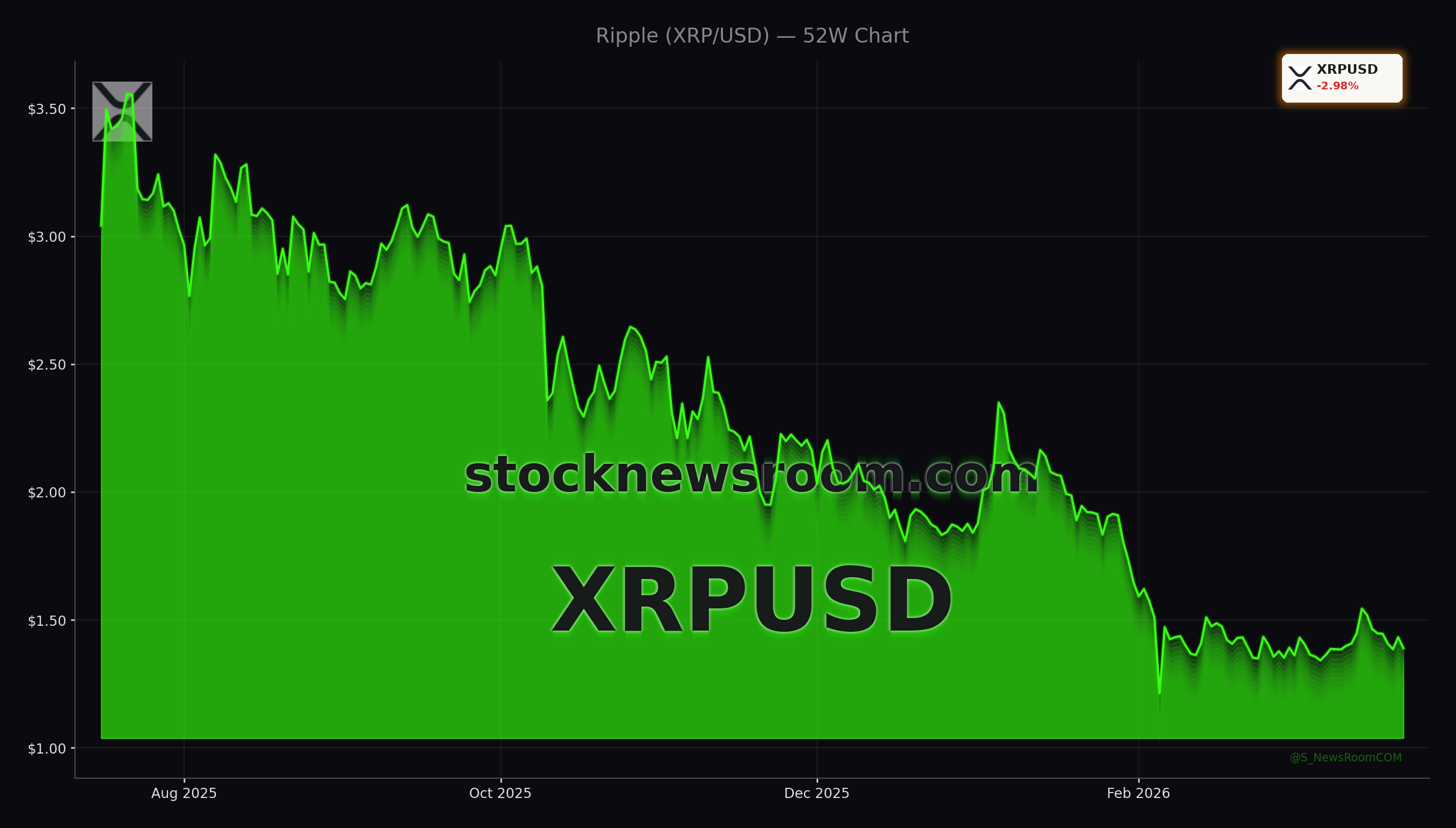
This matters because XRP’s recent bounce above $1.40 looked like the first real attempt to reverse a brutal downtrend that has persisted since late 2025. Leverage often amplifies such moves; switching it off can unintentionally cap upside just as sentiment is trying to turn. With XRPUSD roughly 3% lower today at $1.39 after a prior push toward $1.46, the market is signaling that part of the rally was indeed leverage‑driven.
Unlike mega‑cap Wall Street tech names such as Apple or NVIDIA, XRP trades in a regulatory gray zone and relies heavily on offshore venues for depth. Any constraint on margin in that ecosystem can shift flows toward spot and derivatives on US‑facing exchanges, but typically with lower leverage and more cautious positioning.
Is Ripple’s network telling a different story?
While price action looks shaky, the underlying network trends complicate the Ripple Q2 Outlook. The XRP Ledger has logged a sharp, roughly 100% surge in payment transactions within a 24‑hour window, indicating a powerful spike in on‑chain usage. Such jumps are often linked to renewed utility demand — for example, cross‑border settlement activity — or speculative capital rotating back into the ecosystem via active wallet transfers instead of just exchange churn.
Historically, sustained increases in on‑chain activity have tended to precede or accompany recoveries in major crypto assets. For XRP, this new wave of ledger activity follows a five‑month stretch of double‑digit monthly losses that pushed sentiment into deeply oversold territory. Technical indicators like the Relative Strength Index have climbed out of extreme pessimism toward a neutral area near 50, while the MACD lines are close to a bullish crossover on the weekly chart, hinting at a potential shift from red to green candles in the coming weeks.
XRP has also quietly broken its negative monthly streak in March, now showing a modest single‑digit percentage gain. That contrasts with some Nasdaq favorites such as Tesla, where price action has recently been far more tied to macro rates and S&P 500 risk appetite than to a single technical breakout.
What does history say about Ripple Q2 Outlook?
For investors building a Ripple Q2 Outlook, seasonality is hard to ignore. Over 13 years of return data, XRP’s second quarter has rarely been neutral; it tends to deliver either sharp rallies or deep corrections. The standout example remains Q2 2017, when XRP surged more than 1,100%, while Q2 2022 saw a punishing drop of nearly 60%. In 2025, the second quarter closed with a more modest but still positive gain of just over 7%.
Coming into Q2 2026, XRP is exiting a first quarter down about 23.7%, with five straight red months stretching from October 2025 into February 2026. Such extended losing streaks have historically been followed by attempts at recovery between April and June. April is especially notable, with an average return above 20% and past blockbuster years like 2017 and 2021 where gains exceeded 130% in a single month. May has delivered both huge rallies and heavy drawdowns, while June tends to be a cooling period with a slightly negative average performance.
This pattern suggests that, statistically, the April–May window is where a decisive move is most likely. If the current oversold backdrop meets sustained network strength, that move could skew to the upside; if macro or regulatory shocks hit crypto again, Q2 could instead become another harsh cleansing phase.
How are technicals shaping XRP’s risk profile?
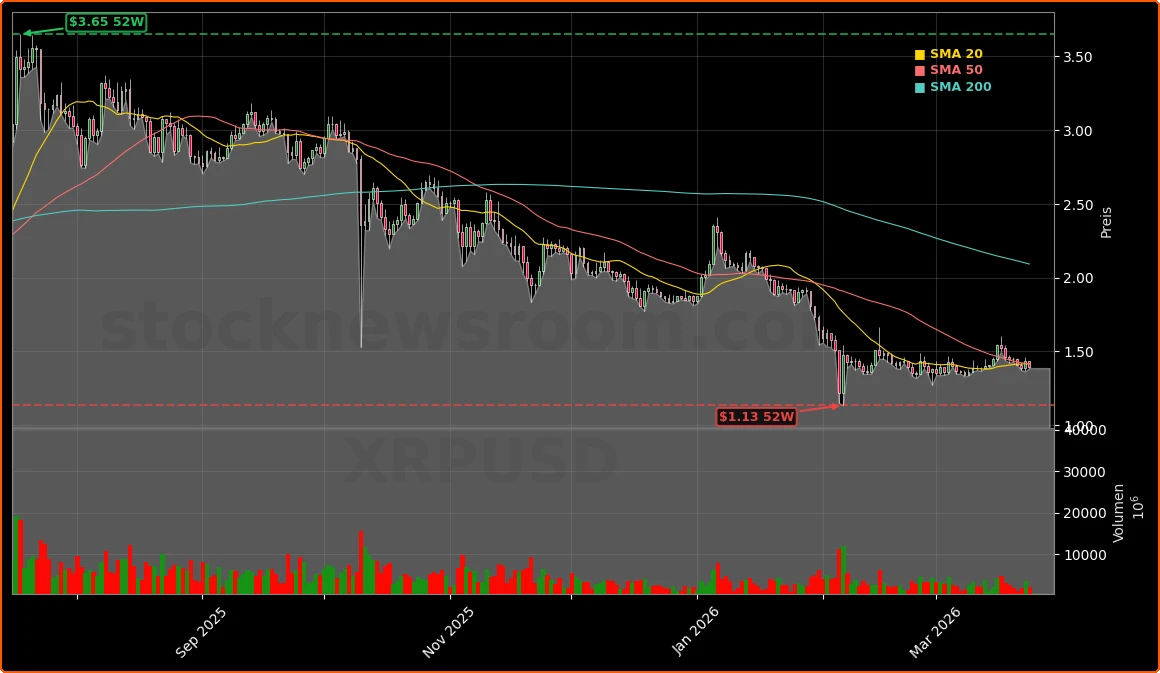
Technically, XRP remains trapped below its 50‑, 100‑ and 200‑day EMAs, which continue to act as layered resistance and cap every attempt at a more durable trend change. Traders are watching the $1.51–$1.55 zone as the next major resistance band. An Elliott Wave framework currently points to XRP being in a Wave 2 “temporary recovery”; failure to clear that band could trigger a pullback toward the next critical support around $0.87.
Momentum buyers are also laser‑focused on $1.65 as a key invalidation level for the bearish wave structure. A clean break and sustained hold above that price would effectively negate the current downside count and signal that a more durable uptrend is underway. Until then, analysts warn that the latest move above $1.40 could still prove to be a classic “dead cat bounce” in a broader downtrend, especially with leverage on Binance being forced lower.
Notably, while equities like Apple or NVIDIA attract formal coverage from houses such as Goldman Sachs, Citigroup or RBC Capital Markets, XRP still lacks consistent Wall Street analyst ratings due to regulatory uncertainty around US‑listed crypto securities. That leaves technicals, on‑chain metrics and cyclical patterns as primary tools for building a Ripple Q2 Outlook.
Related Coverage
Investors focused on the banking angle of XRP’s story may want to study how a full banking charter could reshape its balance‑sheet power. Our deep dive, “Ripple Banking License Boom: Could XRP Vault Into Top Banks?”, explores whether Ripple’s treasury and payment rails could one day compete directly with traditional global lenders on capital efficiency and cross‑border speed.
For a broader view of crypto regulation risk on US‑listed players, the article “Coinbase Stablecoin Regulation -7.2% Crash Sparks Debate” analyzes how looming oversight of stablecoins might transform Coinbase’s revenue mix. That piece offers useful context for understanding how regulatory shifts could also shape liquidity and demand for assets like XRP, even when they are not the direct target of new rules.
The Ripple Q2 Outlook thus sits at the crossroads of conflicting forces: a Binance margin clampdown, rising XRP Ledger activity, and a historical pattern of extreme second‑quarter moves. For US and global investors, XRP remains a high‑beta, high‑conviction play on the future of cross‑border payments and institutional adoption rather than a consensus Wall Street asset. The next quarter will show whether this combination of oversold sentiment and improving fundamentals can finally flip the narrative from cautious hope to confirmed recovery.