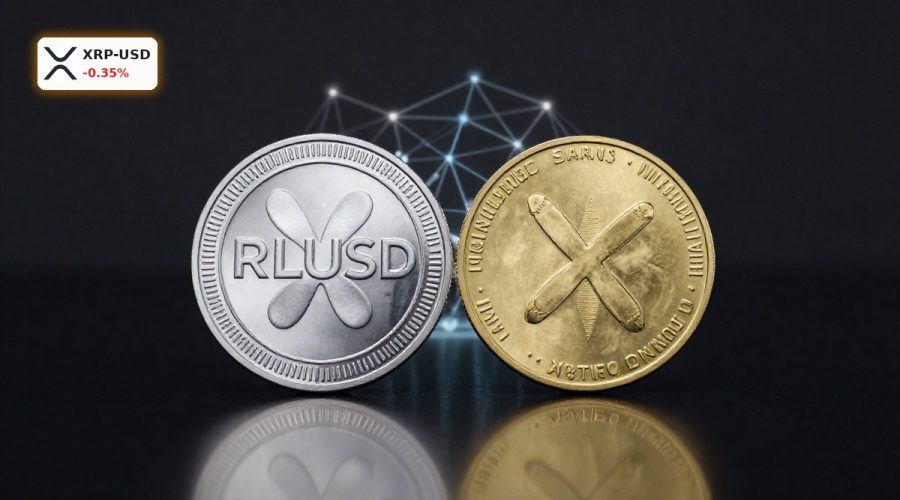
Can Ripple’s new stablecoin RLUSD really grow the network without quietly eroding the long-term bull case for XRP?
Ripple (XRP) und Konkurrenz durch Stablecoin RLUSD is quickly becoming one of the most important debates in digital assets. XRP’s role as a “bridge asset” for cross-border payments is now being challenged by its own issuer’s new dollar stablecoin, raising questions for portfolios exposed to XRPUSD on U.S. exchanges.
How does RLUSD change Ripple’s value stack?
For a decade, XRP’s main fundamental argument was its use as a bridge currency in Ripple’s payment products, formerly branded On-Demand Liquidity. The idea was simple: institutions would use XRP to move value between fiat currencies, generating organic demand and, over time, higher prices. The Ripple Stablecoin Strategy upends that logic by offering RLUSD as an alternative settlement asset that can provide liquidity with far lower volatility.
Unlike XRP, RLUSD is designed to hold a stable value of $1 through reserves, making it more attractive to banks and payment providers that want predictable balance sheet exposure rather than crypto price swings. That means the very customers once expected to drive XRP utility may increasingly prefer the stablecoin, especially for compliance-sensitive cross-border flows. The more successful RLUSD is in that role, the less structural need exists for XRP as a bridge asset.
Ripple’s leadership has simultaneously promoted a five-year roadmap focused on blockchain utility and institutional adoption for XRP, targeting a meaningful share of the $156 trillion global cross-border payment market by 2031. But with RLUSD now in the picture, it is no longer obvious which asset will capture most of that payment volume.
Is the Ripple Stablecoin Strategy bearish for XRP?
For U.S. investors, the crucial question is whether the Ripple Stablecoin Strategy cannibalizes XRP or complements it. In theory, both tokens could coexist: RLUSD could dominate low-volatility payment rails while XRP powers higher-risk liquidity provision and secondary market trading. In practice, large financial institutions generally prefer instruments with minimal price risk, especially under heightened regulatory scrutiny.
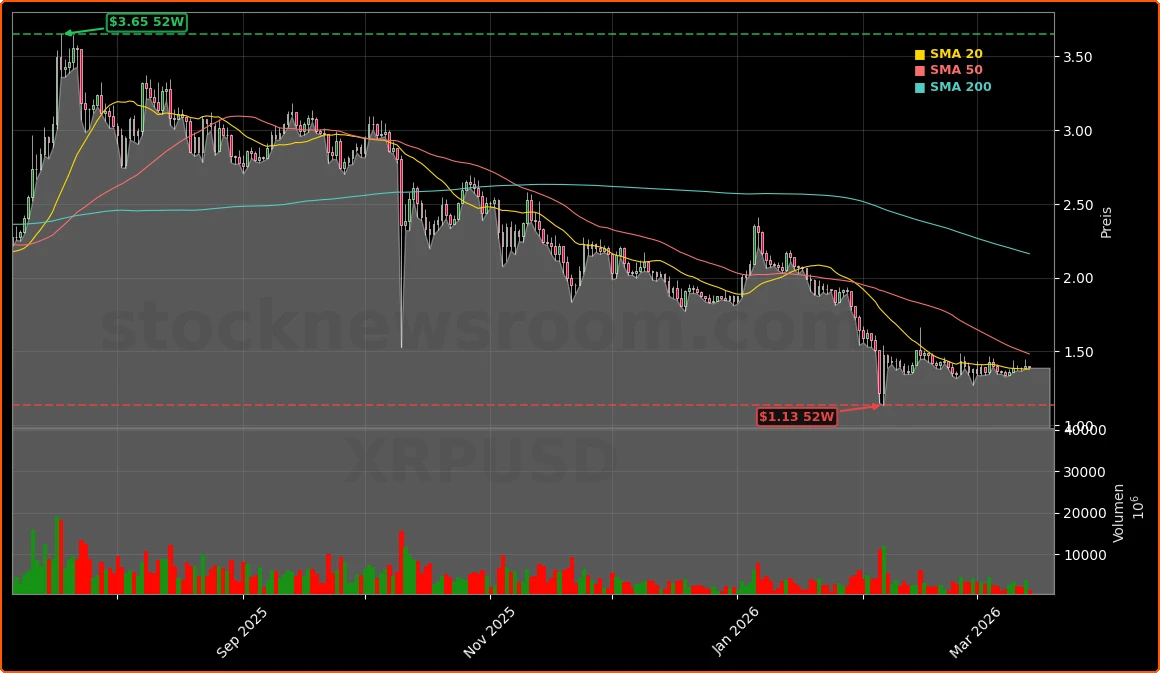
That tension is surfacing at a difficult technical moment. XRPUSD trades near $1.39, stuck below key resistance levels at roughly $1.45, $1.55 and $1.64. On-chain cost-basis data shows heavy overhead supply: about 36.8 billion XRP, roughly 60% of circulating supply, sits below an average cost basis of around $1.44, with many holders underwater. Roughly 1.85 billion XRP was bought between $1.76 and $1.80, creating a major resistance cluster where investors are likely to sell at breakeven rather than wait for further upside.
With XRP now below its 20-, 50-, 100- and 200-day exponential moving averages near $1.46, $1.64, $1.85 and $2.08, momentum remains negative. Bulls are betting that clearer U.S. regulation — potentially via legislation such as the CLARITY Act — plus the relisting of XRP on major exchanges and renewed ETF inflows could flip that trend. But the rise of RLUSD adds another headwind: even if Ripple’s network volumes grow, that may not translate directly into XRP demand.
How does Ripple compare with Bitcoin and Ethereum?
The strategic pivot comes as capital continues to consolidate into “blue chip” crypto assets like Bitcoin and Ethereum. Over the past 12 months, Bitcoin’s drawdown of roughly 16% and Ethereum’s modest 8% gain both outperformed XRP’s 40% slide from last year’s peak, even after regulatory wins and the approval of U.S.-listed XRP products. Institutional allocators on Wall Street largely treat BTC and ETH as core positions, while XRP remains a higher-risk satellite allocation with lingering regulatory ambiguity.
Structurally, XRP also lacks two key features that support long-term narratives for its larger peers. It cannot be mined like Bitcoin, limiting the scarcity story, and it does not natively support smart contracts in the way Ethereum does, restricting its role as a base layer for decentralized finance or Web3 applications. That leaves utility in payments as its main pillar. If RLUSD can deliver the same fast, cheap cross-border settlement as XRP with much lower volatility, the uniqueness of XRP’s value proposition narrows.
By contrast, stablecoin strategies at U.S.-listed payments and tech names — for instance potential future moves by firms such as Apple Pay or Tesla’s payments experiments — are generally additive to their equity stories, not in competition with a separate native token. Ripple is in a different position: the asset that may benefit most from RLUSD adoption is the privately held company itself, not necessarily XRPUSD trading on crypto exchanges.
What should U.S. investors watch next?
For now, there is no clear Wall Street consensus on the impact of RLUSD, and major banks such as Citigroup, Goldman Sachs or Morgan Stanley have not published headline ratings specifically tied to the stablecoin. Instead, institutional research has focused more broadly on the shift toward regulated stablecoins, the dominance of incumbents like USDT and USDC, and the growing role of tokenized dollars in cross-border settlement.
Key datapoints to monitor will be RLUSD’s adoption curve among banks, fintechs, and remittance providers; any regulatory guidance from U.S. agencies on stablecoin reserves and licensing; and the behavior of XRP holders around the $1.45 to $1.80 resistance band. If ETF flows swing back to net inflows near prior peaks around $250 million per month and Bitcoin approaches the $75,000 to $80,000 range, broader risk-on sentiment could still pull XRP higher despite competition from RLUSD.
Conclusion
Ultimately, the Ripple Stablecoin Strategy forces investors to separate the fortunes of Ripple the company from XRP the token. For American portfolios, XRP now looks less like a pure play on Ripple’s enterprise growth and more like a speculative asset whose upside depends on overcoming both technical resistance and internal competition from RLUSD. The next phase of adoption will determine whether XRP can coexist with its stablecoin sibling or gradually gets sidelined by it.
Further Reading
- XRP price and market data (CoinMarketCap)
- Global cross-border payment flows forecast (McKinsey & Company)
- Stablecoins: risks, potential and policy (IMF)
- Ripple (XRP) und Konkurrenz durch Stablecoin RLUSD bei Yahoo Finance (Yahoo Finance)