Can the current Ripple Strategy turn deep XRP losses and rising ETF demand into a genuine long-term comeback for the token?
How does Ripple Strategy meet today’s market?
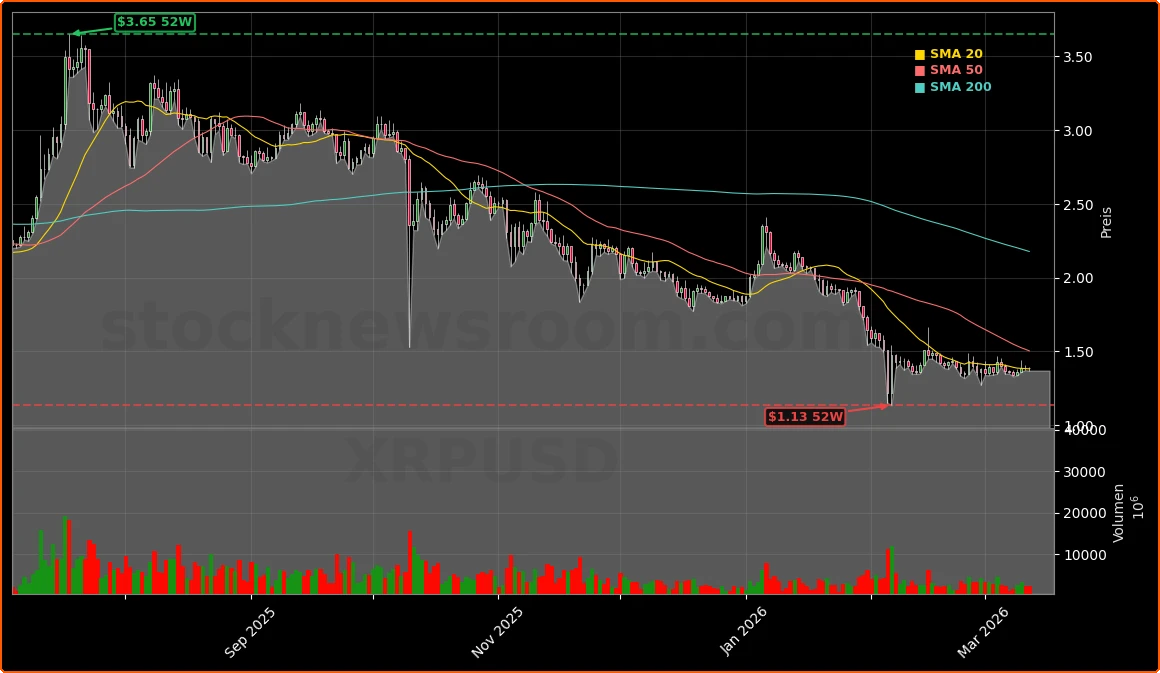
Ripple (XRPUSD) is trading near $1.38, roughly where it closed in the previous session, leaving the token about 62% below last July’s high of $3.65. That places XRP in a milder drawdown than its past crashes, when it fell 84% to 95%, but still far steeper than Bitcoin’s roughly 40% slide over the same period. The core of the current Ripple Strategy is to lean on stronger fundamentals than in earlier cycles—including regulatory clarity in the U.S. and new institutional products—to position XRP for the next market upswing.
From a portfolio perspective, XRP has behaved like a high-beta satellite position relative to Bitcoin and large-cap tech on the NASDAQ. When Bitcoin corrects 40% to 50%, XRP typically overshoots on the downside and, historically, in subsequent recoveries as well. With no major Wall Street houses like Goldman Sachs or Morgan Stanley currently publishing headline XRP price targets, U.S. investors are left to weigh structural developments, ETF flows and on-chain indicators rather than conventional analyst coverage.
What signals are ETFs sending about Ripple?
One pillar of the Ripple Strategy in this cycle has been opening the door to institutional capital via spot ETFs. Since their launch in November 2025, XRP ETFs have accumulated about $1.44 billion in cumulative inflows and locked roughly 785 million XRP in custody. That sequesters a meaningful slice of the circulating supply from the open market and anchors a base level of long-term demand that did not exist during earlier XRP drawdowns.
These inflows are noteworthy because they continued even as the price fell more than 40% from the cycle high. For Wall Street allocators, that suggests a cohort of long-horizon institutional buyers treating XRP more like a structural exposure than a short-term trading vehicle. While no major ETF issuer has disclosed detailed investor composition, the pattern resembles early days of Bitcoin ETFs, where pensions, RIAs and multi-asset funds gradually built positions despite volatility.
At the same time, XRP’s Net Unrealized Profit and Loss (NUPL) metric indicates that about 36.8 billion XRP—around 60% of circulating supply—is currently sitting at an unrealized loss of roughly $50.8 billion. Historically, such deep “capitulation” readings have aligned with late-stage bottoms rather than mid-cycle drawdowns. Still, macro risk from the Federal Reserve, including uncertainty around the potential Warsh Fed leadership, could keep risk assets ranging until policy visibility improves.
Is Ripple Strategy aligned with XRP utility?
The most contentious issue for XRPUSD investors is whether the evolving Ripple Strategy actually requires XRP at its core. Ripple’s original vision in 2012 was a bridge currency to reduce friction and bypass intermediaries in global payments. That edge has faded as dollar-backed stablecoins have taken center stage in cross-border transfers, offering lower volatility while running on multiple chains such as Ethereum and Solana.
Ripple, the company, is expanding quickly through acquisitions in stablecoin issuance, digital asset custody and corporate treasury management. Yet many of these businesses—including Ripple Custody and various tokenization and settlement partnerships—use the XRP Ledger’s infrastructure without making XRP itself essential. A recent example is the use of Ripple’s U.S. dollar stablecoin RLUSD by major non-profits for cross-border aid flows; XRP is used primarily for low-value network fees rather than as the settlement asset.
This divergence means that the success of the corporate Ripple Strategy does not automatically translate into rising token demand. Unlike equities in Apple or NVIDIA, XRP is not a direct claim on Ripple’s cash flows or valuation, even after the company raised $500 million at a $40 billion valuation last November. For U.S. investors used to conventional cash-flow-based valuation frameworks, that gap between network usage and token economics is a critical risk factor.
What does the Australia push mean for investors?
Regionally, Ripple is executing on a licensing-heavy approach that aims to embed its payment rails deeper into traditional finance. The planned acquisition of BC Payments Australia is designed to secure an Australian Financial Services Licence (AFSL), giving Ripple direct control over onboarding, compliance, FX, liquidity and final payouts in that market. This should streamline cross-border flows for existing Australian clients such as Hai Ha Money Transfer, Novatti Group, Stables, Caleb & Brown, Flash Payments and Independent Reserve.
In Asia-Pacific, Ripple reports that payments volume nearly doubled year over year in 2025, and globally the company now holds more than 75 regulatory licenses, supplemented by full Electronic Money Institution authorization in Luxembourg. For institutions in the U.S. and Europe, that track record may reduce counterparty and operational risk concerns when evaluating Ripple-based solutions versus rival platforms from global payment networks or large-cap fintechs like Apple Pay or even crypto-native competitors.
Australia is a key market for Ripple, and an AFSL strengthens our ability to scale Ripple Payments across the region.
— Fiona Murray, Managing Director, Ripple Asia Pacific
Conclusion
However, the XRP Ledger still trails badly in the stablecoin race, with about $415 million in stablecoins compared with over $160 billion on Ethereum and nearly $16 billion on Solana. For investors who view network effects and stablecoin depth as key value drivers, that underperformance tempers the bullish narrative around the current Ripple Strategy.
Further Reading
- XRP price, market cap and charts (CoinMarketCap)
- Ripple to acquire BC Payments Australia for AFSL licence (Electronic Payments International)
- XRP ETFs see steady inflows despite price correction (Bloomberg)
- Ripple (XRPUSD) bei Yahoo Finance (Yahoo Finance)