Can Ripple’s tokenization with billion-dollar potential drive the XRP price upward in the long term despite chart pressure and whale sales?
How is Ripple positioning itself in tokenization?
At the center of the investment story is increasingly the Ripple tokenization of real assets. According to the development plan for 2026, Ripple is significantly expanding the functionality of the XRP Ledger to provide institutional investors with a regulatory-compliant environment. New identity verifications are planned directly on the integrated DEX to create so-called walled gardens—closed, permissioned markets. Here, tokenized stocks, commodities, and other financial instruments are to be traded.
Tokenized assets are nothing more than digitally certified ownership rights that are represented as tokens on a blockchain. Approximately $449 million in tokenized assets are already circulating on the XRPL, with the value having increased by about 50% within 30 days. At the same time, trading volume during this period was around $150 million. This momentum suggests that market participants are increasingly testing the new possibilities of Ripple tokenization—long before all planned features go live.
What role does Ripple play for institutional investors?
In addition to tokenization, Ripple is clearly targeting professional market participants with further upgrades. A new lending feature is planned that will allow access to fixed-rate, unsecured loans directly on the chain. The credit assessment will be conducted by the involved parties themselves. In parallel, an enhanced smart escrow function is to be introduced, which will complement existing escrow mechanisms with programmable conditions, thereby bringing a degree of smart contract functionality to the XRPL.
Another component is the introduction of confidential transactions. Institutional traders often do not want to disclose their positions in real-time to avoid competitive disadvantages. Privacy features will allow orders and positions to be better concealed without sacrificing the advantages of a public blockchain. Together, these steps could make the use of the XRPL for professional lending, trading, and settlement processes significantly more attractive—a core argument for investors betting on the Ripple tokenization as a structural trend.
How strong is the boom in on-chain activity at Ripple?
Alongside the technical upgrades, activity on the chain is increasing. Daily successful transactions on the XRP Ledger have recently risen by about 40%, approaching the mark of 2.5 million per day. Such on-chain metrics are often seen in the crypto market as early indicators of growing real-world utility, even if this does not immediately reflect in the price.
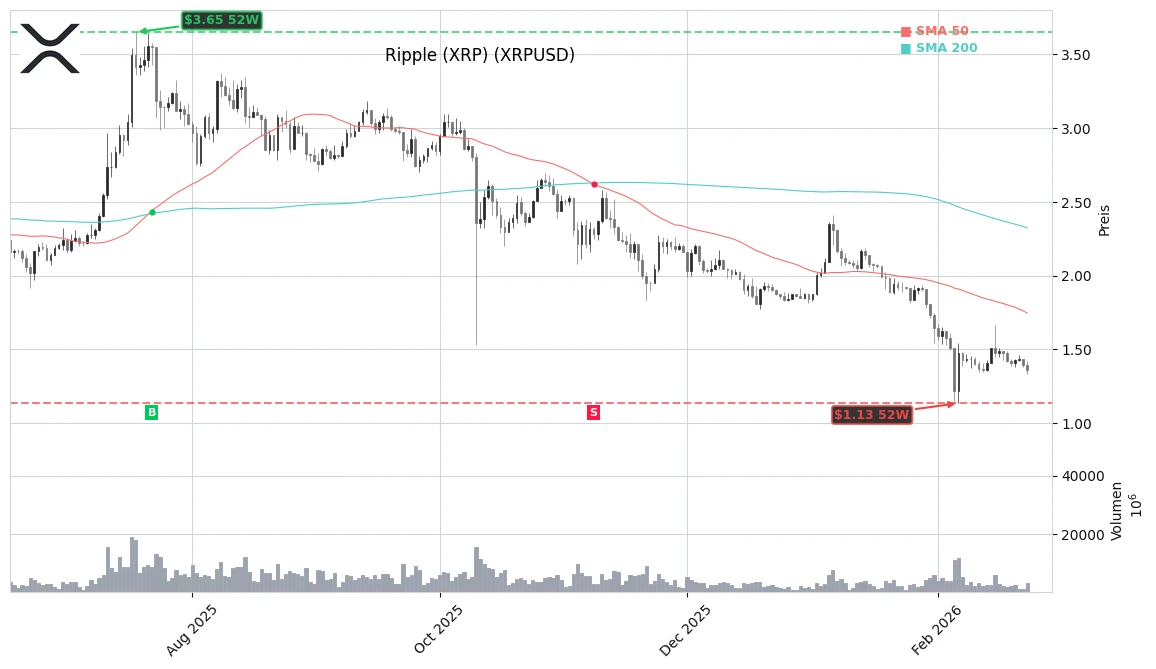
At the same time, the short-term chart picture remains tense. After a decline to the zone around $1.12, a bearish pennant formation has formed for Ripple (XRP). Technical analysts see further downside potential with a break of support around $1.22 to $1.20 and below $1.11, potentially down to the range of $1.00 to $0.80. The pressure is further intensified by large inflows of XRP holdings (“whales”) onto the Binance exchange, with nearly 31 million tokens recently—an indication of additional selling pressure.
What significance does Arizona have for Ripple tokenization?
The Ripple tokenization is receiving a boost from the regulatory side. In Arizona, a bill for a “Digital Assets Strategic Reserve Fund” has been advanced, which explicitly names XRP as an allowable digital asset. The fund is to be financed from seized or state-transferred digital assets as well as from budgetary funds and will operate separately from the general state budget. The responsible state treasury is expected to actively manage the holdings and generate returns, including through lending transactions.
Even though the draft has not yet been finalized, it sends an important signal: XRP is being considered at the state level as a potential component of institutional reserves. For investors betting on a growing acceptance of tokenization platforms, this could serve as a blueprint for other states or countries.
Major firms like Citigroup, RBC Capital Markets, or Goldman Sachs have repeatedly emphasized the potential of asset tokenization in general, without specifically committing to XRP. However, their studies regularly point out that regulatory clarity and institutional structures are crucial—exactly where the current developments at Ripple (XRP) are focused.
Bottom Line
Despite the short-term weak price and a 34% correction over three months, the strategic story remains intact: If Ripple can implement its roadmap and consistently attract capital into tokenized assets on the XRPL, Ripple tokenization could establish itself as an important building block in the institutional crypto market.
Related Sources
- XRP Ledger Tokenization Metrics (XRPL Foundation)
- Arizona Digital Assets Strategic Reserve Bill (Arizona Legislature)
- XRP Market Data (CoinMarketCap)
- Ripple (XRP) on Yahoo Finance (Yahoo Finance)