Can a fragile Rivian Forecast survive higher-for-longer rates, an EV demand slump and the high-stakes R2 launch?

How fragile is the Rivian Forecast in today’s economy?
The macro backdrop facing Rivian Automotive, Inc. is getting tougher just as the company enters its most important product cycle. Inflation projections have moved sharply higher, with consumer prices recently jumping 3.3% year over year, driven in part by elevated energy costs amid ongoing geopolitical tensions in the Middle East. Forecasts now see inflation near 4.2% by year-end, well above earlier expectations and raising the risk that the Federal Reserve keeps interest rates higher for longer.
At the same time, recession probabilities in the U.S. over the next 12 months have risen toward roughly 50% in some models, while layoff totals climbed again in 2025, signaling a softer labor market. For auto buyers already stretched by record monthly payments averaging about $772, these pressures come on top of a rising share of borrowers who are underwater on their current vehicles. Against that backdrop, the Rivian Forecast must account for the possibility that even affluent buyers delay or trade down on big-ticket purchases like electric SUVs and trucks.
This macro risk is especially relevant because EV demand is no longer on a one-way trajectory. Industry-wide EV sales fell around 28% in the first quarter, reflecting consumer fatigue with high prices, concerns over charging infrastructure and tighter credit. While leaders like Tesla have the scale to cut prices and protect share, younger players such as Rivian have less flexibility to sacrifice margin as they ramp volume.
Can Rivian’s R2 lineup overcome EV slowdown fears?
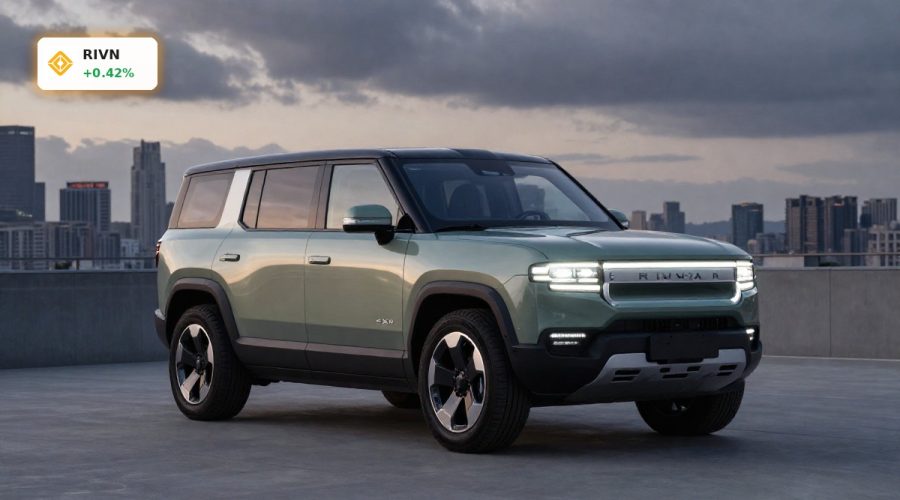
The R2 platform sits at the center of any realistic Rivian Forecast. The first R2 configuration, a mid-size SUV, recently opened for orders at about $58,000, with cheaper variants slated over the next year and a base model around $45,000 targeted for late 2027. Strategically, R2 is designed to pull Rivian down-market toward the heart of the U.S. new-car price spectrum and broaden its addressable customer base beyond early adopters of its R1T pickup and R1S SUV.
Early signs around the product are constructive. An EPA certification points to an estimated range around 335 miles on certain R2 trims, putting Rivian’s offering in a more competitive position versus mainstream options such as Tesla’s Model Y. Strong Q1 2026 deliveries and management’s decision to reaffirm full-year volume targets reinforce the view that demand for Rivian’s vehicles remains solid despite sector headwinds.
Yet execution risk remains high. Any prolonged economic slowdown could hit precisely the demographic Rivian needs most: buyers able to stretch into a $45,000–$60,000 EV but dependent on financing. Higher-for-longer interest rates would keep monthly payments elevated, potentially capping the upside for R2 reservations and delaying Rivian’s path to scale-driven cost reductions. For Wall Street, the key Rivian Forecast question is not just demand in a vacuum, but demand in a world of tighter credit and shaky consumer confidence.
How do partnerships and software reshape the Rivian Forecast?
Even as the macro narrative darkens, Rivian is trying to shift its story from a pure hardware play toward a more diversified, software-enabled revenue model—an approach familiar to investors in Apple or NVIDIA. A major pillar is the new collaboration with Uber, under which Rivian plans to supply up to 10,000 autonomous R2-based robotaxis beginning in 2028. The arrangement includes a potential Uber investment of up to $1.25 billion, underscoring confidence in Rivian’s platform and autonomy roadmap.
This robotaxi initiative, combined with Rivian’s own in-house software ambitions, could provide high-margin recurring revenue streams over time and help offset pressure on vehicle margins. It also positions Rivian more directly against players exploring autonomous fleets, including Tesla with its planned robotaxi platform. For investors building a Rivian Forecast out to the early 2030s, these software and services lines are a critical swing factor in long-term valuation, especially as traditional price-to-sales multiples for EV makers compress.
Recent capital markets signals have been mixed but not alarming. DA Davidson recently upgraded Rivian from Underperform to Neutral while maintaining a $14 price target, indicating that at least one formerly bearish shop now sees downside as more limited. Separately, insider activity has drawn attention: CEO Robert J. Scaringe sold about 20,264 shares at $15 under a 10b5-1 plan, while CFO Claire McDonough and the chief accounting officer received substantial stock options and RSU grants, aligning a chunk of leadership’s compensation with long-term equity performance.
What does all this mean for U.S. growth investors?
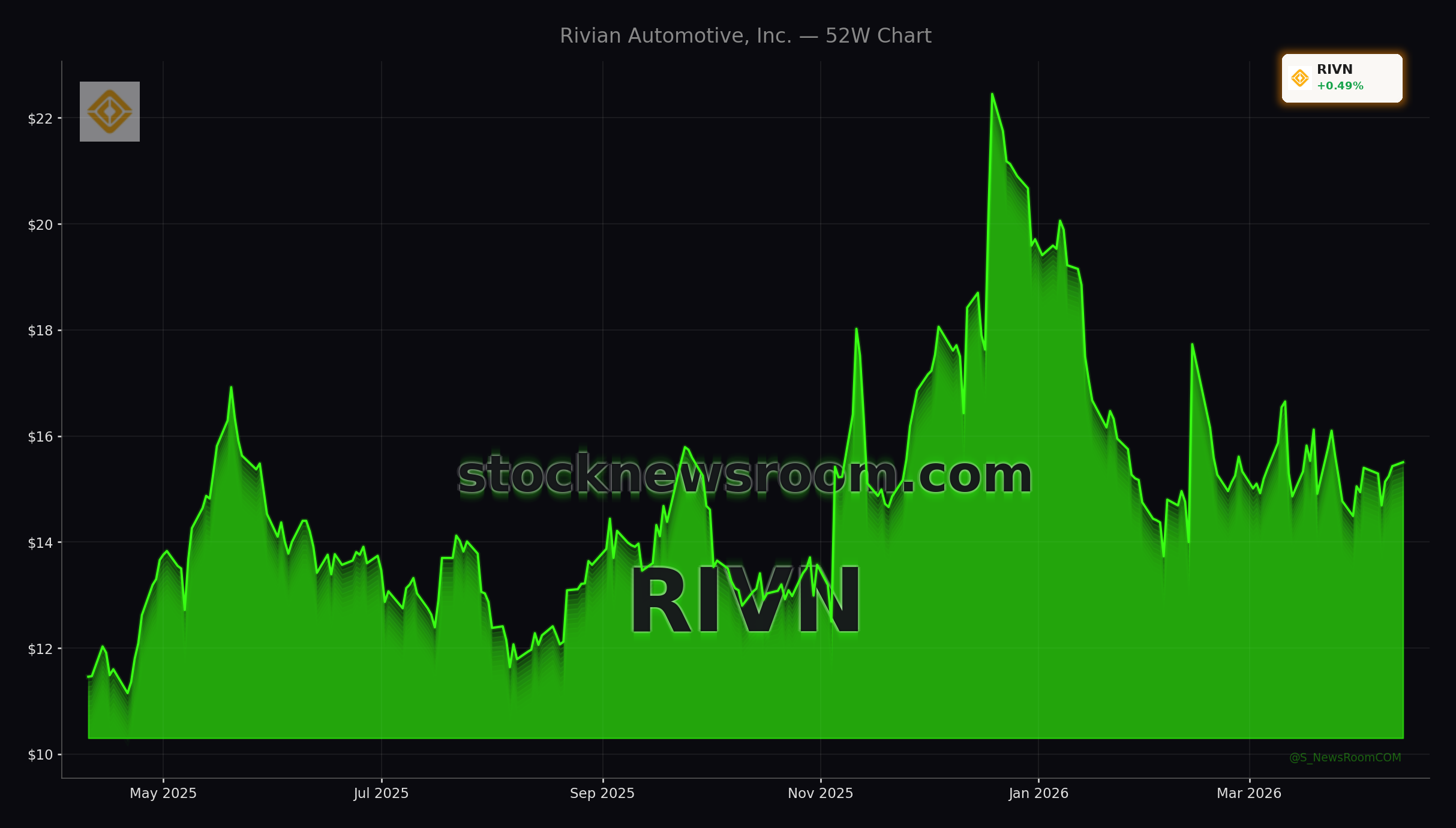
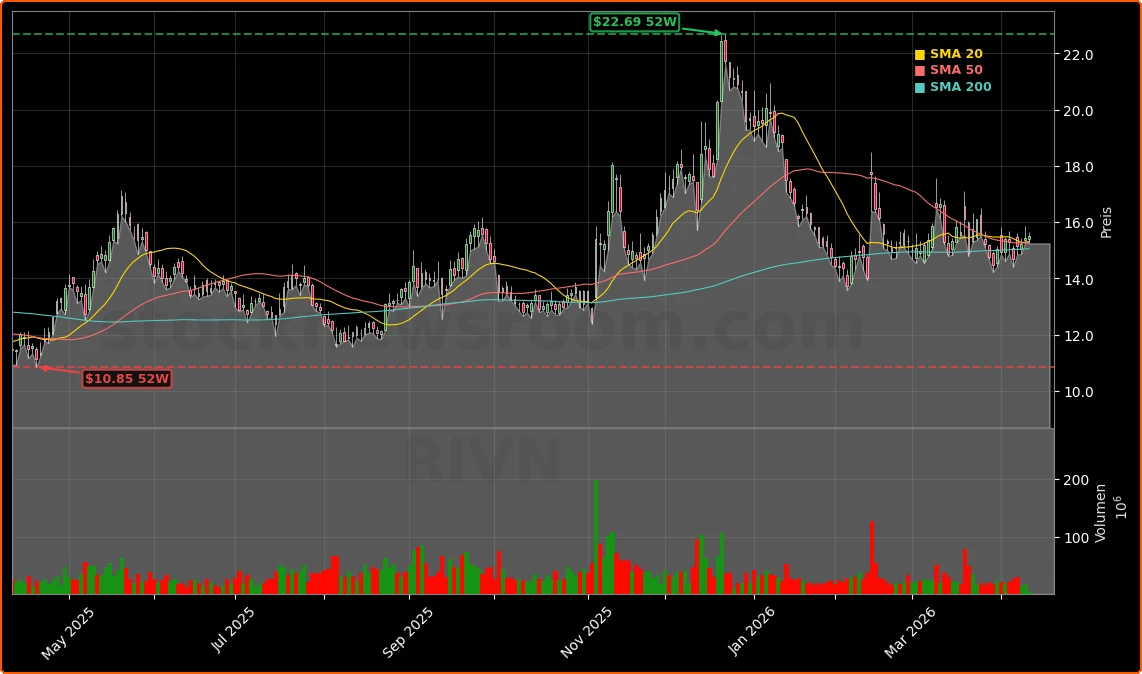
At a share price around $15.49, Rivian remains well below many analysts’ fair value estimates, including models clustering in the mid-$20s, but also far from speculative penny-stock territory. Technical commentary on platforms like TradingView shows a split tape: some traders see bottoming patterns and long-term upside; others warn that short-term charts remain bearish ahead of the next earnings report on April 30, 2026. That tension mirrors the broader Rivian Forecast: a credible path to scale and software monetization, but undercut by cyclical headwinds and capital-intensity risks.
For U.S. investors comparing Rivian to larger EV names in the NASDAQ and S&P 500 ecosystems, the trade-off is clear. Market leaders such as Tesla offer deeper liquidity and proven profitability, but already embed aggressive expectations for autonomy and AI. Rivian, by contrast, sits earlier in its lifecycle with higher execution risk but more room for upside if the R2 ramp and robotaxi strategy deliver. Position sizing, time horizon and risk tolerance are therefore crucial; Rivian fits better as a satellite growth holding than a core portfolio anchor.
Related Coverage
For a deeper dive into how AI and autonomy could change the company’s trajectory, including its deals with Volkswagen and Uber, see this analysis of Rivian’s AI strategy, the R2 and robotaxis. To understand the broader competitive landscape and how another major EV player is balancing robotaxi dreams with slowing EV demand, read this detailed look at Tesla’s robotaxi boom and EV slowdown risks, which provides useful context for comparing the Rivian Forecast against sector peers.
In conclusion, the Rivian Forecast hinges on whether the R2 launch and emerging software opportunities can outpace mounting macro and sector headwinds. For investors, Rivian remains a high-beta way to bet on the next phase of U.S. EV and autonomy growth, with robotaxi and platform partnerships adding optionality beyond pure vehicle sales. The next few quarters—especially the R2 ramp and updates around the Uber alliance—will show whether Rivian can turn today’s challenging environment into a springboard instead of a stumbling block.