RIVN
$16.83
+2.16%
Feb 18, 2026 4:18 PM ET
Rivian Automotive, Inc.
Can the strong Rivian quarter of 2025 and the R2 launch finally turn the loss-making EV story into a real growth rally?
How strong was the Rivian quarter of 2025 really?
The latest Rivian quarter marks a significant improvement in earnings. For the full year 2025, Rivian Automotive, Inc. reported an impressive turnaround in gross profit: from a negative value of around $1.2 billion in the previous year to a positive gross profit of about $144 million. This improved the gross margin by approximately $1.3 billion – a key reason for the recent stock surge.
Drivers of this development were primarily higher average selling prices and significantly lower unit costs. According to management, the average selling price per vehicle increased by about $5,500, while manufacturing costs per unit decreased by approximately $9,500. At the same time, revenue in 2025 increased by 8% overall, despite the automotive sector alone experiencing a decline of 15% – an effect of expired EV tax credits and previously pulled-forward demand.
The business with software and services showed particularly dynamic growth: revenues in this segment exploded by 222% to $576 million, supported by the partnership with Volkswagen. Nevertheless, Rivian remains deep in the red for the full year, with a net loss of around $3.6 billion and a negative free cash flow of about $2.5 billion.
Rivian Automotive: How ambitious is the outlook for 2026?
In focus after the Rivian quarter are the plans for 2026. The management of Rivian Automotive, Inc. expects deliveries between 62,000 and 67,000 vehicles. The average of this range corresponds to a growth of about 53% compared to the 42,247 vehicles delivered in 2025, while the upper end would even mean an increase of 59%. This clearly positions Rivian as a growth stock – despite the currently cooling overall EV market and tough competition from Tesla and established automakers.
At the same time, the company expects an improvement in adjusted EBITDA, although 2026 will be characterized by the production ramp-up of a new model. Rivian guides for an adjusted EBITDA loss of $1.8 to $2.1 billion – still significant losses, but with noticeable efficiency gains. Critical analysts, such as those from D.A. Davidson, warn that the ambitious delivery forecast heavily depends on a smooth and successful market launch of the R2 and recently rated the stock with a sell recommendation.
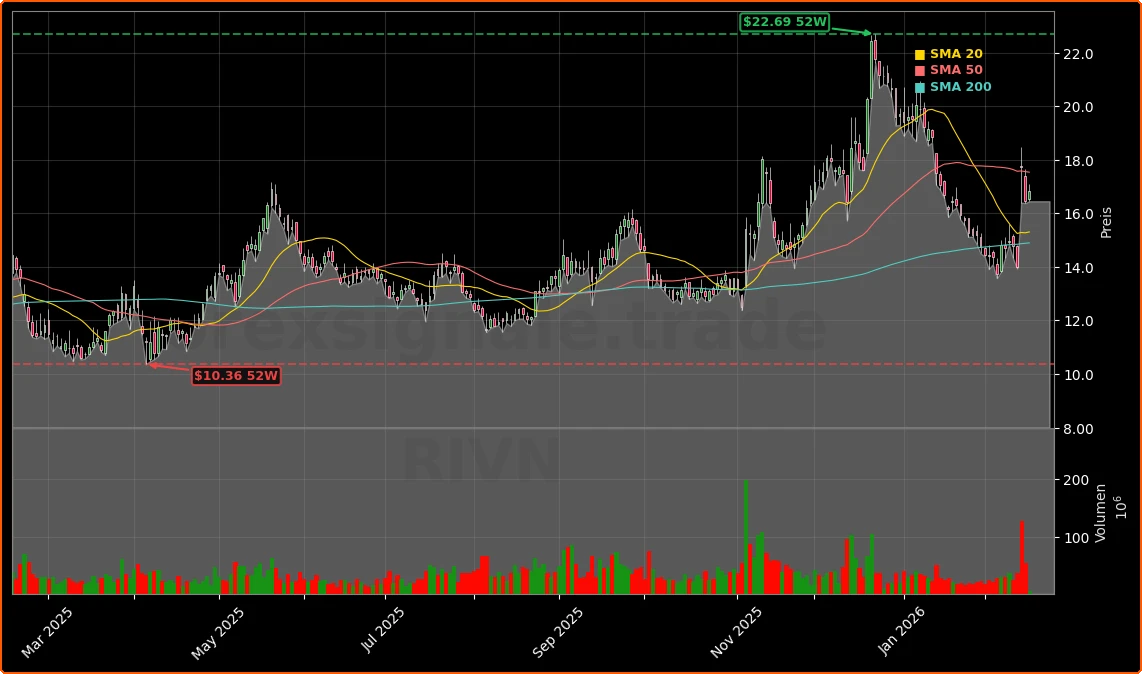
Nevertheless, the new tone is well received on the stock market: following the Q4 numbers, the stock rose by more than 25% in one day and is currently priced at $16.83. While it is still far from previous highs, it has clearly outperformed Tesla and other EV stocks over the past twelve months.
Rivian Quarter: Will the R2 be the hoped-for game changer?
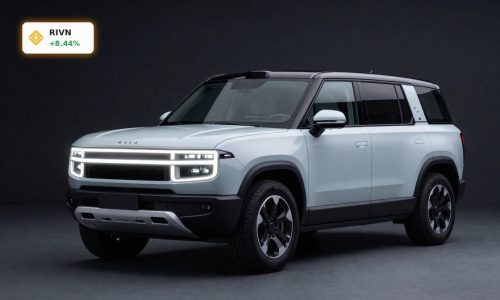
The Rivian quarter has shown that the existing R1 platform can become more profitable, but the real leverage lies in the R2. With the new, more mass-market SUV, Rivian Automotive, Inc. aims to massively expand its addressable customer base. Prices will be officially announced in March, but the R2 is expected to be positioned significantly below the existing premium models R1T (starting at $72,990) and R1S (starting at $76,990). Planned features include over 300 miles of range and more than 650 horsepower – while significantly reducing manufacturing complexity and vehicle costs.
CEO RJ Scaringe describes the R2 as a potential “game changer” for customers, the company, and the entire industry. Strategically, Rivian targets the segment of five-seat SUVs and crossovers with average new car prices slightly above $50,000 – a large market with high demand for practical yet emotionally appealing e-SUVs. Analyst firms like Seeking Alpha see the R2 platform and the planned capacity expansion by 2027 as the basis for a fivefold increase in deliveries and a possible break-even in adjusted EBITDA.
Nevertheless, the chance-risk profile remains demanding. The capital requirements for further expansion, including the second plant, are high, and investors must expect dilution and volatility. Skeptical voices – such as those from D.A. Davidson – point to potential startup issues with the R2, delays in plant construction, and the waning EV boom in the U.S. Optimistic market observers, including several growth-oriented research firms, argue that the combination of positive gross margins, a rapidly growing software and service business, and the R2 scaling presents an attractive turnaround story.
„We believe that the R2 will be a game changer for our customers, our company, and the entire industry.”
— RJ Scaringe, CEO of Rivian Automotive, Inc.
Bottom Line
In the end, the valuation of the stock crucially depends on whether Rivian fulfills its growth promises and sustainably improves profitability. The current Rivian quarter provides initial solid evidence for this – now the coming quarters must show whether the trend continues.
Related Sources
- Rivian Automotive, Inc. (RIVN) stock price and metrics (Yahoo Finance)
- Is Rivian Stock a Buy in 2026? (The Motley Fool)
- Rivian Stock: The EV Recovery Play to Watch (The Motley Fool)
- Rivian Posts Biggest Gain Since IPO After Q4 2025 Earnings (MarketBeat)