Can a $1.5 billion Robinhood Buyback Program really stabilize the stock just as crypto headwinds and user fatigue intensify?

Is Robinhood nearing a market bottom?
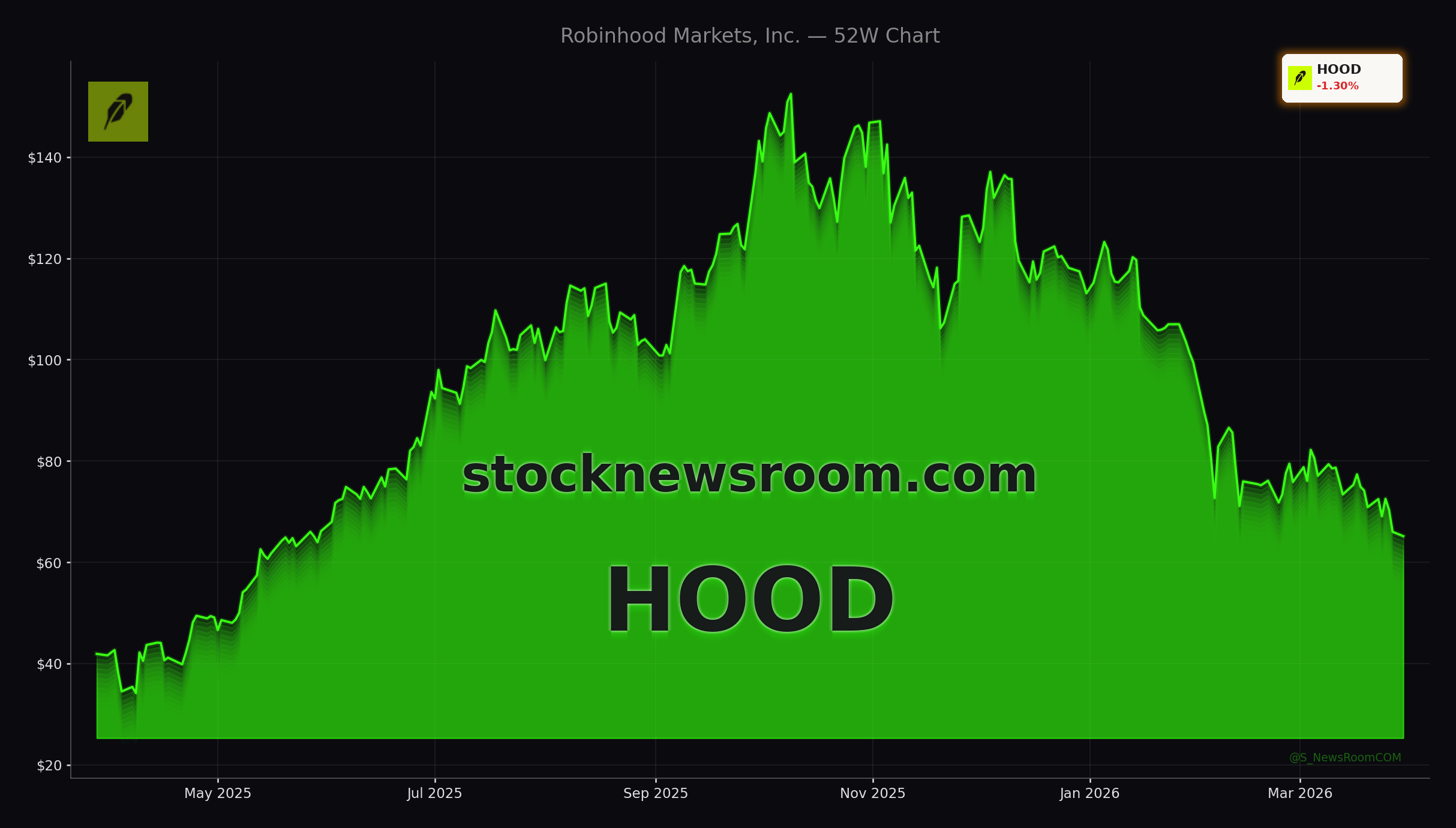
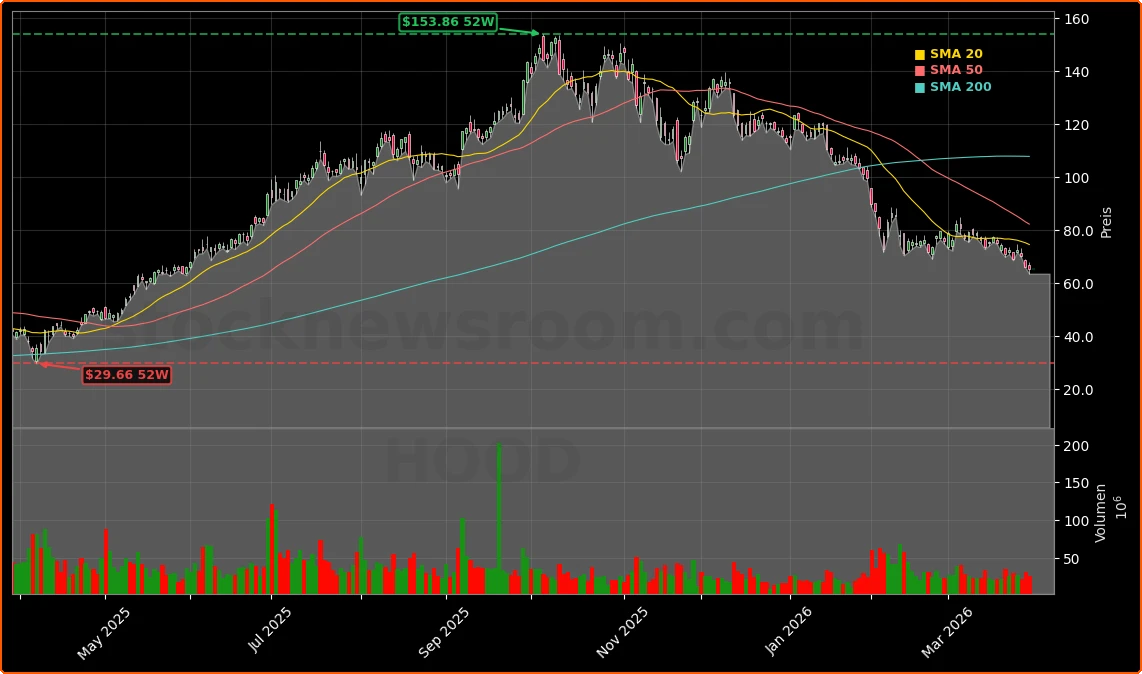
Robinhood Markets, Inc. (HOOD) closed Monday at $65.16, down 1.30% on the day, with after‑hours trading nudging the stock slightly higher to $65.28 as of 4:30 p.m. ET. That price leaves the stock roughly 16% lower for March alone, sliding from nearly $80 at the start of the month, and about 42% lower year‑to‑date, making it one of the weakest names in the S&P 500 so far in 2026.
Over the past 12 months, Robinhood’s valuation has effectively been cut in half, even though the business is still coming off a strong 2025 in which revenue grew 52% for the full year. The pressure has intensified as growth slowed to 27% year‑over‑year in Q4 2025 and as investors reassessed how sustainable the pandemic‑era trading boom and subsequent AI‑ and crypto‑driven enthusiasm really are.
Bernstein analysts, led by Gautam Chhugani, argue that crypto‑exposed stocks like Robinhood, Coinbase and Figure Technology Solutions are now trading at what they describe as “big discounts” after falling roughly 60% from their all‑time highs. Bernstein has trimmed its price target on Robinhood but maintained an Outperform rating, contending that weak Q1 2026 results could coincide with a bottom for crypto stocks and set up a recovery as sentiment and volumes normalize.
That more constructive view stands in contrast to the tape. Robinhood is grappling with a tougher macro backdrop, a 7% year‑to‑date decline in the S&P 500, and fading speculative activity in crypto and options – the very verticals that fueled its breakout growth.
How much trouble is crypto causing Robinhood?
The most acute headwind is coming from digital assets. Revenue from crypto transactions dropped about 38% year‑over‑year as of Q4 2025, while crypto app volumes plunged roughly 58%. That shift has reversed one of the company’s most lucrative growth drivers and exposed Robinhood’s sensitivity to speculative cycles, even though management emphasizes that roughly 80% of total revenue is now unlinked to crypto.
Lower trading appetite among younger retail users has shown up across the platform. Monthly Average Users (MAUs) have trended lower from peak levels, and market participants worry that if economic conditions deteriorate further, retail investors could pull back even more from options, margin and crypto trades that have historically generated strong revenue per user.
Morningstar recently initiated coverage on Robinhood with a narrow economic moat rating and a $50 fair value estimate, calling the stock “expensive” at current levels despite its recent slide. The firm highlights the broker’s heavy reliance on options and crypto trading compared with more diversified rivals like Charles Schwab or Interactive Brokers (not internally linked), and questions whether its younger base will consolidate more assets at Robinhood as they age or migrate to more established incumbents such as Apple’s expanding financial services ecosystem or Cash App and PayPal.
At the same time, Robinhood is not purely a crypto story. Management has been pushing aggressively into prediction markets, a “Robinhood Social” feed, EU stock tokens, and broader super‑app functionality. Those initiatives aim to cushion the blow from lower pure trading volumes and to position the company closer to multi‑product fintech platforms like NVIDIA‑powered AI finance apps and super apps emerging in Asia.
What exactly is the Robinhood Buyback Program?
Against this volatile backdrop, the board has authorized a new $1.5 billion Robinhood Buyback Program, replacing a prior repurchase plan and adding more than $1.1 billion in additional capacity. The authorization is expected to be executed over approximately three years and is designed to offset dilution from stock‑based compensation and signal confidence in Robinhood’s long‑term prospects.
The market’s initial reaction has been skeptical. HOOD shares fell roughly 6% on the day the Robinhood Buyback Program was detailed, sliding from an opening print above $70 to the mid‑$60s. Investors appear unconvinced that buybacks alone can fix structurally weaker crypto volumes, competitive pressure in prediction markets, and the overhang of potential regulation around payment for order flow and new trading products.
Yet there are tangible financial implications. With the stock now trading at about 32 times trailing earnings, down from well over 60 several months ago, repurchasing shares at current levels is more accretive than it would have been near the highs. If the company can sustain positive free cash flow while keeping operating expenses in check, the Robinhood Buyback Program could meaningfully reduce the share count over three years and boost per‑share metrics even in a modest growth environment.
Robinhood has also strengthened its balance sheet flexibility with a larger credit line, giving it more room to support the buyback while continuing to invest in new products and markets. The board’s decision to name Shiv Verma as the new chief financial officer, along with recent investments through its Ventures Fund I into companies like Stripe and ElevenLabs, underlines management’s intention to stay on offense strategically even as the stock comes under pressure.
How are Wall Street analysts positioned?
Despite the poor share‑price performance, the sell‑side remains divided but far from capitulation. Bernstein continues to rate Robinhood Outperform, emphasizing exposure to multi‑trillion‑dollar opportunities around prediction markets, stablecoins, tokenized real‑world assets and crypto derivatives. Their thesis is that current weakness is cyclical, not structural, and that Robinhood’s diversified revenue mix should prove more resilient than pure‑play exchanges.
Morningstar, by contrast, sees limited upside from here with its $50 fair value estimate below the current $65 handle, effectively treating HOOD as overvalued. The firm acknowledges Robinhood’s critical mass of client assets and rapid product innovation, but points to a riskier business mix than traditional brokers and meaningful uncertainty around long‑term customer retention.
Consensus on Wall Street still skews bullish. The average analyst price target sits around $117.48, implying roughly 80% upside from Monday’s close. That target reflects expectations that Robinhood can re‑accelerate growth as its new product lines scale and as retail activity stabilizes. However, the wide dispersion of targets – from cautious fair‑value estimates like Morningstar’s up to much higher bullish calls – shows just how polarized views have become.
For now, Robinhood trades more like a high‑beta fintech and crypto sentiment gauge than a steady online broker. Any upside surprise in user engagement, trading volumes, or regulatory clarity could quickly re‑rate the stock, just as further disappointments or a deeper crypto winter could put more pressure on management and the Robinhood Buyback Program.
What does competition mean for Robinhood’s strategy?
Competitive dynamics are shifting fast. In trading and brokerage, Robinhood faces pressure not only from legacy firms such as Schwab and Fidelity but also from newer fintechs and big‑tech entrants. Tesla and Apple both illustrate how brand power and ecosystem lock‑in can reshape investor behavior, with Apple’s foray into savings, credit cards and payments hinting at how quickly tech platforms can expand their financial footprints.
In prediction markets and social trading, niche rivals are racing to launch innovative products, sometimes with fewer regulatory constraints in offshore jurisdictions. That raises questions about whether Robinhood can maintain differentiation in features like Robinhood Social or stock tokens in the EU once competitors catch up, particularly if regulators in the U.S. and Europe tighten oversight around gamification, leverage, or tokenization.
Robinhood has also reportedly been in the mix to help distribute high‑profile IPOs to retail investors, such as the looming SpaceX listing, but recent indications suggest that E*Trade is currently leading the retail push while Robinhood and SoFi compete for a role. Being sidelined from marquee deals would be a setback for its brand positioning as the default gateway for younger investors seeking access to Silicon Valley growth stories.
Still, Morningstar’s bullish strategic view – that Robinhood is well placed to become the primary financial services provider for the next generation of active traders – hinges on exactly these competitive battles. If Robinhood can use the Robinhood Buyback Program to shore up investor confidence while channeling operating cash flow into differentiated super‑app features, it could entrench itself as the first stop for high‑engagement investors, even as they later diversify assets to broader platforms.
Related coverage
For a deeper dive into how the $1.5 billion repurchase authorization and expanded credit facility initially rattled investors, the article “Robinhood Buyback Program $1.5B: Stock’s -4.7% Plunge Shock” examines the market’s first reaction to management’s capital‑return strategy. It walks through why the announcement failed to spark an immediate rally and what skeptics see as the key execution risks.
Investors watching the broader tech and AI landscape may also want to read “Alphabet TurboQuant Shock: Is Google Rewriting AI Memory Costs?”. That piece explores how Google’s AI memory innovations could reshape cloud and chip demand, a backdrop that indirectly affects high‑growth tech and fintech names like Robinhood as risk appetite and sector rotations shift across the NASDAQ and S&P 500.
In the end, the $1.5 billion Robinhood Buyback Program is a high‑stakes bet that the current sell‑off and crypto malaise represent a buying opportunity rather than the start of a prolonged decline. For U.S. and global investors, the stock now sits at the intersection of retail trading behavior, evolving regulation, and multi‑trillion‑dollar themes like tokenization and prediction markets. The next couple of quarters – especially around Q1 2026 earnings and crypto sentiment – will show whether this buyback‑fueled reset can stabilize one of the S&P 500’s most volatile fintech names and potentially set the stage for a rebound.