Is the latest Robinhood Forecast signaling the start of a durable profit boom or just another sentiment-driven spike?
Is Robinhood still a growth story for Wall Street?
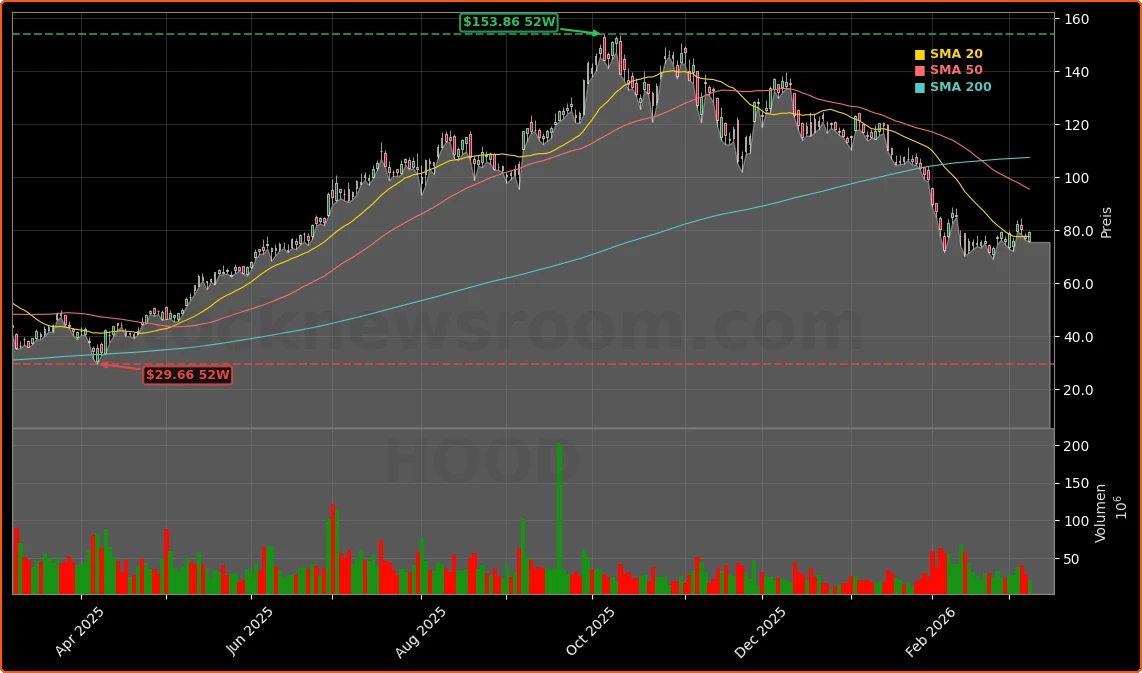
Despite the recent correction, HOOD remains one of the standout post-pandemic winners in US fintech. Since its 2021 IPO at $38 per share, the stock has more than doubled, even after the year-to-date drawdown tied to weaker crypto prices, softer retail trading volumes and valuation concerns. From 2020 to 2025, annual revenue jumped from $959 million to about $4.5 billion, while funded accounts climbed from 12.5 million to 27 million. That customer growth underpins any serious Robinhood Forecast: the platform is still adding users and deepening relationships rather than simply riding a one-off meme-stock wave.
The upgraded Robinhood Gold subscription is central here. Gold members pay $5 per month or $50 per year for perks like interest-free margin buffers, lower margin rates and higher yield on idle cash. By 2025, Gold subscribers had surged 58% to 4.2 million, creating a more recurring, less trading-dependent revenue stream. For comparison, traditional brokers such as Charles Schwab and Fidelity have long relied on similar membership and cash-yield economics; Robinhood is now catching up fast in that respect, while still leaning on its mobile-first, gamified experience.
How much does crypto still drive Robinhood?
One of the biggest swing factors in any Robinhood Forecast is crypto. Management has worked to diversify beyond Bitcoin and Ethereum, but crypto-related trading and staking remain a major revenue driver. Historically, HOOD’s share price has tracked Bitcoin closely; overlaying Bitcoin with Robinhood’s stock since early October shows a strikingly tight correlation, underscoring how sentiment in digital assets can quickly change equity valuations.
To capitalize on a warming crypto environment, Robinhood has expanded its footprint through acquisitions such as WonderFi and Bitstamp, adding scale and international reach. At the same time, regulatory risk has eased: the SEC under the current Trump administration has stepped back from imposing new limits on payment for order flow (PFOF) and has adopted a more permissive stance toward cryptocurrencies. That shift removes a key overhang that once threatened Robinhood’s zero-commission model and crypto operations, though regulation can always swing back with a change in Washington.
Robinhood Forecast: Can profits keep accelerating?
The most compelling pillar of the bullish Robinhood Forecast is profitability. After returning to GAAP profitability in 2024, Robinhood grew earnings per share by about 31% in 2025. Higher interest rates boosted net interest income on uninvested client cash, margin balances and sweep programs, while options and crypto trading picked up alongside greater engagement. Cost discipline also played a role: the company streamlined headcount and curbed stock-based compensation.
Between 2020 and 2025, adjusted EBITDA margin expanded from roughly 16% to 56%, while net margin jumped from 1% to 42%. Looking ahead to 2025–2028, Wall Street expects revenue to compound near 18% annually and adjusted EBITDA around 21%. With an enterprise value of roughly $72 billion, HOOD trades at about 22 times this year’s projected adjusted EBITDA. If it executes on that growth and re-rates to 25 times current-year EBITDA by early 2028, upside of roughly 50%–60% from current levels appears plausible, comfortably ahead of the S&P 500’s long-term average return.
What does the new venture fund mean for investors?
A newer piece of the Robinhood Forecast involves its push into alternative assets. The firm has launched Robinhood Ventures Fund I (ticker RVI), a closed-end fund that gives retail clients exposure to late-stage private companies such as Databricks, Revolut and Mercor. The fund, around $658 million in assets, now trades on the NYSE, but its debut was rocky: RVI fell about 11% on its first trading day amid choppy equity markets and skepticism over lofty private valuations, particularly Revolut’s $75 billion mark.
This venture move is strategically important even if near-term market reaction is muted. It signals Robinhood’s ambition to evolve into a broader wealth and asset-management platform rather than a pure trading app. That direction aligns with the firm’s efforts to target more affluent customers, roll out card-based banking, AI-driven portfolio tools and even tokenized assets. It also puts Robinhood into more direct competition with established wealth players like Morgan Stanley’s E*TRADE, as well as with mega-cap platforms such as Apple’s and NVIDIA’s expanding financial and AI ecosystems.
How are analysts positioning HOOD now?
Institutional sentiment is mixed but improving. Growth-focused managers such as Cathie Wood’s ARK Invest have been adding to their Robinhood position, effectively treating HOOD as a long-duration fintech platform that could benefit from an eventual super-app transition. Value-oriented research shops remain more cautious, flagging the stock as expensive versus traditional brokers and raising execution risk around the new venture strategies.
Across Wall Street, the consensus leans toward moderate upside over the next 12–24 months, with several large banks maintaining buy or overweight ratings and price targets above the current $79 range. Compared with other high-growth financial names in the NASDAQ universe, Robinhood’s valuation is not outlandish given its margin profile, but the stock is clearly sensitive to any disappointment in user growth, trading activity or crypto conditions.
Conclusion
For US investors weighing the latest Robinhood Forecast, the key question is whether the company can keep expanding its ecosystem fast enough to offset inevitable volatility in trading and Bitcoin cycles. If it can, HOOD could remain a high-beta but attractive way to gain leveraged exposure to the next wave of retail investing, AI-driven finance and private-market access.
Further Reading
- Robinhood Markets, Inc. (HOOD) Stock Quote & Overview (Yahoo Finance)
- 5 Reasons to Buy Robinhood (HOOD) Stock Like There’s No Tomorrow (The Motley Fool)
- Robinhood’s $658 Million Private Retail Fund Goes Public (Benzinga)
- Robinhood’s venture fund, which gives investors access to private companies, tanks 11% on first day (CNBC)
- Robinhood Ventures Fund I: Turning Retail Investors Into Venture Capitalists (Seeking Alpha)