
Can the Robinhood Strategy survive a brutal crypto comedown while user growth slows and valuation pressure keeps rising?

Is Robinhood Markets, Inc. losing its momentum?
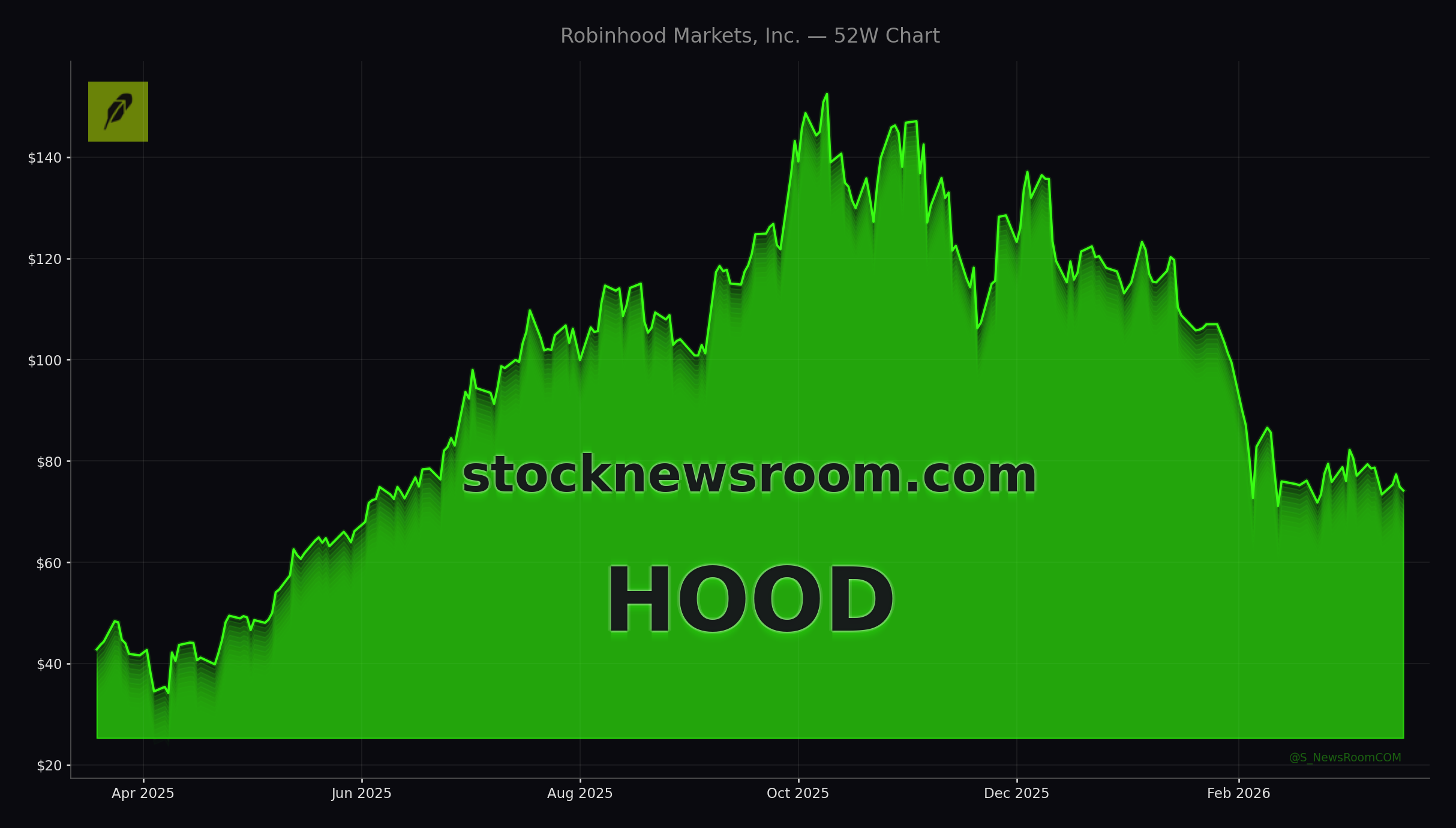
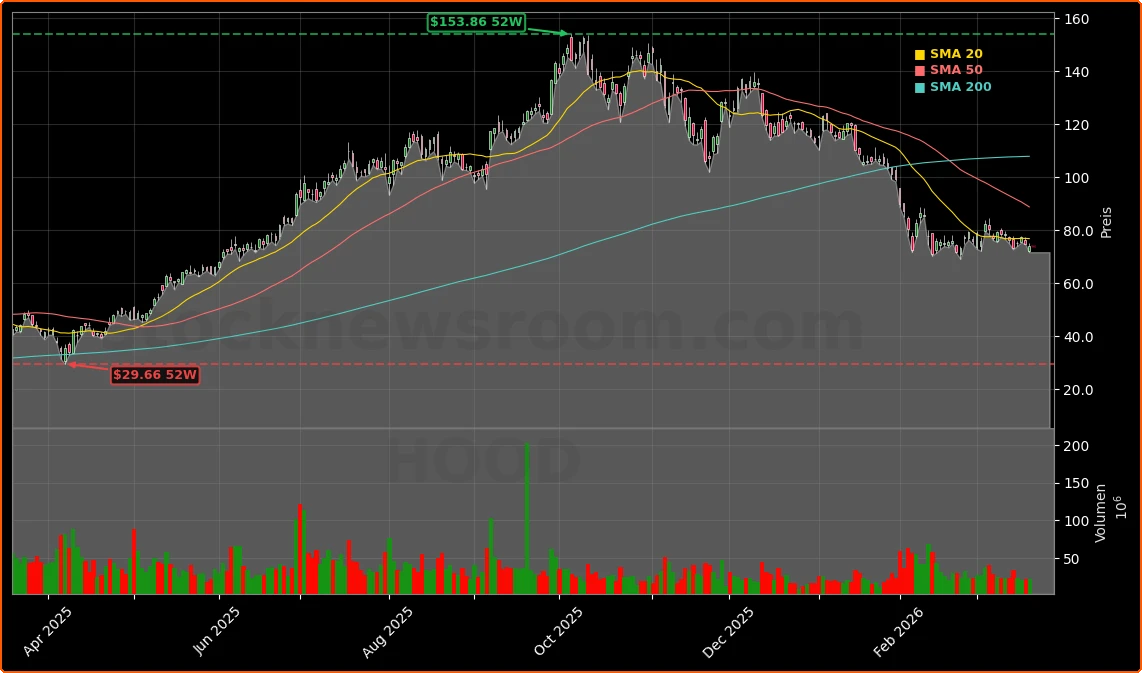
Robinhood Markets, Inc. (HOOD) closed at $74.16 on Thursday, slipping 0.99% and edging lower again in pre-market trading to $73.69. The move continues a multi-month slide: after peaking above $150 in October 2025, the stock has shed roughly half its value. That drop came even as revenue rose in the mid-20% range year over year, highlighting growing concern about the quality and sustainability of growth, particularly in crypto trading and high-risk options activity.
Market data show HOOD trading well below its 52‑week high, so the recent bounce from the lows is far from a full recovery. With a price-to-sales ratio still in the mid-teens — well above its post-IPO average of around 11.5 — valuation remains a sticking point for many institutional investors. The sell-off has turned HOOD into one of the more hotly debated fintech names on NASDAQ, with trading volumes elevated as short-term traders and long-term investors reassess the risk/reward profile.
How central are free stocks to the Robinhood Strategy?
A cornerstone of the current Robinhood Strategy is the aggressive use of free-stock rewards to attract and retain users. New customers who open and fund an account can receive a free share worth roughly $5 to $200, and referral bonuses provide additional chances to earn stock. While the upper end of that range looks eye-catching in marketing materials, in practice the vast majority of rewards land near the minimum value.
For first-time investors, the ability to start a portfolio with free stocks, commission-free U.S. equity and option trading, and FDIC-backed cash sweep products is appealing. Robinhood supports both taxable brokerage accounts and IRAs, including a 1% standard match on eligible retirement contributions, rising to as much as 3% with its Gold subscription. The company emphasizes that client securities are protected up to $500,000 through SIPC insurance, which helps offset some of the perceived risk of a mobile-first broker.
However, these free-stock incentives are not free to shareholders. The Robinhood Strategy effectively trades near-term customer acquisition costs for long-term trading and interest revenues, a model that only works if new users remain active and profitable over time. The recent decline in monthly active users puts that assumption under pressure and raises questions about the ultimate payback of the promotional spend.
Can Robinhood Strategy handle the crypto comedown?
The biggest swing factor for HOOD over the last 18 months has been crypto trading. After Donald Trump’s 2024 election victory fueled a massive speculative wave, Robinhood’s crypto transaction revenue jumped 732% year over year in Q4 2024 to a record $358 million, more than half of total transaction revenue. That surge helped drive the parabolic move in the stock last year, but it also set the stage for the current hangover.
As the value of global crypto assets slid from about $4.4 trillion at the 2025 peak to $2.5 trillion more recently, Robinhood’s crypto revenue dropped 38% year over year to $221 million in Q4 2025. Bitcoin and Ethereum are both down more than 40% from their highs, and the loss of momentum has pulled many retail traders to the sidelines. While options and prediction-market betting helped offset some of the crypto decline, these activities are also highly speculative and may not deliver stable, recurring revenue.
For comparison, dedicated crypto platforms like Coinbase and diversified fintech players such as NVIDIA’s AI-driven trading infrastructure partners have been trying to broaden beyond pure trading spreads. If Robinhood Strategy remains heavily tied to short-term speculative volume, HOOD could stay more volatile than broader benchmarks like the S&P 500 and NASDAQ Composite.
What about new products like prediction markets and cards?
Robinhood is pushing into new verticals to reduce reliance on traditional trading commissions and payment-for-order-flow economics. Its prediction-markets unit, launched in partnership with Kalshi, has quickly scaled to more than 12 billion event contracts traded in 2025 and exited Q4 2025 at about $435 million in annualized revenue, more than triple the prior quarter. Customers can now bet on outcomes ranging from elections to sports results, a segment adjacent to sports betting.
The company is also moving into premium credit cards with the Robinhood Platinum Card, a direct challenge to incumbents like Apple’s Apple Card and premium products from American Express. The Platinum Card charges a $695 annual fee and advertises over $3,000 in potential yearly perks, mirroring the structure of the American Express Platinum but undercutting its $895 fee. Bundled with the Gold subscription, this fits into a broader Robinhood Strategy to capture more of the financial wallet of higher‑value customers.
Gold itself, at $5 per month, offers 4% APY on cash, IRA contribution matches up to 3%, and access to professional research — benefits designed to compete with more traditional brokers and asset managers. Still, as competition intensifies from platforms tied to tech giants like Tesla’s in‑car financial services experiments and the broader Apple ecosystem, Robinhood will need to prove it can keep affluent users engaged.
How are analysts on Wall Street reacting?
Wall Street remains divided on HOOD. Zacks Investment Research recently highlighted Robinhood as a trending stock, noting the sharp year-over-year increase in February equity and options DARTs and a 68% jump in platform assets to $314.2 billion. However, separate coverage from Zacks pointed out that HOOD has underperformed the broader market in recent sessions, reflecting valuation worries and macro uncertainty.
Forbes recently framed the stock as potentially either a value trap or a bargain after a roughly 40% decline since late 2025, despite revenue climbing about 25%. Bearish commentators argue that the current price-to-sales multiple still bakes in very optimistic assumptions about future trading activity and product adoption. Bullish investors counter that if Robinhood can stabilize crypto volumes, grow prediction-market revenue, and cross‑sell new products like the Platinum Card and IRAs, today’s valuation may ultimately look attractive.
Major banks such as Goldman Sachs, Morgan Stanley, Citigroup, and RBC Capital follow the broader U.S. fintech space closely, often emphasizing user-growth trajectories and unit economics when setting targets, though recent research has generally been cautious on high-multiple consumer trading platforms. Until HOOD re‑rates meaningfully lower or delivers several quarters of more predictable earnings, many institutional investors may stay on the sidelines.
Related Coverage
Investors looking for a deeper dive into earnings trends and profit dynamics can review this detailed analysis of the latest Robinhood forecast and profit surge, which examines whether recent margin improvements are sustainable or merely cyclical. For a broader sector lens on how software and fintech intersect with artificial intelligence, this review of the Salesforce AI strategy and Q4 profit boom highlights how incumbents are using AI to deepen customer relationships and expand recurring revenue.
In summary, the Robinhood Strategy of pairing free-stock rewards with a widening suite of speculative and premium products has delivered rapid growth but also heightened volatility for shareholders. The next few quarters will show whether crypto and prediction markets can stabilize enough to justify HOOD’s still-elevated valuation multiples. For U.S. investors building diversified portfolios, Robinhood remains a high-beta fintech bet where careful position sizing and close monitoring of execution on the current Robinhood Strategy are essential.