
Can the Salesforce AI Strategy and booming Agentforce platform turn a beaten-down software giant into a long-term AI winner for investors?

Is Salesforce defying a weak tech tape?
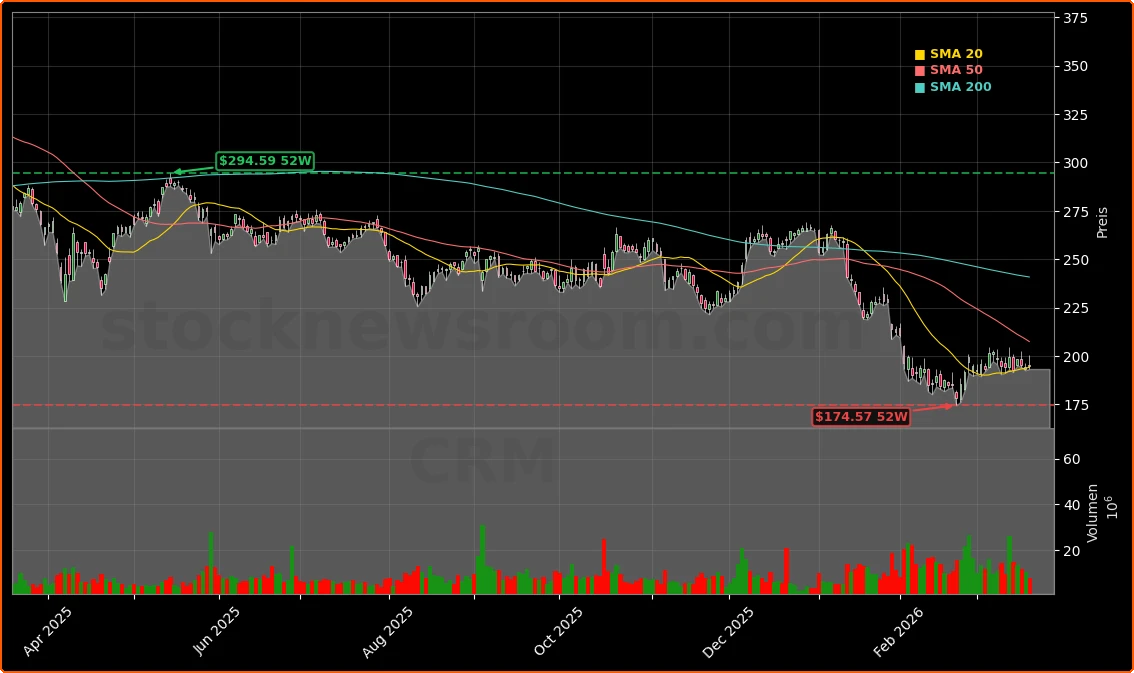
Salesforce Inc. (CRM) was trading modestly higher around $194.97 on Thursday, up roughly 0.31% on the day, even as the Nasdaq and S&P 500 drifted lower in a broadly risk-off session. The move puts the stock in relative-strength territory versus a technology sector that remains under pressure following a sharp 12‑month drawdown. Shares are still down almost 30% over the past year and sit closer to their 52‑week lows than highs, a reminder that the wider software sell-off in 2026 has not spared Salesforce.
Yet cash-generative, large-cap software names such as Salesforce, Oracle and Intuit have seen selective inflows as investors look for defensive growth amid geopolitical tensions and rotation away from cyclical risk. For U.S. portfolios, the key question is whether the Salesforce AI Strategy and record capital returns can offset concerns about valuation, leverage and structural AI disruption to traditional SaaS models.
How strong were Salesforce’s latest results?
In its fiscal Q4 2026 (ended Jan. 31), Salesforce posted revenue of $11.2 billion, up 12% year over year and slightly ahead of consensus. Adjusted earnings of $3.81 per share comfortably topped expectations near $3.04, supported by disciplined cost control and operating leverage in its core cloud portfolio. Net income climbed roughly 13.7% to $1.9 billion, underscoring the company’s transition from a pure growth story to a free-cash-flow machine.
Sales momentum is holding up at the high end of the market. Remaining performance obligations reached about $72 billion, while deals over $1 million grew 26% year over year and contracts above $10 million jumped 33%. For U.S. investors worried that AI consolidation could compress software spend, this large-deal strength suggests that Salesforce remains deeply embedded in customer workflows ranging from sales and marketing to customer service and analytics.
What is distinctive about the Salesforce AI Strategy?
The Salesforce AI Strategy centers on agentic automation embedded directly into its cloud stack, rather than stand-alone AI tools that might cannibalize existing products. The company’s Agentforce platform enables clients to build, deploy and manage AI agents that handle tasks like qualifying leads, resolving support tickets and nudging customers along purchase paths inside existing Salesforce environments.
Within just 15 months of launch, Salesforce has closed roughly 29,000 Agentforce deals across more than 23,000 customers, reaching an estimated $800 million annualized revenue run rate. Notably, each of the company’s top 10 deals in the most recent quarter included Agentforce, signaling that AI has become a must-have component of large enterprise contracts rather than an optional add-on.
Management is also layering monetization via premium subscription tiers, consumption-based AI agents and broader enterprise agreements that bundle Agentforce with Data Cloud, Tableau and MuleSoft. Some customers adopting the broader agentic platform are reportedly expanding their Salesforce spend by two to four times, highlighting how the Salesforce AI Strategy is designed to lift both revenue per customer and platform stickiness.
How does Salesforce compare to other AI leaders?
On Wall Street, Salesforce now competes not only with direct SaaS rivals but also with hyperscale AI ecosystems anchored by companies like NVIDIA and platform peers such as Apple, Microsoft and ServiceNow. While NVIDIA’s GPU dominance captures much of the AI infrastructure narrative, Salesforce is targeting the application layer, where AI agents act directly on CRM and operational data to automate work.
Competitors like Microsoft and ServiceNow are pursuing similar agentic and copilot strategies, but Salesforce’s edge lies in its vast installed base in customer relationship management and its integrated Data Cloud, which feeds AI models with rich, real-time customer data. For U.S. investors construction a diversified AI basket, Salesforce offers a different exposure than chipmakers or consumer platforms: it is a bet on AI-driven productivity inside enterprise workflows rather than on raw compute or consumer apps.
Can buybacks and insider buying support the stock?
Beyond the Salesforce AI Strategy, capital allocation has become a major narrative driver. The board recently authorized a new $50 billion repurchase program and launched a $25 billion accelerated share repurchase, the largest ASR ever announced, funded in part through a $25 billion senior notes offering underwritten by major banks. Management frames this as a sign of confidence in durable growth and free cash flow, even as some investors worry about rising leverage late in the cycle.
Technical indicators show a stock trying to base: Salesforce is trading just above its 20‑day simple moving average but remains well below its 100‑day trend line, with an RSI in the mid‑40s and a bullish MACD crossover suggesting early signs of momentum repair. Insider activity adds another incremental positive signal. Director David Kirk recently bought 2,570 shares on the open market around $194.62, lifting his holdings to 13,689 shares—an unusual insider purchase in a year otherwise dominated by sales.
Wall Street remains cautiously constructive. Citigroup rates the stock Neutral but recently raised its price target to $200, while Northland Capital Markets holds a Market Perform rating with a $229 target, and DA Davidson is Neutral with a $200 target. The average analyst price target near $270 implies meaningful upside if Salesforce can execute on its AI roadmap and sustain double-digit top-line growth.
Related Coverage
For a deeper dive into the debt-funded repurchase plan that now dominates the capital allocation story, readers can review our analysis of Salesforce’s $25 billion buyback strategy and its AI-era risks and rewards. Investors comparing AI roadmaps across Big Tech can also read how Meta is repositioning its own AI bets in our coverage of the Meta Platforms AI Strategy and its metaverse pivot, a useful counterpoint to Salesforce’s more enterprise-focused approach.
Altogether, the Salesforce AI Strategy, anchored by Agentforce and Data Cloud, is turning AI from a threat into a monetization engine, while record buybacks and insider buying underline management’s conviction. For U.S. investors seeking diversified AI exposure beyond chips and consumer platforms, Salesforce looks increasingly like a pivotal application-layer player, and the next few quarters will show whether agentic adoption can reaccelerate growth and help close the valuation gap created by the 2026 software sell-off.