Is Salesforce’s $25 billion debt-fueled buyback a smart AI-era value play or a risky bet on slowing growth?
Is Salesforce overreacting to the SaaS sell-off?
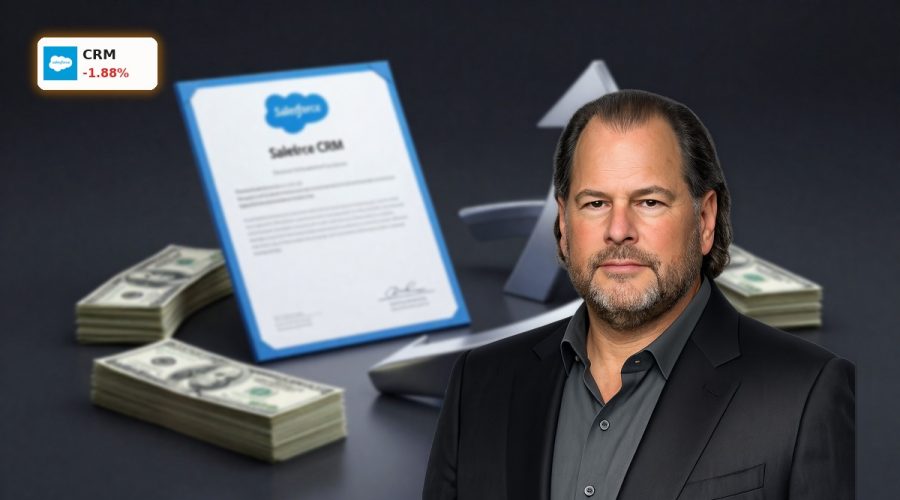
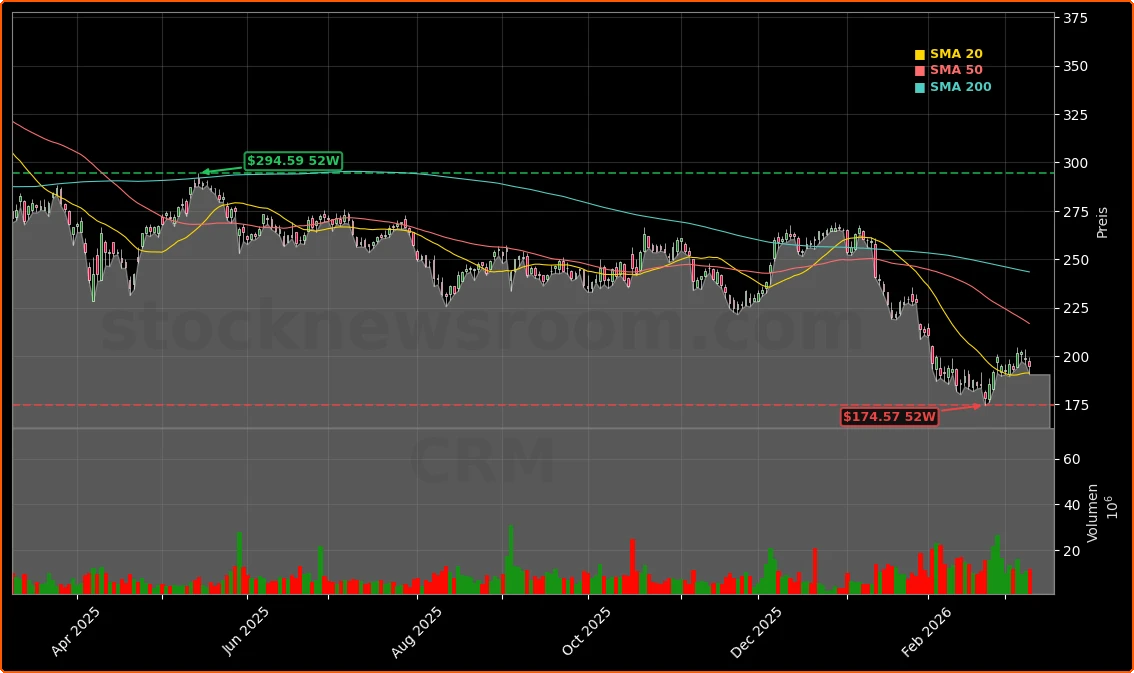
On Wall Street, software has been under pressure since early 2025, badly lagging high‑flying chip leaders like NVIDIA and broad tech benchmarks on the NASDAQ. Salesforce Inc. shares trade around $195.05 after slipping 1.88% on the day, well below recent 52‑week highs and caught in a downdraft that has also hit peers such as Adobe, Oracle, Microsoft, and Apple. Fears center on a single question: will AI agents destroy the need for millions of human “seats” that underpin legacy SaaS pricing?
So far, the damage has shown up mostly in valuation multiples, not in Salesforce’s reported fundamentals. Fiscal 2026 revenue rose 10% year over year to $41.5 billion, with subscription and support providing roughly 95% of sales and a non‑GAAP operating margin above 34%. The company exited the fiscal year with $72 billion in remaining performance obligations, up 14% and offering multi‑year visibility that many cyclicals in the S&P 500 can only envy.
Yet guidance for fiscal 2027 of $45.8 billion to $46.2 billion in revenue, or 10%–11% growth, disappointed investors used to faster expansion. Against that backdrop, the Salesforce Buyback Strategy is emerging as management’s answer to a maturing growth profile and compressed multiples.
How big is the Salesforce Buyback Strategy?
The centerpiece is a plan to issue up to $25 billion in new debt securities to finance share repurchases, one of the largest leveraged buyback moves currently on the NYSE. The announcement triggered a modest negative reaction, with the stock dropping around 1%–2% as investors digested the higher leverage and questioned timing in a still‑uncertain rate environment.
In fiscal 2026, Salesforce already returned more than $14 billion to shareholders, equivalent to 99% of free cash flow. Layering a debt‑funded $25 billion program on top effectively accelerates that capital return profile, signaling that management believes the shares are meaningfully undervalued. At a price‑to‑earnings ratio near 25, versus a three‑year average above 130, Salesforce trades closer to a mature software compounder than a hyper‑growth AI story.
Institutional behavior supports the idea that this is a battleground stock rather than a consensus favorite. Capital Research Global Investors, for example, trimmed its position by nearly 19% in the latest reported quarter, while other large holders such as Vanguard and Capital International boosted stakes. Several MarketBeat‑tracked analyst desks still rate Salesforce a “Moderate Buy” with average price targets around the high‑$200s, though some portfolio managers are clearly de‑risking.
Can Agentforce AI offset seat-based risks?
The Salesforce Buyback Strategy would be hard to justify without a credible AI growth engine. That role is increasingly played by Agentforce, Salesforce’s agentic AI platform that allows enterprises to design, deploy, and manage AI agents across customer service, sales development, employee support, and research workflows.
In just the first 15 months after launch, Salesforce closed more than 29,000 Agentforce deals, pushing Agentforce annual recurring revenue to about $800 million, up 169% year over year by the end of fiscal 2026. Crucially, more than 60% of Agentforce and Data 360 bookings are coming from existing customers, suggesting Salesforce is deepening wallet share rather than merely adding fragile new logos.
Data 360, a unified data layer that stitches together fragmented enterprise information, underpins these AI agents by improving data quality and governance. The 2025 acquisition of Informatica’s cloud data management business for roughly $8 billion has already contributed close to $400 million in revenue, reinforcing the company’s strategic push into data plus AI. Third‑party developers are joining in: Pimly’s newly launched Product Intelligence on Salesforce AgentExchange aims to turn product data into a high‑quality AI signal for manufacturers and retailers, an example of the growing ecosystem around Agentforce.
How does Salesforce stack up against mega-cap tech?
Compared with platform giants like Microsoft and Apple, Salesforce Inc. remains more narrowly focused on enterprise software, and that sector has borne the brunt of AI disruption fears. While Microsoft can offset Office and Dynamics risk with Azure and its stake in OpenAI, Salesforce must prove that agentic workflows and data platforms can convert potential license compression into higher‑value AI and automation revenue.
Some buy‑side analysts now group Salesforce with high‑quality but temporarily dislocated names, alongside Adobe and Intuit, arguing that the “SaaS‑pocalypse” has overshot the fundamentals. A recent Seeking Alpha review, for instance, framed Salesforce as a rare buying opportunity created by panic selling, highlighting resilient free cash flow, geographic diversification, and the emerging concept of Agentic Work Units (AWUs) as a new, AI‑native way to monetize usage beyond simple seat counts.
At the same time, skeptics warn that if enterprises aggressively cut white‑collar headcount using AI, every reduction in staff could translate into fewer paid seats for Salesforce, Microsoft 365, and Adobe. To defend or expand multiples, software leaders may need to charge more for demonstrable productivity gains or successfully transition customers to usage‑based or value‑based pricing around AI agents.
Against this backdrop, the Salesforce Buyback Strategy represents a high‑conviction wager that the market is underestimating its ability to manage that transition while compounding earnings.
Conclusion
In the end, the Salesforce Buyback Strategy, combined with fast‑growing Agentforce and a sticky SaaS core, positions the company as a leveraged recovery play on the next phase of enterprise AI adoption. For long‑term investors, Salesforce remains a heavyweight of U.S. cloud software, and the coming quarters will show whether debt‑funded repurchases and AI monetization can reverse the “SaaS‑pocalypse” narrative. For portfolios willing to stomach volatility, the mix of discounted valuation and aggressive capital returns could be an attractive entry point.
Further Reading
- Salesforce Inc. (CRM) Stock Price, News, Quote & History (Yahoo Finance)
- 1 Number From Salesforce’s Earnings That Changes the AI Narrative (The Motley Fool)
- Salesforce: The SaaSpocalypse Created A Rare Buying Opportunity (Seeking Alpha)
- Pimly Announces Product Intelligence on Salesforce AgentExchange (GlobeNewswire)