Can Salesforce withstand AI doubts with Agentforce and the Anthropic partnership and reignite growth after the earnings?
What’s at Stake for Salesforce Before Earnings?
With the upcoming Salesforce Earnings for the fourth quarter, the pressure is on management to deliver a robust AI roadmap. Analysts expect, according to current consensus estimates, revenue of around $11.19 billion and adjusted earnings per share of about $3.05. This would represent a revenue increase of nearly 12% and an adjusted profit increase of around 10%; however, net profit is expected to decline by about 15%.
Particularly in focus is the backlog, or Remaining Performance Obligation (RPO). Wedbush analyst Dan Ives considers the expectations for revenue, profit, and margin to be “beatable” and points to this metric as a key indicator of whether growth can return to double-digit rates in the next 12 to 18 months. Meanwhile, investors are also watching for further progress on the integration of the Informatica acquisition and the expected synergies from it.
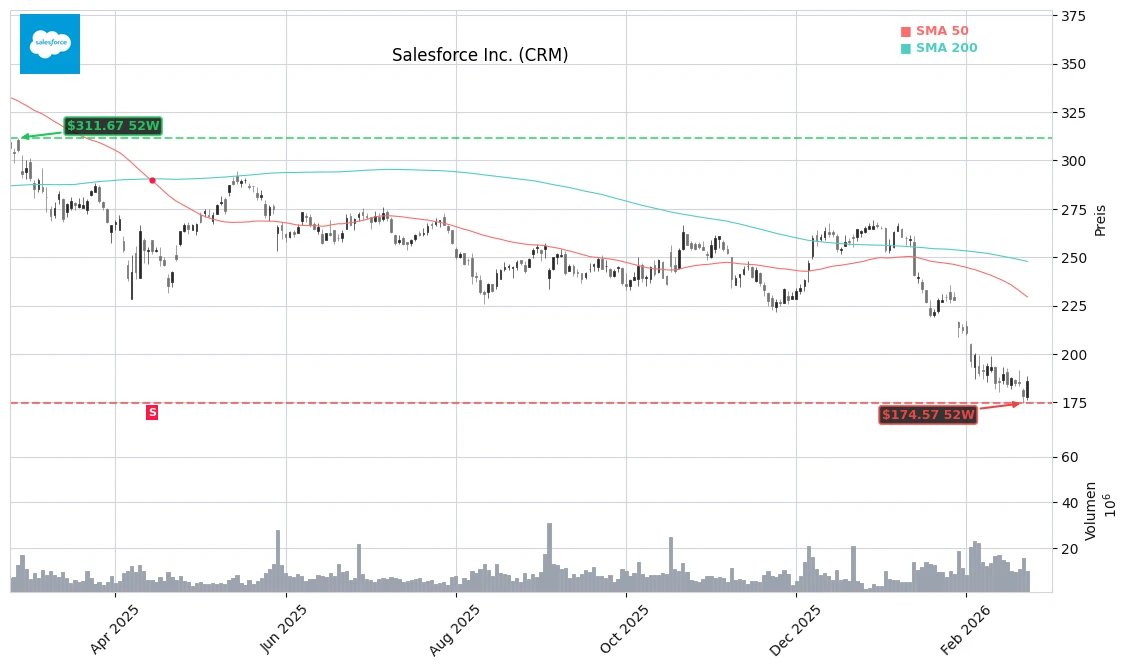
On the stock market, the price increase to $185.85 provides some relief after the stock had lost around 30% since the beginning of the year. Nevertheless, the price remains significantly below the repeatedly lowered price targets from major firms in recent months.
How Do Analysts Evaluate Salesforce and Agentforce?
Wall Street’s assessments of Salesforce Inc. are currently mixed. While Morgan Stanley, Wells Fargo, Oppenheimer, Stifel, and Mizuho have recently adjusted their price targets significantly downward, most research firms maintain a predominantly positive rating. For instance, KeyBanc continues to hold its “Overweight” rating despite a reduced price target, describing it as a “multiple reset” rather than fundamental issues.
Wedbush analyst Dan Ives goes even further: he sees the massive sell-off as a market misperception tied to his coined term “AI ghost trade.” In this narrative, software stocks are broadly sold off out of fear that AI agents will displace traditional enterprise software. For Salesforce, this concern is exaggerated, as the company’s decades-long structured customer data repository and products like Agentforce position it structurally differently from many other SaaS providers.
Other analysts, such as those on platforms like Seeking Alpha, emphasize that AI at Salesforce could act more as a profitability and margin driver, even if revenue growth accelerates only moderately in the short term. The key will be whether Agentforce pilot projects can be converted into scalable, recurring contracts.
What Role Does AI Partner Anthropic Play for Salesforce?
Specifically, the AI strategy shapes expectations for the Salesforce Earnings. A trigger for the recent recovery rally in the software sector was the announcement of new partnerships with AI specialist Anthropic, which also collaborates with Salesforce. This news provided a noticeable relief across the entire IGV software ETF, which had previously experienced massive outflows.
The collaboration with Anthropic is intended to help Salesforce embed generative AI models more deeply into its platforms like Data Cloud, Einstein, and Agentforce. The core of the bullish argument: Salesforce not only has access to strong models but also to the critical, clean, domain-specific enterprise data from more than 150,000 customers, including over 90% of Fortune 500 companies. This combination of models and proprietary data is expected to enable Agentforce to provide AI agents with deterministic, business logic-based behavior that many generic AI providers cannot deliver.
At the same time, skeptical voices, such as those at MarketWatch and Forbes, caution that Salesforce has already lost more than 30% of its market value twice within a few weeks, and investors should not underestimate the cyclicality of the stock. Jim Cramer recently admitted he feels he is on the “wrong side of history” with his previous Salesforce positioning, although he considers the Agentforce platform to be strong.
What Do the Salesforce Earnings Mean for Investors?
For investors, the Salesforce Earnings will serve as a reality check: if management can dispel widespread displacement fears with clear numbers and a robust AI monetization strategy, the stock could have room for an upward revaluation. Many price targets—including Wedbush’s $375 target—are well above the current level, while the market is currently pricing in risk rather than opportunity.
Conversely, if the numbers or outlook are weaker, the current recovery could quickly evaporate. It will be crucial for Salesforce to provide concrete metrics on Agentforce revenues, AI-related deal pipelines, and margin contributions during the earnings call. Overall, investors in the software sector are speculating that the recently observed bottoming process in the IGV ETF will be confirmed and that AI will prove to be an evolutionary rather than a structural disruption.
The central question of this Salesforce Earnings is not whether AI poses a risk, but whether Salesforce can transform its data base into a sustainable AI margin advantage.
— Editor in Chief
Bottom Line
Ultimately, the upcoming Salesforce Earnings will serve as a litmus test for whether the AI bet on Agentforce can counter the current pessimism. For investors, a potential revaluation is at stake between multiple resets and AI premiums. The next quarterly results and updates on AI monetization will reveal whether Salesforce transitions from being a victim of the “AI ghost trade” to a beneficiary of the next software cycle.
Related Sources
- Salesforce Inc. (CRM) on Yahoo Finance (Yahoo Finance)
- Salesforce faces its AI reckoning on Wednesday, but Wedbush sees a buying opportunity in the wreckage (Proactive Investors)
- Salesforce’s SaaS Is Not Dead, But More Profitable With AI (Earnings Preview) (Seeking Alpha)
- US software stocks climb as Anthropic announcement sparks relief rally (Reuters)