
Will the upcoming Salesforce quarter take the wind out of the sails of AI skeptics or further exacerbate the current stock decline?
Salesforce Quarter: What Does Wall Street Expect?
The upcoming numbers from Salesforce Inc. for the fourth fiscal quarter of 2026 (Q4 FY 2026, report on Feb 25) are seen as an important sentiment test for the entire software and SaaS sector. The market wants to see in the Salesforce quarter whether the massive investments in artificial intelligence are already reflected in an acceleration of demand. Analysts emphasize that AI must not only reduce costs but also drive growth in the core CRM, Marketing, and Service Cloud businesses.
In the current fiscal year, Salesforce recently showed solid but not outstanding growth rates. In the third fiscal quarter of 2026, revenue rose to $10.3 billion, an increase of 9% year-over-year, while adjusted earnings per share jumped 38% to $2.20. Particularly important: Remaining performance obligations (RPO) climbed 12% to $59.5 billion—a signal that the order pipeline is growing more robustly than current revenue. For the upcoming Salesforce quarter, management has projected revenue of around $11.2 billion, which would represent growth of about 11%.
Salesforce: AI as an Opportunity or Disruptor?
At the center of the debate is whether AI provides tailwinds for established SaaS providers like Salesforce Inc. or puts their business model under pressure. Many software stocks, from Salesforce to SAP to Adobe, have fallen sharply in recent months as investors fear that new AI agents could attack traditional licensing and subscription models. At the same time, Salesforce is often cited as one of the best-positioned providers for AI agents, as the company expands its entire platform—from Data Cloud to Tableau to Slack—with generative and agent-based features.
However, this AI offensive comes at a cost. For the current Salesforce quarter, management expects that high investments in new AI tools will temporarily pressure profitability, with earnings per share expected to decline by about 15% compared to the previous year. Investors must weigh whether to accept the temporary margin pressure in order to benefit from potentially higher growth rates starting in 2026/27. Some market observers also point to new partnerships, such as with insurtech providers, whose solutions will be made available through the Salesforce AppExchange and are expected to drive additional platform usage.
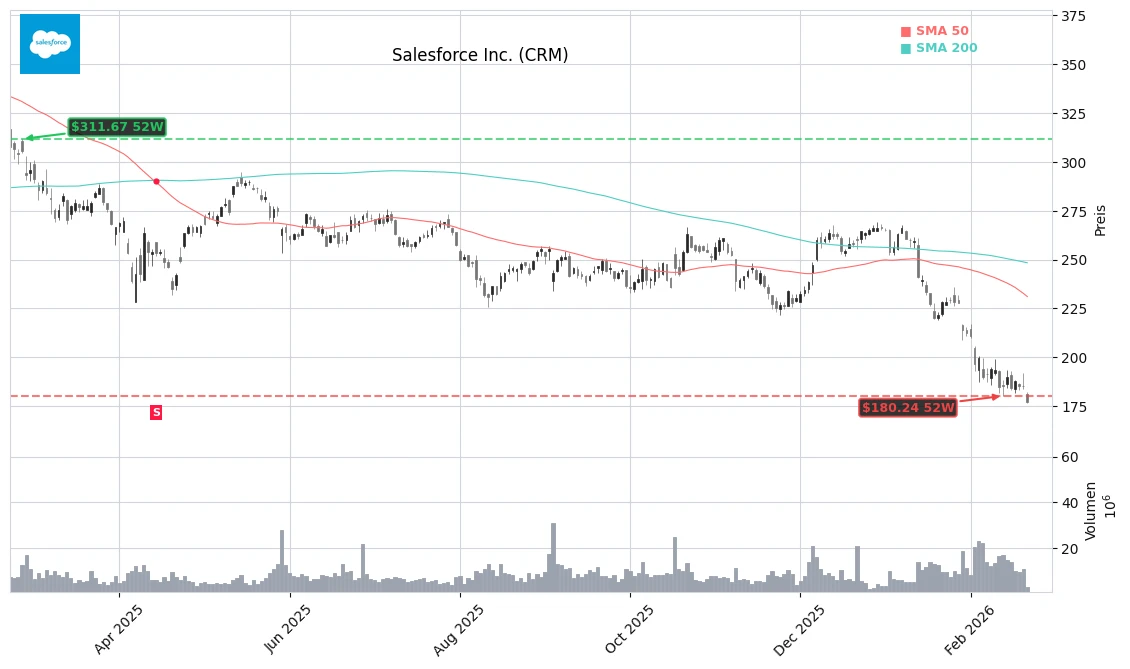
Salesforce: Stock Decline and Significant Price Target Cuts
Market sentiment ahead of the Salesforce quarter is tense. The stock is currently trading at around $177.14, down from $185.16 the previous day—a decline of 4.33%. Previously, the stock had fallen from an all-time high of $369 in December 2024 to a multi-year low around $180, representing a drop of about 50%. Year-to-date, Salesforce is down about 27%, and over the past twelve months, the decline is approximately 40%. With a P/E ratio of nearly 35, the market is still pricing in significant growth despite the decline—which increases the risk if the Salesforce quarter fails to meet expectations.
Several investment banks have lowered their price targets in recent days. Citigroup cut its target, as did UBS, signaling increasing skepticism that Salesforce can return to previously priced growth rates in the short term. Meanwhile, observers warn of notable insider selling in the tech sector, which includes Salesforce. On the other hand, some analysts emphasize the strong cash flow generation, conservative debt levels, and historically solid growth dynamics of the company.
Salesforce: How Realistic is $250 by 2030?
Despite the current uncertainty, many strategists believe that the stock could be significantly higher in the long term. Some forecasts see the stock reaching around $250 by 2030. These scenarios are based on continued revenue growth in the high single-digit to low double-digit percentage range, a gradual improvement in margins following the completion of the current AI investment wave, and further acquisitions that strengthen the ecosystem around the core CRM.
Bottom Line
This perspective is supported by studies that classify Salesforce as a value play for quality and value investors: High profitability, efficient capital use, and relatively moderate debt compared to the industry suggest that the company has financial leeway for investments and stock buybacks. At the same time, the recent price target cuts from Citigroup and UBS indicate that the market is currently more focused on growth slowdown and AI risks than on opportunities through 2030. The next Salesforce quarter is likely to be a key indicator of whether the current stock decline represents a buying opportunity or a warning signal for further losses.
Related Sources
- Salesforce Inc. (CRM) Overview (Yahoo Finance)
- Big Salesforce Price Target Cuts Ahead of Q4 Earnings (24/7 Wall Street)
- Salesforce: Capitalizing On The Massive Agentic AI Opportunity (Seeking Alpha)
- Salesforce Inc. (NYSE:CRM): A Value Investing Case Study (ChartMill)