Why is the stock market punishing Salesforce after a record quarter and a massive buyback program with a significant drop in share price?
Salesforce Quarter: How Strong Were Revenue and Profit?
Salesforce Inc. achieved a new record level in the latest Salesforce quarter. Revenue rose by 12% in the fourth fiscal quarter to $11.2 billion, slightly exceeding market expectations. For the full year, the company reported revenues of $41.5 billion, an increase of 10%. Even more impressive was the profitability: the adjusted earnings per share were $3.81, significantly surpassing consensus estimates of around $3.05–$3.04. Net income for the quarter climbed nearly 14% to about $1.9 billion, while the annual result increased by approximately 20% to about $7.5 billion—despite a higher tax burden.
The metrics for recurring revenue also paint a robust picture. The remaining performance obligations (RPO) now total $72 billion, a 14% increase year-over-year. The Current RPO value stood at $35.1 billion, growing by 16%. This indicates that the Salesforce quarter continues to show a solid demand base, even as the entire SaaS sector has been struggling with structural AI concerns for months.
Salesforce: How Is the AI and AgentForce Business Performing?
At the center of the narrative is the AI offensive. The AgentForce ecosystem became a growth driver in the Salesforce quarter. AI agents and Data 360 offerings now generate an annual recurring revenue of $800 million, representing a growth of 169%. Together with Data 360 and the Informatica partnership, the corresponding ARR is around $2.9 billion—a rise of about 200%.
Operationally, Salesforce Inc. closed approximately 29,000 AgentForce deals in the final quarter, 50% more than in the previous quarter. Larger customer contracts exceeding $10 million increased by 33%. Notable contracts include a ten-year agreement worth up to $5.6 billion with the U.S. Army, highlighting the platform’s role in the public sector. Management also emphasizes that AI agents on the Salesforce platform are already processing billions of so-called “agentic work units” and that they have multiple levers for monetization through Flex Credits and new seats.
Salesforce: Why Is the Stock Reacting Negatively Despite a $50B Buyback?
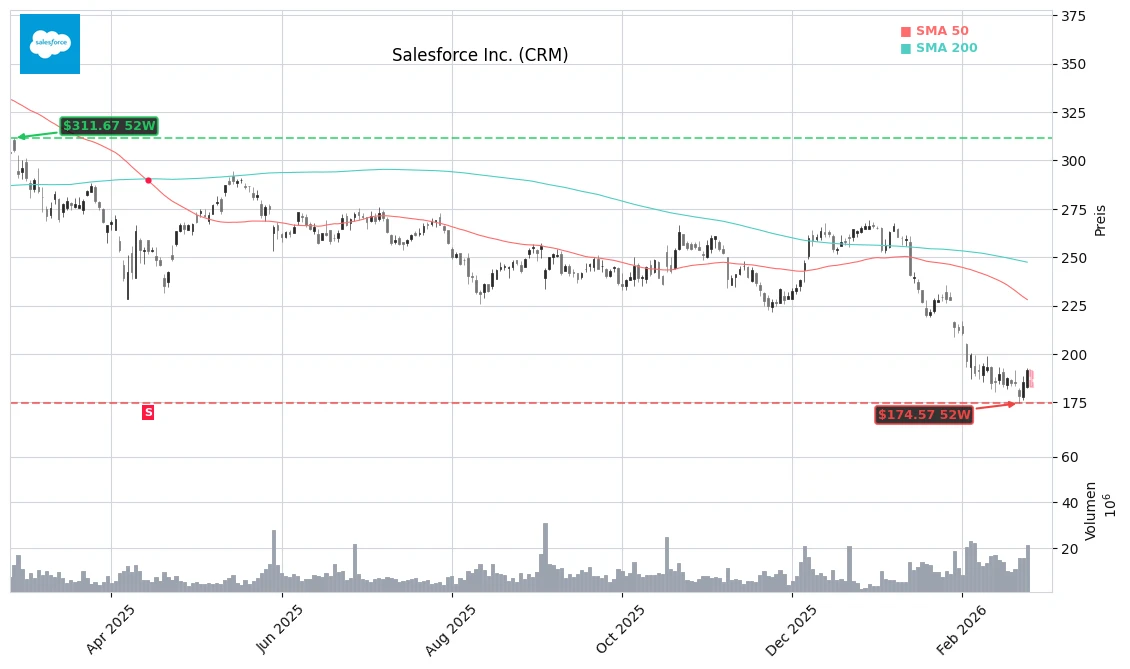
Despite the numbers, concerns prevailed in the market. Shares of Salesforce Inc. closed at $191.75 on the NYSE, up 3.41% from the previous day. However, in after-hours trading, the price turned negative to about $183, losing around 4–5%. This keeps the stock well below its 52-week high of $313.67; it is far from new highs.
The trigger for the price reaction is less about the past Salesforce quarter and more about the outlook. For the fiscal year 2027, management projects revenues of $45.8 to $46.2 billion—essentially in line with previous analyst expectations, but not exceeding them. Additionally, operating cash flow is expected to shrink by 9–10% next year, as is free cash flow. In an environment where software stocks are under significant pressure due to AI fears, being “in line” apparently isn’t enough to alleviate valuation discounts.
At the same time, Salesforce Inc. announced one of the largest buyback programs in the tech sector. The authorization for stock buybacks will be increased to $50 billion; in the past fiscal year, around $14 billion or 99% of free cash flow was returned to shareholders. Additionally, the company is raising its quarterly dividend by 5.8% to $0.44 per share. Nonetheless, concerns persist that hyperscalers and model providers with their own AI agents could attack parts of the traditional SaaS business in the medium term.
Salesforce: How Are Analysts Positioning Themselves Now?
On the analyst side, there is a mixed but overall constructive picture. KeyBanc Capital Markets had already expressed a positive outlook ahead of the numbers, rating the stock as “Overweight” with a price target of $300. The bank points primarily to the accelerated momentum of AgentForce and the growing AI revenue base. Other firms, such as Zacks Investment Research, highlight that revenue and earnings in the Salesforce quarter were clearly above consensus estimates but remain cautious about the outlook.
„This is not our first SaaSpocalypse,” emphasizes Marc Benioff, referring to previous technology waves that Salesforce has also survived and leveraged.
— Marc Benioff, CEO of Salesforce Inc.
Bottom Line
At the same time, rather skeptical voices—such as those at MarketWatch and Investor’s Business Daily—point out that the guidance for fiscal year 2027 has disappointed the imagination of many growth investors and that the fear of a “SaaSpocalypse” from AI competitors has not really been dispelled. Nevertheless, CEO Marc Benioff emphasizes that the company is on track to achieve annual revenues of $63 billion by 2030—more than many experts are currently modeling. Whether this confidence will be reflected in the next Salesforce quarter in a visible acceleration of organic growth remains the central test.
Related Sources
- Salesforce Inc. (CRM) on Yahoo Finance (Yahoo Finance)
- Salesforce Delivers Record Fourth Quarter Fiscal 2026 Results (Business Wire)
- Salesforce (CRM) Beats Q4 Earnings and Revenue Estimates (Zacks Investment Research)
- Salesforce’s stock falls as mixed earnings forecast fails to dispel AI gloom (MarketWatch)
- Salesforce CEO Marc Benioff: This isn’t our first SaaSpocalypse (TechCrunch)