Can the latest SanDisk Earnings surge and billion‑dollar Nanya deal turn recent AI memory fears into a fresh leg of the rally?

How Are Markets Reacting to SanDisk Earnings Momentum?
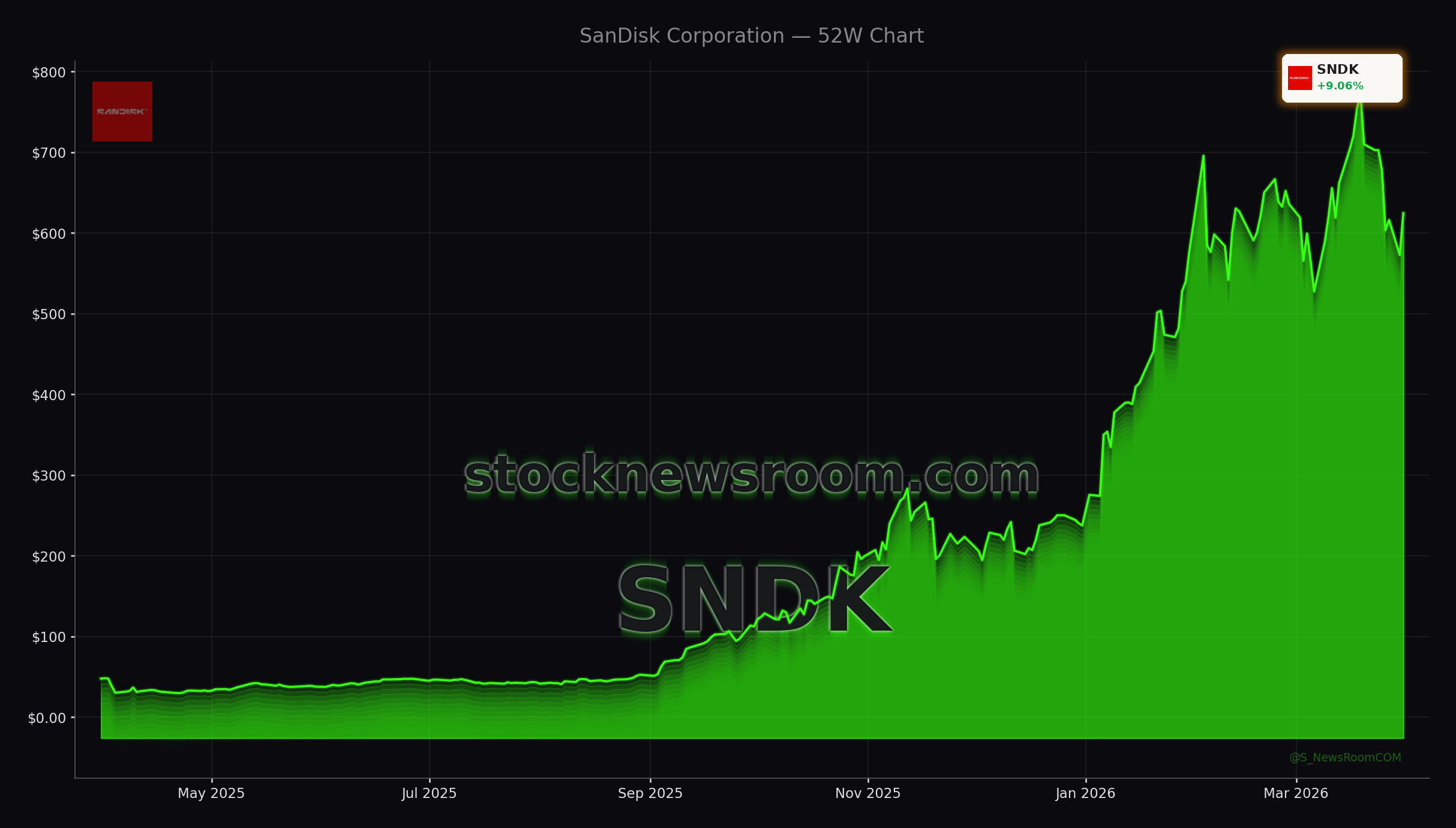
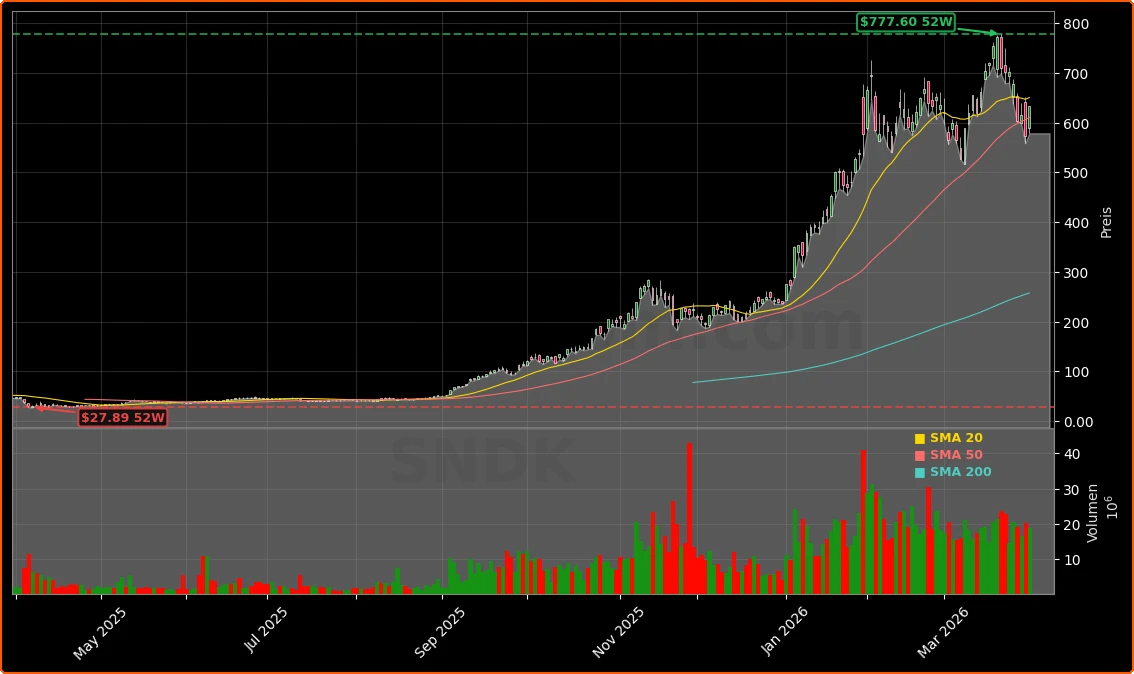
SanDisk Corporation (SNDK) is again one of the most volatile AI infrastructure names on the NASDAQ. The stock recently traded around $632.50, up 10.5% on the session, clawing back part of an 18%+ slide triggered by concerns that Google’s TurboQuant algorithm might slash memory demand for AI workloads. Even after that shock, SanDisk remains one of the standout winners of the S&P 500 and AI trade: the shares are up roughly 1,166% over the past 12 months and more than 150% year to date, following the company’s spin‑off from Western Digital in early 2025 as a pure‑play NAND flash specialist.
The latest rally is being driven less by speculation and more by fundamentals. In its fiscal Q2 2026, SanDisk (Western Digital) delivered revenue of $3.025 billion, up 61% year over year, with net income surging to $803 million – a 672% jump. Free cash flow hit $980 million, supported by $1.5 billion in cash and a net cash position of $726 million. For U.S. investors, the key takeaway is that the stock’s violent swings have, so far, ridden on top of a powerful earnings recovery rather than masking deterioration.
What Do SanDisk Earnings Say About the AI Memory Cycle?
The latest SanDisk Earnings snapshot underlines how quickly the business has pivoted toward high‑value AI infrastructure. The company guided Q3 FY2026 revenue to a range of $4.4 billion to $4.8 billion, with non‑GAAP gross margins of 65% to 67%. That margin profile places SanDisk at the upper end of the memory sector and reflects a product mix shift toward cloud and enterprise SSDs used in AI training and inference clusters at hyperscale data centers run by giants like NVIDIA partners, major U.S. cloud providers and large enterprises.
SanDisk’s Edge segment – which supports AI workloads closer to devices and endpoints – generated $1.678 billion in Q2 FY2026 revenue, up 63% from a year earlier. Ironically, the same TurboQuant breakthrough that sparked the recent sell‑off could expand that addressable market by enabling more AI inference at the edge, from smartphones to vehicles produced by companies such as Tesla. That dynamic helps explain why firms like Morgan Stanley have reaffirmed Overweight ratings even in the face of headline risk, arguing that memory remains a critical bottleneck for AI growth rather than a commodity at risk of structural oversupply.
How Does the Nanya Deal Strengthen SanDisk’s Position?
Beyond the core SanDisk Earnings story, management is moving aggressively to lock in supply and pricing power. SanDisk has committed a $1 billion strategic equity investment in Nanya Technology, buying about 139 million Nanya shares – roughly 3.9% of the company – at a 15% discount to the 30‑day average price. The deal comes with a three‑year lock‑up and a multi‑year DRAM supply agreement, embedding SanDisk in a broader $2.5 billion consortium investment intended to secure long‑term DRAM supply.
This is strategically significant for U.S. portfolio managers comparing SanDisk to rivals like Micron and Western Digital. By combining leading NAND capabilities with guaranteed DRAM access, SanDisk can offer more integrated AI storage platforms, potentially capturing wallet share from hyperscalers and OEMs that want fewer, more strategic vendors. As DRAM prices are projected to rise 50% or more in Q2 2026 amid tight supply, the Nanya deal could enable SanDisk to benefit from both NAND and DRAM price strength – a rare dual exposure in the sector.
How Bullish Are Wall Street Analysts on SanDisk?
Analyst commentary around SanDisk Earnings has been notably constructive despite recent volatility and media focus on Google’s memory compression efforts. Morgan Stanley has reiterated its Overweight stance, emphasizing that structural undersupply and long‑term AI demand should support elevated pricing and margins. Bank of America (BofA Securities) has maintained a Buy rating and a $900 price target on SNDK, citing strong demand from hyperscalers, AI inference growth and expected share gains in enterprise SSDs.
Across Wall Street, the average 12‑month price target stands near $760, while KGI Securities is even more optimistic with a $992 target. With SanDisk trading below its 52‑week high of $777.60, the gap between current levels and consensus targets suggests analysts still see upside, provided the AI memory supercycle thesis holds. Some research houses, including Zacks Investment Research and Simply Wall Street, have flagged elevated valuation multiples compared with traditional memory peers, but they also highlight SanDisk’s structural shift away from commoditized consumer storage toward higher‑margin data center and edge markets.
Related Coverage
For a deeper dive into recent volatility, the article “SanDisk Earnings -8.1% Plunge After Blockbuster AI Quarter” analyzes how a sharp post‑earnings sell‑off collided with a still‑booming AI demand backdrop and what that means for risk‑tolerant investors. For a broader sector lens, “Micron Forecast +2.8%: Can the AI Boom Outrun the Plunge Shock?” looks at Micron’s trajectory and helps frame how SanDisk stacks up against another key U.S. memory player in this evolving AI cycle.
Looking ahead to the next SanDisk Earnings event, investors will be watching the company’s April 30 Q3 FY2026 conference call to see whether explosive revenue growth, high‑60s gross margins and disciplined capital allocation can be sustained. With AI workloads ramping, DRAM prices tightening and major banks like BofA and Morgan Stanley still firmly in the bull camp, SanDisk remains a high‑beta way to express conviction in the AI infrastructure build‑out. For long‑term investors who can stomach volatility, the upcoming quarters could determine whether SanDisk (Western Digital) cements its place among the elite AI hardware beneficiaries alongside names like Apple and other mega‑cap tech leaders.